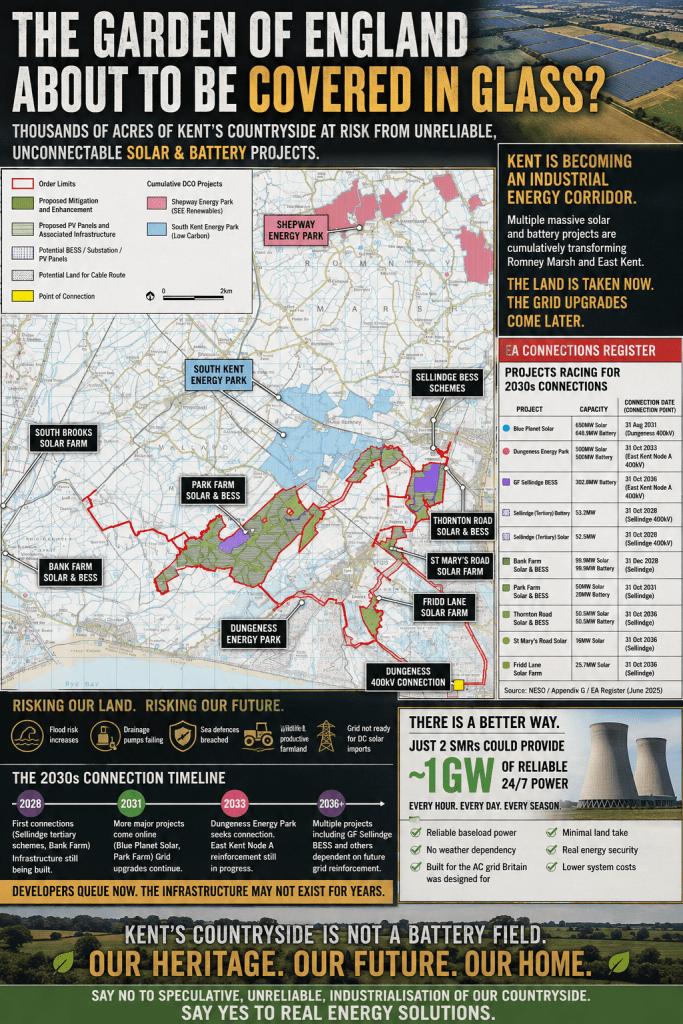
And when you combine the cumulative project maps with the EA Connections Register, the true scale becomes impossible to ignore.
This i
s no longer about one or two solar farms.
It is the creation of an entire East Kent energy corridor stretching across Romney Marsh toward the Dungeness and Sellindge grid infrastructure.
The cumulative mapping now shows overlapping development zones involving:
• South Kent Energy Park
• Shepway Energy Park
• South Brooks Solar Farm
• Dungeness Energy Park
• Blue Planet Solar
• Bank Farm
• Park Farm
• Thornton Road
• St Mary’s Road Solar
• Fridd Lane Solar Farm
• GF Sellindge BESS
• multiple Sellindge tertiary battery and solar schemes
Together these schemes involve: • thousands of hectares of countryside
• industrial-scale battery compounds
• extensive cable corridors
• substations and converter compounds
• access roads and hardstanding
• major transmission infrastructure expansion
And the EA Register reveals something even more extraordinary:
Most of this infrastructure is dependent on connection dates stretching deep into the 2030s.
Examples from the register include:
• BLUE PLANET SOLAR — 650MW Solar + 648.9MW Battery — Dungeness 400kV — 31 August 2031
• Dungeness Energy Park — 500MW Solar + 500MW Battery — East Kent Connection Node A 400kV — 31 October 2033
• GF SELLINDGE BESS — 302.8MW Battery — East Kent Connection Node A 400kV — 31 October 2036
• Sellindge Tertiary Battery — 53.2MW — 31 October 2028
• Sellindge Tertiary Solar — 52.5MW — 31 October 2028
• Bank Farm — 99.9MW Solar + 99.9MW Battery — 31 December 2028
• Park Farm — 50MW Solar + 20MW Battery — 31 October 2031
• Thornton Road — 50.5MW Solar + 50.5MW Battery — 31 October 2036
• St Mary’s Road Solar — 16MW — 31 October 2036
• Fridd Lane Solar Farm — 25.7MW — 31 October 2036
This is the key point:
Kent’s countryside is being industrialised NOW for grid infrastructure that largely depends on reinforcement that may not fully exist for another 10–15 years.
That is not strategic planning. That is speculative queueing on a massive scale.
The Dungeness corridor was historically designed around reliable AC nuclear generation — not huge intermittent DC-heavy solar imports spread across reclaimed marshland.
NESO’s own “Beyond 2030” plans make clear that major reinforcement recommendations continue throughout the 2030s.
In plain English: Developers are racing into the queue first and hoping the infrastructure arrives later.
Meanwhile Romney Marsh residents are warning about: • breached sea defences
• drainage pump failures
• flood vulnerability
• cumulative land industrialisation
• loss of productive farmland
• ecological damage
• and long-term landscape transformation
Yet the official response remains: “the flood defences say it will be fine.”
This is the madness of the current Net Zero planning system.
To put this into perspective:
Just TWO Rolls-Royce SMRs could likely provide around 1GW of constant 24/7 electricity output — every hour, every day, every season — without covering vast areas of Kent in solar panels and battery compounds.
And critically: SMRs connect directly into the AC grid system Britain was originally built around.
Instead, NESO and DESNZ are pursuing a system that requires: • enormous inverter infrastructure
• battery balancing systems
• curtailment payments
• decades of transmission reinforcement
• new substations and converter stations
• and speculative future connection architecture
Kent is no longer simply hosting renewable projects.
It is being transformed into a strategic energy corridor driven by speculative infrastructure planning, future grid assumptions, and the pursuit of unreliable intermittent generation.
The Garden of England is slowly being consumed by one of the largest speculative energy build-outs in the country.
 SAY NO TO THE DESTRUCTION OF OUR LAND
Leave a comment