How Britain chose the target before it built the system
The roots of Britain’s expensive and increasingly complicated energy system were laid more than two decades ago.
The remarkable thing is not that nobody saw the risks. Government, Parliament, Ofgem and the National Audit Office were documenting them as the policy was being built.
Britain’s energy predicament was not created in a single Parliament and it would be wrong to pretend that Tony Blair invented renewable-energy support. Subsidies and government intervention in electricity existed before New Labour.
But the architecture that has shaped the modern system began to take recognisable form under Blair and was then embedded in law under Gordon Brown.
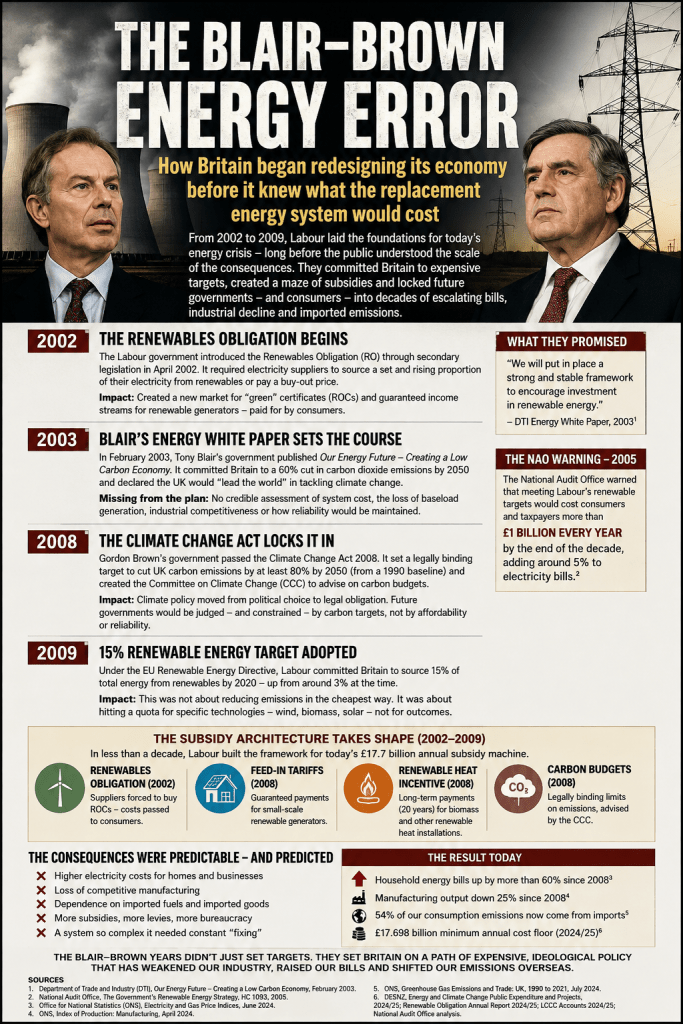
The critical date is April 2002, when the Renewables Obligation came into force in Great Britain. Electricity suppliers were required to present a specified number of Renewables Obligation Certificates, or ROCs, for the electricity they supplied, or pay into a buy-out fund. Renewable generators earned ROCs in addition to the income received from selling their electricity.
Ofgem still describes the scheme as one designed to encourage electricity generation from eligible renewable sources.
The importance of that decision is easily missed. Government was no longer merely taxing pollution or setting environmental standards. It had created an additional revenue stream specifically to change which technologies investors would build.
The National Audit Office subsequently described the purpose of the Renewables Obligation in unusually clear terms:
it increased the income received by renewable generators above the market price of electricity. The NAO also observed that many of the technologies receiving support would not then have been commercially viable without financial assistance.
That was the first great change.
The electricity market would increasingly be expected to deliver a political objective that the market, left to its own economics, was not delivering.
Tony Blair’s government then supplied the destination.
In February 2003 it published Our Energy Future – Creating a Low Carbon Economy.
The White Paper put Britain on a path towards reducing carbon dioxide emissions by around 60 per cent by 2050, while maintaining a target of 10 per cent renewable electricity by 2010 and an aspiration for 20 per cent by 2020. Climate change was not the document’s only objective – security of supply, competitive markets and affordable heating were also expressly identified -but the low-carbon transformation had now become a central organising principle of energy policy.
The timing was extraordinary because Britain was simultaneously approaching a fundamental change in its energy position.
Indigenous oil and gas production was declining, coal had already retreated dramatically, and much of the existing nuclear fleet would eventually need replacing. Government records later described the 2003 White Paper itself as responding to the challenge of declining indigenous energy supplies.
Britain became a net importer of natural gas again in 2004 and a consistent net importer of crude oil from 2005 as UK Continental Shelf production declined.
Yet new nuclear construction was not made the cornerstone of the 2003 programme. The Government accepted that nuclear was a carbon-free source of electricity but concluded that its economics at the time made it an unattractive option for new capacity. Nuclear was not formally ruled out; ministers said the option would remain open and that any future decision to proceed would require further consultation.
That decision deserves far more scrutiny than it usually receives.
Britain knew that domestic fossil-fuel production was declining. It knew ageing coal and nuclear stations would not run indefinitely. It had decided that carbon emissions must fall dramatically. Yet instead of first securing a replacement fleet of dependable low-carbon generation, it began by expanding renewable obligations while postponing the nuclear decision.
Within three years the weakness of that position was becoming difficult to ignore.
The Blair government reopened the nuclear question in its 2006 Energy Review, explicitly recalling that the 2003 White Paper had found nuclear economically unattractive but acknowledging again that new nuclear might be required to meet the country’s carbon objectives.
The 2007 Energy White Paper then moved towards allowing private companies to invest in new nuclear stations.
Britain had therefore spent several crucial years with the low-carbon destination established but one of the principal technologies capable of providing firm low-carbon power still sitting in the waiting room.
Meanwhile, the cost warnings had already started.In February 2005, barely three years after the Renewables Obligation began, the National Audit Office reported that pursuing the renewable target would cost consumers and taxpayers more than £1 billion a year by the end of the decade and would increase electricity prices by around 5 per cent.
It found that carbon reductions delivered through the Renewables Obligation were then significantly more expensive than those available through policy measures primarily promoting energy efficiency.
It also warned that because the same support was being given across eligible projects, some cheaper technologies , notably onshore wind and landfill gas at good sites , were receiving more support than was necessary to secure development.
Those findings destroy the comforting argument that the financial consequences only became apparent years later.
They were being identified in 2005.
But instead of provoking a fundamental review of whether Britain was choosing the cheapest way to reduce emissions while maintaining a reliable power system, the direction of policy hardened.
In 2007, EU leaders agreed an objective for renewables to provide 20 per cent of total EU energy consumption by 2020, alongside other climate and energy commitments.
Britain eventually received a binding national target of 15 per cent of total energy consumption from renewable sources by 2020. This was not simply an electricity target. It covered electricity, heat and transport.
This was the moment the scale of the challenge changed dramatically.
Government figures later showed that renewable energy accounted for only 2.25 per cent of Britain’s electricity, heat and transport energy consumption in 2008. Reaching 15 per cent by 2020 therefore required an almost seven-fold increase in barely 12 years.
The Government’s lead scenario envisaged renewable sources providing more than 30 per cent of electricity, around 12 per cent of heat and 10 per cent of transport energy.
Tony Blair left Downing Street in June 2007.
Gordon Brown inherited the direction and proceeded to make it considerably harder for future governments to change.
The Energy Act 2008 expanded the machinery.
It provided for Feed-in Tariffs for small-scale low-carbon electricity generation and the statutory powers for renewable-heat incentives, while also altering the Renewables Obligation.
The Feed-in Tariff scheme would begin in April 2010;
the Renewable Heat Incentive would follow under the Coalition.
But the legislative foundations were Brown-era legislation.
Then came the decision that changed climate policy from political ambition into a statutory framework.
The Climate Change Act 2008 established the system of five-year carbon budgets and the Committee on Climate Change and required the UK’s 2050 carbon account to be at least 80 per cent below its 1990 baseline. That 80 per cent target was later replaced by the 100 per cent, or Net Zero, target in 2019, but the machinery through which successive governments would be constrained by carbon budgets originated in the 2008 Act.
This was not solely a Labour decision in the partisan sense. Gordon Brown’s government introduced and carried the legislation, but Parliament overwhelmingly embraced it.
At Third Reading on 28 October 2008, the Climate Change Bill passed the Commons by 463 votes to three. The political responsibility for the statutory framework therefore extends far beyond the Labour front bench.
What is remarkable is what was happening outside Parliament at almost exactly the same time.
In its response to the Government’s Renewable Energy Strategy consultation in 2008, Ofgem warned that the envisaged renewable-electricity expansion under the existing Renewables Obligation could cost well over £4 billion a year for electricity alone. Ofgem argued that the RO needed reform if the new targets were to be delivered with better value for consumers.The regulator was therefore warning about multi-billion-pound annual costs while Parliament was simultaneously constructing the legal framework that would require an accelerating reduction in emissions.
Again, the eventual cost problem was not invisible.
The Government pressed on.By July 2009, the Brown administration’s UK Renewable Energy Strategy translated the target into an implementation programme.
Britain’s renewable share had to move from 2.25 per cent in 2008 to 15 per cent in 2020. The Government expected more than 30 per cent of electricity to come from renewables, much of it wind.The official impact assessment attached to that strategy estimated resource costs of around £4 billion in 2020, net of the cost of carbon in the large-scale electricity sector, and explicitly included grid costs. This was not an estimate produced by opponents of the programme.
It was the Government’s own impact assessment for its own policy.
The physical consequences were becoming clearer too.
Large amounts of generation would need to connect in places where the existing transmission network had not been designed to accommodate them.
The 2009 Electricity Networks Strategy Group work identified transmission reinforcements costing about £4.7 billion, a figure that would itself subsequently rise substantially when the programme was reassessed.
Nor did government modelling assume that wind removed the need for conventional generation.
The 2009 Energy Markets Outlook explicitly acknowledged the intermittent nature of many renewable sources and the challenges that brought. Its analysis of wind said the electricity system would still require generation capable of operating flexibly when wind output was low.
That point is critical because it exposes the difference between the cost of a generating technology and the cost of the electricity system required around it.
A wind turbine has a generation cost. But an electricity system with a large amount of weather-dependent generation also requires networks capable of moving its output, generation or other resources capable of responding when its output changes, and mechanisms for balancing supply and demand.
Those consequences were already being considered before the end of the Brown government.
The answer was not to slow the commitment until the infrastructure caught up. It was to provide investors with greater certainty.
By the end of 2009 the Government had announced that the Renewables Obligation would be extended to 2037. Subsequent implementing rules limited most new projects to a maximum of 20 years’ support, but the political significance was already obvious:
decisions being taken at the end of the 2000s could create support commitments lasting decades.
This is where the Blair–Brown legacy becomes impossible to dismiss as merely a collection of environmental aspirations.
By the time Gordon Brown left Downing Street in May 2010, Britain had a renewable electricity support mechanism dating from 2002, a statutory carbon-budget system, an independent climate committee, legislation for Feed-in Tariffs and renewable heat support, a legally binding 15 per cent renewable-energy target, plans for an almost seven-fold expansion of renewable energy in little more than a decade, an extended Renewables Obligation capable of supporting projects deep into the 2030s, and the beginnings of a major transmission rebuilding programme.And ministers could not claim that nobody had discussed the costs.
The National Audit Office had warned in 2005 that the renewable target would cost consumers and taxpayers more than £1 billion annually by the end of that decade and add about 5 per cent to electricity prices. Ofgem had warned in 2008 that the renewable electricity volumes being contemplated under the existing RO could cost well over £4 billion a year for electricity alone. The Government’s own 2009 impact assessment calculated approximately £4 billion of annual resource cost in 2020 for its Renewable Energy Strategy.
The argument is therefore not that Blair and Brown deliberately set out to make British energy expensive.
Their stated objectives also included security of supply, competitive markets, reduced fossil-fuel dependence and the development of new industries. Nor can every subsequent increase in an electricity bill or every loss of manufacturing be placed at their door.
The evidence supports a narrower and more serious charge.
They established the target-driven architecture before Britain had built the replacement energy system capable of delivering it.
The emissions destination came first.
The renewable quotas followed.
Subsidies were strengthened to obtain the required investment.
Grid reinforcement followed the generation targets.
Flexible conventional capacity remained necessary to cope with intermittency.
Nuclear, having been judged unattractive in 2003, was reconsidered only after precious years had been lost.
What should have been an engineering question , what combination of generation, networks and fuels can provide Britain with the most secure and affordable low-carbon electricity? was increasingly being answered backwards.
Government decided how much renewable energy and how much carbon reduction it wanted and then constructed financial and regulatory mechanisms to make the electricity system conform.
That was the inheritance waiting for David Cameron in May 2010.
He had an opportunity to examine the costs, reconsider the sequencing and ask whether Britain had placed the political destination ahead of the engineering.
Instead, Cameron promised the “greenest government ever”.And under his first Energy Secretary, Chris Huhne, the experiment was about to enter a much more expensive phase.
References
1. Ofgem — Renewables Obligation. Official description of the scheme, its 2002 commencement and ROC mechanism.
2. National Audit Office — Department of Trade and Industry: Renewable Energy, 11 February 2005. Includes the estimate of more than £1 billion annual consumer/taxpayer cost by the end of the decade, around 5 per cent electricity-price impact, and findings about commercial viability and over-support.
3. Department of Trade and Industry — Our Energy Future: Creating a Low Carbon Economy, 24 February 2003. The Blair government’s foundational Energy White Paper.
4. House of Commons / DTI — nuclear policy following the 2003 Energy White Paper and the 2006–07 reconsideration of new nuclear.
5. Council of the European Union — 2007 renewable-energy conclusions and 2009 legislative package. Establishes the EU 20 per cent objective and subsequent mandatory national targets.
6. Energy Act 2008. Statutory basis for Feed-in Tariffs and renewable-heat incentives.
7. Climate Change Act 2008 and House of Commons Hansard, 28 October 2008. Carbon budgets, Committee on Climate Change and the Commons Third Reading vote of 463–3.
8. Ofgem — Response to BERR consultation on the UK Renewable Energy Strategy, 2008. Ofgem warned that approximately 120 TWh of renewable electricity under the then-current RO could cost well over £4 billion annually for electricity alone.
9. HM Government — UK Renewable Energy Strategy / official 2009 impact assessment and Energy Markets Outlook. Sources for the 15 per cent target, 2.25 per cent 2008 baseline, almost seven-fold expansion, system-flexibility requirements and approximately £4 billion 2020 resource-cost estimate.
10. Government/Ofgem transmission assessments. Contemporary estimates of transmission reinforcement required alongside increased renewable deployment.
Shane Oxer. Campaigner for fairer and affordable energy
 SAY NO TO THE DESTRUCTION OF OUR LAND
Leave a comment