Britain was promised that the great transition to wind and solar would deliver cheap electricity.
Summer 2026 has put that promise through one of its toughest real-world tests yet.
England experienced its warmest June on record. July became the UK’s sunniest July on record. Solar generation broke records.
Yet behind those impressive renewable headlines, something rather different was happening to Britain’s electricity system.
Low wind. Tight generation margins. Repeated Electricity Margin Notices. Heavy dependence on gas. Emergency interventions. An Ofgem investigation into one of the most serious operational episodes of the summer. And electricity prices repeatedly heading towards or through £200/MWh.
This isn’t one inconvenient evening that can be dismissed as an anomaly.
It has become the story of the summer.
23 June: the event we should not forget
The most important event came during the extreme June heatwave.
On 23 June, Britain’s grid frequency repeatedly fell below NESO’s normal operating range of 49.8–50.2Hz.
NESO subsequently reported a minimum frequency of 49.66Hz. It remained above the statutory lower boundary of 49.5Hz and no customers were disconnected. NESO therefore maintains that the electricity system remained secure.
But that isn’t the end of the story.
Industry analysis reported that frequency remained outside the normal operating range for unusually prolonged periods and that NESO had to intervene, including changing interconnector flows. Whistleblowers subsequently alleged that the system had been operating dangerously close to the point where power cuts could have resulted if further generation had been lost. NESO disputes those claims.
The allegations were serious enough that Ofgem formally commissioned an in-depth review and independent investigation into system operation during the extreme-heat period.
That distinction matters.
We should not claim that a national blackout was inevitable — the evidence does not establish that.
But neither should one of the most unusual grid-frequency events in recent years simply be brushed aside as business as usual while the regulator is still investigating what happened.
And what were the conditions?
NESO itself identified the combination:
low wind, reduced gas-generation availability, sustained high demand, adverse interconnector flows and network constraints.
That is an extraordinary sentence when examining where Britain’s electricity system is heading.
Then came the margin warnings
The stress did not end on 23 June.
NESO issued Electricity Margin Notices for 24 and 26 June because available generation margins had become unusually tight during the heatwave.
These notices matter.
They don’t mean that blackouts are about to occur. They are an operational call to the market for more generation or flexibility.
But they tell us something important:
the system operator was not comfortable with the available safety margin between supply and demand.
NESO’s own June report reveals why.
On 23, 24 and 26 June, gas supplied more than 50% of Britain’s generation mix.
Those were precisely the days at the centre of the heatwave stress.
Meanwhile, wind generation fell dramatically as the weather changed.
NESO says wind output during the second half of June was approximately 940GWh lower than during the first half.
That is the inconvenient reality hidden by quoting installed renewable capacity.
Britain can install ever more turbines.
It cannot command the weather to turn them.
9 July: another warning
Then it happened again.
On 9 July, during another heatwave, NESO issued another Electricity Margin Notice — the third summer warning in a matter of weeks.
NESO also used its Demand Flexibility Service.
Households and businesses were paid to reduce electricity consumption, with approximately 233MWh of demand reduction between 5pm and 11pm that day.
Think about what that means.
During summer — traditionally the easy season for Britain’s electricity system — the operator was simultaneously asking generators for more electricity and paying consumers to use less of it.
All while Britain was enjoying exceptional sunshine.
Then came the eclipse
And then, on 12 August, came perhaps the most revealing example of all.
Britain experienced a major partial solar eclipse during the evening peak.
NESO issued yet another Electricity Margin Notice.
Its initial forecast suggested that the system could be around 1.7GW short of the margin it wanted. That later improved to roughly 1.2GW. NESO subsequently cancelled the notice after enough additional capacity became available.
Again, the lights stayed on.
But look at what was required to make sure they did.
The eclipse was expected to remove hundreds of megawatts of solar output just as evening demand increased.
Gas generation was called upon.
Electricity was sought through interconnectors.
Connah’s Quay gas station agreed to provide electricity at £875/MWh during part of the period.
And the evening wholesale market price was around:
£212/MWh
The £875 figure was a balancing action, not the normal wholesale price, and the distinction should be made.
But that distinction doesn’t make the event less significant.
It demonstrates what electricity available exactly when the system needs it can be worth.
And now another £188/MWh evening
Fast-forward to 18 August.
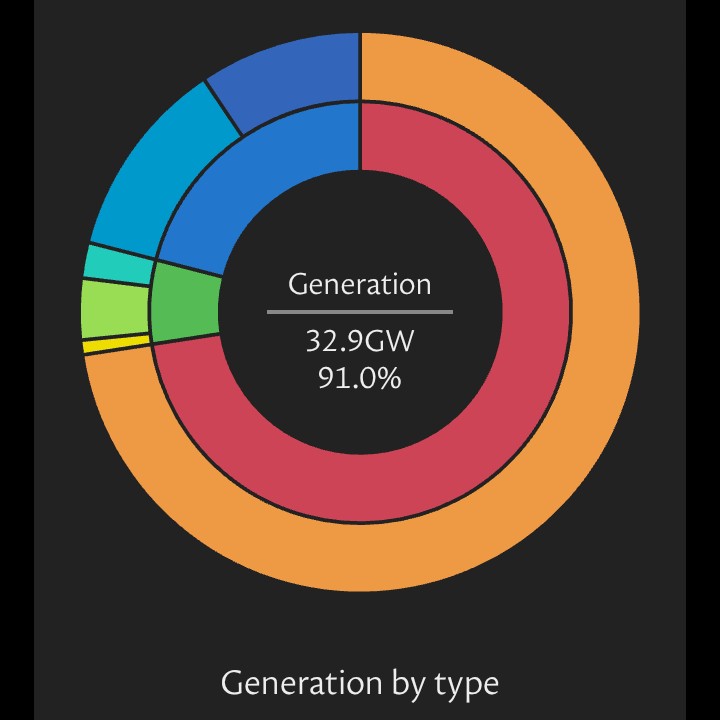
At 8:30pm the figures showed:
Gas: 48.1%
Wind: 25.2%
Solar: 0.5%
And the wholesale electricity price:
£188.43/MWh
So after record sunshine, record solar generation and tens of billions invested in renewable infrastructure, Britain was once again relying on gas for almost half its electricity as solar disappeared for the evening.
This is the question policymakers cannot avoid:
If renewables are delivering cheap electricity, why does the system repeatedly become expensive when we actually need dependable power?
And then we penalise the gas that keeps the lights on
There is another part of this story that is routinely left out.
When wind falls and solar disappears, Britain frequently relies upon gas.
But government policy deliberately increases the cost of gas-fired electricity.
Fossil-fuel electricity generators participate in the UK Emissions Trading Scheme, under which emitting carbon carries a financial cost. The Government explicitly says the objective of carbon pricing is to place a cost on activities including fossil-fuel power generation.
On top of that comes Carbon Price Support.
The Government describes CPS explicitly as a tax on fossil fuels used for electricity generation. It is currently set at the equivalent of £18 per tonne of CO₂.
And NESO reports that the carbon market price in June was about £67.30 per tonne.
So Britain’s gas generators were operating against a carbon-price environment of roughly £85 per tonne of CO₂ when the two components are considered together, before considering the underlying gas price, plant efficiency and other operating costs.
For perspective, Ofgem has historically used approximately 0.4 tonnes of CO₂ per MWh as a representative CCGT figure.
That gives an indicative carbon burden of roughly:
£34/MWh
on gas-fired electricity under those June carbon-price conditions.
That calculation is illustrative — individual plants, efficiencies, hedging positions and ETS purchasing costs vary.
But the principle is indisputable.
Government policy deliberately raises the marginal cost of fossil-fuel electricity.
The Government’s own impact assessment acknowledges that higher carbon prices increase the marginal cost of fossil generation and that these higher costs may flow through into electricity prices.
And here lies the contradiction.
Britain makes dispatchable fossil generation more expensive to encourage renewable investment.
Then, when wind output collapses or solar disappears, the electricity system still needs that fossil generation.
Gas comes back onto the system carrying the carbon costs imposed upon it.
Gas may then influence the marginal electricity price.
And politicians point to the resulting expensive gas-linked electricity as evidence that Britain needs still more weather-dependent generation.
That circular argument deserves serious scrutiny.
This summer has exposed the real question
The argument isn’t that wind turbines don’t generate electricity.
They do.
It isn’t that solar wasn’t successful this summer.
It was spectacularly successful during daylight hours.
The argument is that cheap electricity when the weather permits it is not the same thing as a cheap electricity system.
A national grid must function when the wind drops.
It must function at 8pm when solar collapses.
It must survive a heatwave.
It must maintain frequency.
It needs reserve.
It needs inertia.
It needs voltage support.
It needs dispatchable generation.
And somebody has to pay for all of that.
NESO spent £302 million balancing the electricity system in June alone. Constraint costs were £225.3 million. NESO also reports that higher renewable penetration can require synchronous generation to be procured for voltage and inertia services that weather-dependent inverter-based generation does not inherently provide in the same way.
Those are system costs.
Consumers pay for a system, not a wind turbine.
Four warnings. One summer.
June brought the extraordinary frequency event and an Ofgem investigation.
June brought two Electricity Margin Notices.
July brought another.
August’s eclipse brought another.
Low wind repeatedly increased dependence on gas.
Consumers were paid to reduce demand.
Interconnector flows were actively managed.
Gas supplied more than half Britain’s electricity on critical June days.
And wholesale electricity has repeatedly approached or exceeded £200/MWh.
This doesn’t prove that every pound of those costs was “caused by renewables”.
That would be too simplistic.
But it does demolish the equally simplistic claim that adding more wind and solar automatically gives Britain cheap electricity.
The public deserves a different calculation.
Not the isolated cost of producing one megawatt-hour from a solar panel at noon.
Not an LCOE figure for a wind turbine under favourable conditions.
Show us the whole-system cost.
Show the backup.
Show the balancing.
Show the constraints.
Show the transmission expansion.
Show the frequency and voltage services.
Show the reserve generation.
Show the carbon taxes imposed on the dispatchable plant required when renewables disappear.
And then tell us what one reliable megawatt-hour actually costs the consumer.
Because summer 2026 has delivered record heat, record sunshine and record solar generation.
It has also delivered repeated margin warnings, a major grid-security investigation, heavy reliance on gas and electricity around £200/MWh.
So perhaps the question is no longer:
“Are renewables cheap when they generate?”
The question Britain should be asking is:
“Where is the cheap, reliable electricity system we were promised?”
Shane Oxer. Campaigner for fairer and affordable energy
 SAY NO TO THE DESTRUCTION OF OUR LAND
Leave a comment