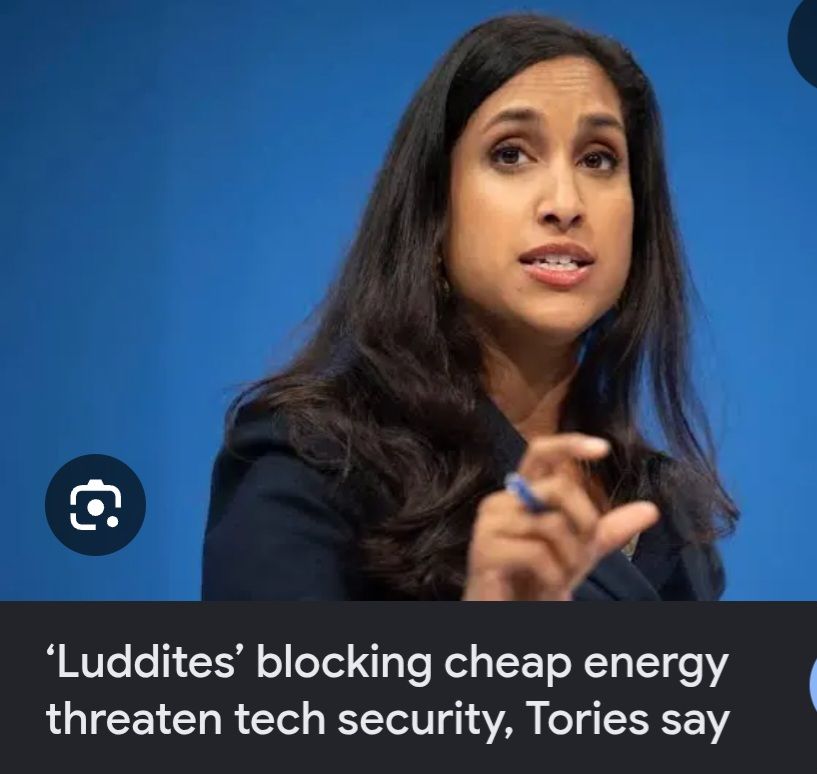
Claire Coutinho, Net Zero and the political conversion Britain should examine carefully
There is an old saying: can a leopard change its spots?
In politics, perhaps it can.
Politicians are entitled to change their minds. In fact, when the evidence changes, we should expect them to. Stubbornly defending a policy that has been shown to be damaging would hardly be a virtue.
But when a politician changes position dramatically, particularly on an issue that has cost households billions of pounds and is reshaping Britain’s electricity system, countryside and industrial economy, the public is entitled to ask a different question:
What exactly changed , the evidence, or the politics?
That question now hangs over former Energy Secretary Claire Coutinho.
October 2023: “Nothing will distract us”
On 18 October 2023, Claire Coutinho was Secretary of State for Energy Security and Net Zero.
Speaking at the Energy UK conference at One Great George Street in London, she could hardly have been clearer:
«”Nothing will distract us from achieving net zero or driving forward renewables.”»
This was not an isolated phrase taken from an ambiguous interview.
It formed part of her first keynote speech as Energy Secretary.
She celebrated the increase in renewable electricity, promoted offshore wind, solar and green investment, and declared that Britain’s ambitions on Net Zero were “undiminished”. The official Government transcript records the speech exactly as delivered.
And this matters.
Because Coutinho was not some junior minister repeating a departmental briefing.
She was the Secretary of State responsible for Britain’s energy system.
She had access to the Department for Energy Security and Net Zero, civil servants, energy modelling, grid information and policy advice.
Indeed, the same 2023 speech demonstrates that she was already aware of one of the enormous problems facing the renewable expansion programme.
She acknowledged that Britain was investing tens of billions of pounds in new energy projects while not yet possessing the grid infrastructure necessary to transport that electricity to homes and businesses.
So the infrastructure problem was not discovered in 2026.
It was staring government in the face in 2023.
Nevertheless, her declaration remained unequivocal:
Nothing would distract the Government from Net Zero or driving forward renewables.
Then came June 2026
Fast-forward less than three years.
On 24 June 2026, during a House of Commons debate on climate change and the Seventh Carbon Budget, Labour MP Luke Murphy confronted Coutinho with her own words.
He quoted her 2023 declaration back to her.
Coutinho’s response was remarkable.
She told the House:
«”I am proud to have changed my party’s position, because I care about the consumer, about jobs, and about the price of food and energy.”»
That statement is recorded in Hansard.
And there, in two quotations, we have an extraordinary political journey.
2023:
«”Nothing will distract us from achieving net zero or driving forward renewables.”»
2026:
«”I am proud to have changed my party’s position…”»
The question is why.
What changed?
Coutinho’s defence is important and should be represented fairly.
She told Parliament that she had inherited her party’s Net Zero position and argued that she had always regarded affordability as important. She said Net Zero should not impoverish consumers and defended changing Conservative policy because of concerns about jobs, food prices and energy costs.
Those concerns are legitimate.
In fact, many of us have been raising precisely those questions for years.
But that creates an uncomfortable problem.
Why were those questions apparently not sufficient to stop the drive in 2023?
Energy affordability mattered in 2023.
Jobs mattered in 2023.
Food prices mattered in 2023.
Grid constraints existed in 2023.
The enormous cost of rebuilding Britain’s transmission network was becoming increasingly apparent.
The intermittency of wind and solar was hardly a newly discovered scientific phenomenon.
The need for backup generation was known.
The planning consequences of thousands of miles of new transmission infrastructure were foreseeable.
And communities were already beginning to experience the consequences of enormous solar, battery and transmission proposals.
Yet the message from the Energy Secretary was not caution.
It was:
“Nothing will distract us.”
That is what deserves examination.
The problem was never simply renewables
There is also an important distinction that Britain’s energy debate desperately needs.
The argument should not be reduced to being “for renewables” or “against renewables”.
Renewable technologies can have a role in an energy system.
The real question is how much, where, at what cost, supported by what grid, backed up by what generation, and with what consequences for consumers and the countryside?
Those are engineering and economic questions.
They should have been asked before Britain committed itself to transforming much of its electricity system.
Instead, successive governments often appeared to begin with legally imposed decarbonisation targets and then attempt to construct an electricity network capable of satisfying them.
That distinction matters enormously.
Energy policy should begin with what Britain needs:
reliable power, affordable power, secure power and sufficient generating capacity throughout the year.
Only then should politicians determine the best mixture of technologies capable of providing it.
Targets should serve the electricity system.
The electricity system should not be distorted simply to serve political targets.
Coutinho may now be asking some of the right questions
There is an irony here.
Some of Coutinho’s present criticisms deserve serious consideration.
In the June 2026 debate she challenged the Government over the economic consequences of its climate policies and questioned whether the impact assessment properly captured effects on jobs, energy security and the wider economy.
Those are exactly the sorts of questions Parliament should ask.
But political memory matters.
It is not unreasonable for the public to ask why such scrutiny appears so much more urgent from the Opposition benches than it did when the Conservatives controlled the department responsible for implementing the policy.
Being right today does not automatically erase responsibility for yesterday.
And that principle should apply to politicians of every party.
Can a leopard change its spots?
Yes.
People change their minds.
Parties change direction.
Evidence accumulates.
Policies fail.
Economic circumstances change.
And there should always be room in politics for someone to say:
We got this wrong.
In fact, Britain would probably be governed considerably better if politicians were prepared to say those four words more often.
But genuine conversion requires more than adopting a new position.
It requires explaining the old one.
If Claire Coutinho now believes Britain’s Net Zero policy failed sufficiently to protect consumers, employment, food costs and energy security, then there is a legitimate question she should answer:
When did she first recognise those failures?
Was it while she was Energy Secretary?
If so, what did she do about them?
If not, what evidence emerged after leaving government that fundamentally changed her assessment?
Because her October 2023 speech shows that she already knew the grid was struggling to accommodate the enormous volume of proposed new generation.
Yet she simultaneously promised:
«”Nothing will distract us from achieving net zero or driving forward renewables.”»
Less than three years later she was telling Parliament:
«”I am proud to have changed my party’s position…”»
Britain should welcome politicians who reconsider failed policies.
But we should also demand accountability from those who helped implement them.
Because the consequences are not theoretical.
They appear on electricity bills.
They appear in new pylons and substations.
They appear in planning applications covering thousands of acres of countryside.
They appear in industrial decisions.
And ultimately they appear in the pockets of British households.
So perhaps the question is not simply:
Can a leopard change its spots?
Perhaps the more important question is:
Why did it take so long to notice the spots were there?
Shane Oxer. Campaigner for fairer and affordable energy
Sources
Official GOV.UK transcript: Claire Coutinho, Energy UK conference 2023: keynote speech, delivered 18 October 2023.
House of Commons Hansard, Climate Change, 24 June 2026 — exchange between Luke Murphy MP and Claire Coutinho MP.

 SAY NO TO THE DESTRUCTION OF OUR LAND
Leave a comment