Two articles. Same problem.
On the morning of 26 August 2026, two of Britain’s major mainstream newspapers published articles about energy.
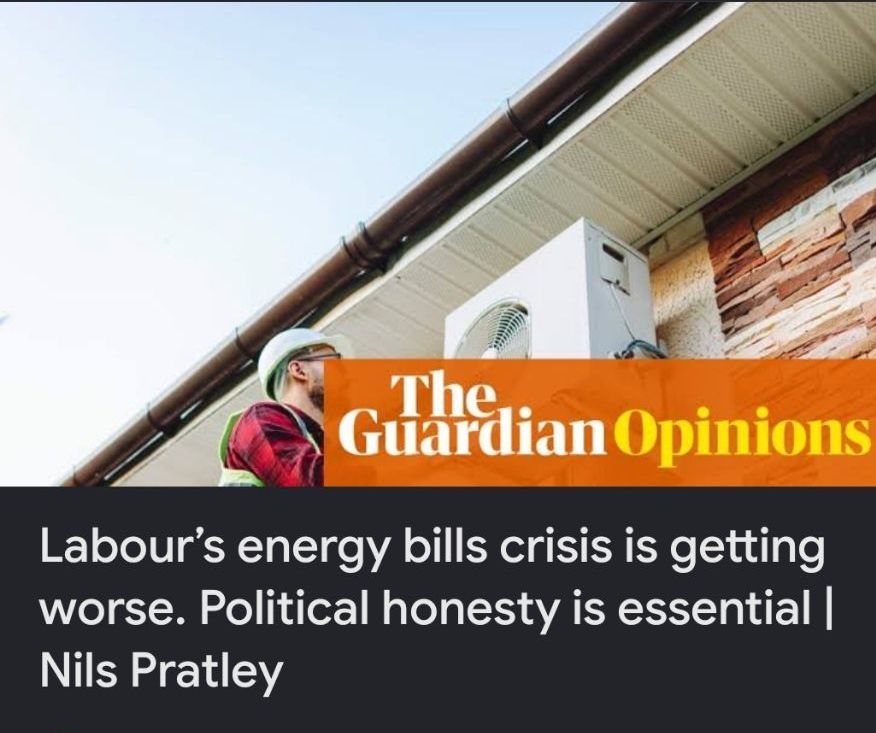
The Guardian’s headline was:
“Labour’s energy bills crisis is getting worse. Political honesty is essential.”
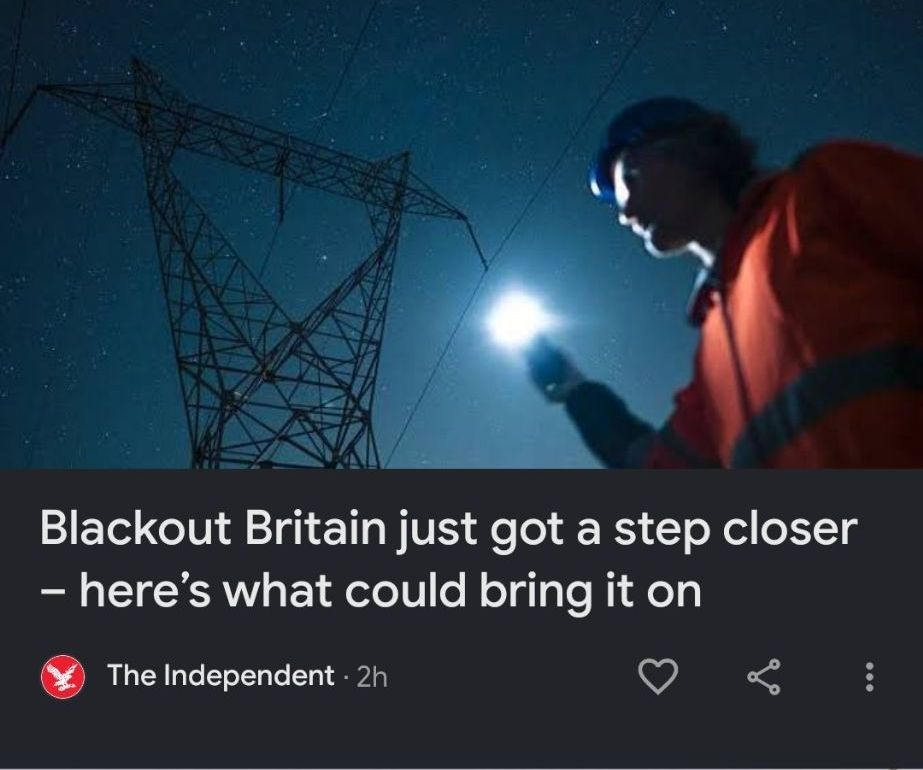
The Independent’s was even more striking:
“Blackout Britain just got a step closer – here’s what could bring it on.”
One is about price.
The other is about security of supply.
But they are not really separate stories.
They are two sides of the same problem.
For years we have been told that renewable energy is cheap, that the transition would protect consumers from volatile fossil-fuel prices, and that ever greater quantities of wind and solar would ultimately bring down our electricity bills.
At the same time, anyone who questioned what happens when the wind does not blow, when the sun does not shine, when generation is built hundreds of miles from demand, or when the electricity network cannot physically carry all that power was too often treated as though they were questioning climate science rather than asking basic engineering and economic questions.
Now the conversation is changing.
Renewables are weather-dependent. Integrating very large quantities of them into an electricity system has costs. And Britain is finally beginning to talk openly about both.
The Guardian asks: where did the cheap electricity go?
What makes The Guardian article significant is not that the newspaper has suddenly turned against renewable energy. It plainly has not.
What matters is that it is beginning to ask the question that consumers have been asking for years:
If renewable electricity is so cheap, why are our electricity bills still so high?
The Guardian’s Nils Pratley points to EDF’s projection that household bills are likely to remain stubbornly high through to the end of the decade. EDF projects an indicative price-cap figure of £1,786 in 2030 compared with £1,721 for the final quarter of 2026, based on its assumptions about future costs.
That deserves attention.
Because the debate can no longer stop at the wholesale price of electricity.
The Guardian itself notes that the wholesale element now represents only around 30 per cent of the electricity bill. The rest includes the cost of networks, policy schemes, contracts supporting generation, carbon-related costs and other charges necessary to operate and transform the system.
And then comes the really important part.
The article identifies Britain’s enormous transmission investment programme — around £70 billion — as one of the major areas where costs need far greater public scrutiny. EDF is itself calling for greater transparency and a strategic review of whether the current programme remains the right one as costs rise and projects are delayed.
Read that again.
We have spent years being shown auction prices and generation costs as evidence that renewable energy is becoming cheaper.
But households do not buy electricity from a wind turbine.
They buy electricity from an electricity system.
And an electricity system has to work every second of every day.
It needs generation.
It needs transmission.
It needs distribution.
It needs substations and transformers.
It needs balancing.
It needs reserve.
It needs frequency stability.
It needs ways of dealing with periods of excess generation.
And it needs ways of dealing with periods when weather-dependent generation falls.
The true question was therefore never simply:
“How cheaply can a wind turbine produce a megawatt-hour when the wind is blowing?”
The question should always have been:
“What does it cost to build and operate a reliable national electricity system around very large quantities of weather-dependent generation?”
Those are not the same calculation.
And finally, even The Guardian is edging towards that debate.
Its article explicitly refers to the absence of a comprehensive “full system cost” analysis taking proper account of backup, balancing and additional grid costs created by greater use of weather-dependent generation.
That is an extraordinary change in the public conversation.
Then The Independent asks: can we keep the lights on?
Just 75 minutes before The Guardian article appeared, The Independent published its own examination of Britain’s electricity system.
And this time the question was not price.
It was whether households might actually have their electricity temporarily disconnected during an electricity shortage.
The article reports on the newly formalised Demand Control Rotation Protocol, or DCRP, under which planned rota disconnections can be used to reduce electricity demand during a short-term supply emergency.
This needs explaining carefully because there is already plenty of sensationalism around the subject.
Britain is not announcing scheduled South African-style load shedding.
Nor does the existence of an emergency procedure prove that blackouts are imminent.
Electricity systems have always required contingency procedures.
But something important has changed.
Ofgem approved modifications to formally introduce the Demand Control Rotation Protocol into the Grid Code, with implementation taking effect in August 2026. Ofgem itself describes demand-control tools as an “essential last resort component of system operation.”
Government guidance says the protocol can be activated where there is at least eight hours’ advance warning of an electricity shortfall and where disconnection needs to occur within 24 hours of that shortfall being identified. Unlike prolonged emergency arrangements, the short-term protocol does not require the Government first to invoke emergency powers.
The system uses rotating disconnections, with the established emergency arrangements based around nominal three-hour periods.
Again, this does not mean the lights are about to go out.
But surely the public is entitled to ask a very simple question.
How did we get from promises of abundant cheap green electricity to a national debate simultaneously involving record-level bills and formal procedures for managing an electricity shortfall?
The connection nobody wanted to discuss
This is where the two articles meet.
The problem is not simply that Britain needs more electricity.
The problem is that electricity has to be available at the right place and at the right time.
Wind generation can be abundant in Scotland while demand is concentrated hundreds of miles away.
Solar generation can peak around the middle of a summer day while Britain’s greatest electricity-security challenge traditionally occurs during dark winter evenings.
A country can therefore have enormous amounts of installed generation capacity and still face shortages at particular times.
Conversely, it can have too much electricity in one location and not enough transmission capacity to move it somewhere else.
That is why Britain can simultaneously pay wind farms to reduce output because the network cannot accommodate their electricity while spending tens of billions of pounds building new transmission infrastructure to relieve those constraints.
That isn’t a contradiction.
It is the consequence of confusing installed capacity with dependable system capability.
And it is precisely why intermittency — or, if we want the more technical phrase, weather-dependent variability — matters.
It has always mattered.
It is not ideology.
It is electrical engineering.
Then along come the data centres
The problem becomes even bigger when we look at the demand side.
Britain is simultaneously attempting to electrify transport, heating and industry while encouraging the development of enormous AI and data-centre infrastructure.
Ofgem has revealed that contracted demand connection offers increased from 41GW to 125GW between November 2024 and June 2025, largely driven by data-centre projects. The regulator has become sufficiently concerned about speculative capacity reservations that it is proposing a Data Centre Commitment Fee ranging from £237,500 to £712,500 per megawatt.
Think about what that tells us.
Grid capacity has become valuable enough that Ofgem believes developers need a substantial financial incentive not to reserve it speculatively.
Meanwhile we have renewable generators waiting years for connections.
We have transmission projects running into delay and cost escalation.
We have consumers paying for reinforcement.
We have generators being curtailed because power cannot always be transported from where it is generated to where it is needed.
And now Britain’s expected future electricity demand is increasing again.
This is no longer a debate about whether Britain should be “green” or “anti-green”.
It is about whether anyone ever produced a realistic, transparent and publicly accountable plan for how all these pieces were supposed to work together.
We planned the generation before we planned the system
That is the fundamental mistake I believe Britain has made.
We concentrated on generation targets.
More wind.
More solar.
More offshore capacity.
More connections.
More electrification.
And politicians celebrated every new gigawatt as though another number on a spreadsheet automatically represented another gigawatt of secure electricity available to consumers.
It doesn’t.
The grid has to carry it.
The system has to balance it.
There has to be sufficient dependable generation when weather-dependent generation is unavailable.
There has to be enough network infrastructure to connect it.
And somebody has to pay for all of that.
Ultimately, that somebody is us.
Through our electricity bills.
Through taxation.
Through network charges.
Through government-backed contracts.
Through constraint payments.
And through the cost of trillions of pounds of infrastructure that Britain may ultimately require if the present transformation continues.
That is why the phrase “renewables are cheap” has become increasingly inadequate.
An individual renewable generator may indeed produce electricity very cheaply under favourable conditions.
But that tells us almost nothing about what it costs to operate the entire electricity system around it.
Only now are we allowed to speak about it
Perhaps “allowed” is not literally the right word.
Nobody passed a law preventing people from discussing intermittency, grid constraints or system costs.
Engineers have discussed them for decades.
But anyone involved in this debate knows what the political atmosphere has been like.
Question the scale of grid reinforcement and you were accused of opposing progress.
Question whether covering agricultural land in solar panels was sensible and you were accused of being anti-renewable.
Question intermittency and somebody would immediately tell you that “the wind is always blowing somewhere”.
Ask about backup and storage and you would be told technology would solve it.
Ask who was paying for the network and balancing costs and the debate would return to wholesale gas prices.
That atmosphere is changing.
And on 26 August 2026, something remarkable happened.
Two mainstream newspapers effectively asked the questions campaigners and critics have been asking for years.
The Guardian asked:
Why isn’t cheap renewable electricity producing cheap household electricity?
The Independent asked:
Why does a country building enormous amounts of generation need strengthened arrangements for emergency power disconnections?
Those questions belong together.
The argument has changed
We should not exaggerate what these articles mean.
The Guardian still supports the energy transition.
The Independent quotes experts who believe Britain’s electricity problems are manageable and that emergency disconnection arrangements are prudent contingency planning.
Neither newspaper has suddenly endorsed every criticism of Net Zero.
That isn’t the point.
The point is that the terms of the argument are changing.
It is becoming increasingly difficult to pretend that electricity policy can be measured simply by the number of wind turbines erected, solar panels installed or gigawatts auctioned.
Reliability matters.
Deliverability matters.
Grid capacity matters.
System stability matters.
Timing matters.
And above all, cost matters.
Britain was promised an energy transition that would produce cleaner, cheaper and more secure electricity.
Now one mainstream newspaper is asking why it remains so expensive while another is discussing what happens when there isn’t enough power to keep everybody connected.
That should be a political turning point.
Not because Britain should stop investing in every form of renewable generation tomorrow.
But because the public deserves the truth about what the electricity system actually costs.
No more presenting the generation price while hiding the system price.
No more treating nameplate capacity as though it were dependable capacity.
No more announcing renewable projects without asking whether the grid infrastructure needed to connect them will actually exist.
No more pretending that backup, balancing, curtailment and transmission are somebody else’s problem.
And no more dismissing people who ask these questions.
Two articles. Same problem.
Renewables are weather-dependent.
A renewables-heavy electricity system is proving extraordinarily expensive to rebuild around.
And after years of being told not to worry about either, Britain is finally beginning to have the conversation it should have had before committing hundreds of billions of pounds and the future security of its electricity supply.
The question now is whether our politicians are prepared to join it.
Shane Oxer. Campaigner for fairer and affordable energy
 SAY NO TO THE DESTRUCTION OF OUR LAND
Leave a comment