The fisherman may own his boat, his nets and his business, but he does not own the seabed beneath him. As offshore wind, marine protection and new energy infrastructure compete for the same waters, that distinction is becoming one of the most important in Britain’s Net Zero economy.
By Shane Oxer
The fisherman is, in many ways, the tenant farmer of the sea. He may have worked the same grounds for decades. His father may have fished them before him. He owns the boat, pays for the fuel, maintains the gear, employs the crew and carries the risk when catches are poor. But he does not own the water beneath his hull and he certainly does not own the seabed below it. That distinction was once largely academic. It is becoming enormously valuable.
Around England, Wales and Northern Ireland, The Crown Estate manages the seabed out to the 12-nautical-mile territorial limit and holds important rights connected with offshore renewable generation farther out across the UK economic zone. Those assets are not King Charles III’s private property. The King does not control them, cannot sell them for his own benefit and does not receive their revenues personally. The Crown Estate is an independent statutory corporation holding the assets “in right of the Crown”, and its net revenue is paid into the UK Consolidated Fund. (“thecrownestate.co.uk” (https://www.thecrownestate.co.uk/about-us/faqs))
That constitutional distinction matters, but economically something remarkable has happened. The seabed has become one of the most valuable assets in Britain’s energy transition.
In 2025/26 The Crown Estate reported operating profit of around £1.2 billion. Offshore Wind Leasing Round 4 option fees alone contributed £875 million, while revenue from existing wind farms rose to £117 million. The marine portfolio was valued at £3.7 billion, and £487 million of revenue-account profit was returned to HM Treasury. (“thecrownestate.co.uk” (https://www.thecrownestate.co.uk/news/the-crown-estate-reports-strong-results))
Nobody manufactured the seabed. Nobody improved its productivity in the agricultural sense. What changed was government policy and the commercial demand flowing from it. Britain decided to build offshore wind at enormous scale. Developers required exclusive rights to defined areas of sea. Those rights acquired a price. Option agreements became valuable. Leases became valuable. Once turbines began operating, revenue-linked rents followed.
A natural asset which had existed for thousands of years had acquired an entirely new economic identity.
This is the offshore equivalent of what we have already seen on farmland. A field becomes more valuable because solar policy creates demand for it. The underlying owner can lease the land while retaining the freehold. At sea, developers do not need to own the North Sea or Celtic Sea. They need contractual control of the part required for their project.
The difference is that the numbers offshore are vastly larger.
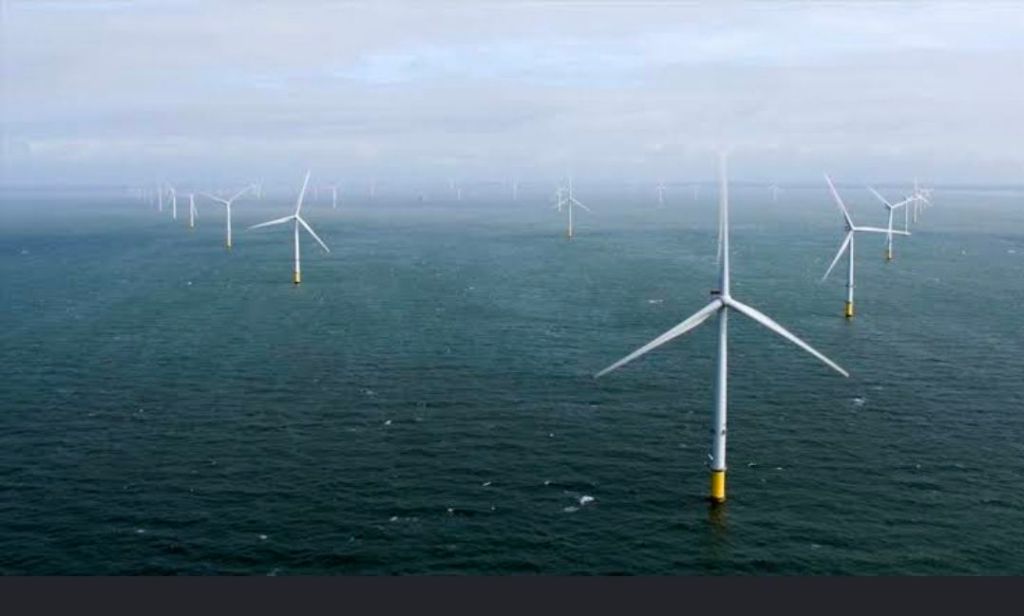
The latest Crown Estate offshore-wind pipeline around England, Wales and Northern Ireland sits within a UK pipeline measured in tens of gigawatts. Round 5 alone is opening roughly 1,000 square kilometres of Celtic Sea seabed to three floating offshore wind developments with a combined potential capacity of up to 4.5GW. The Crown Estate’s own engineering estimates envisage more than 260 floating turbines, around 1,000 anchors, at least 300 kilometres of mooring lines and roughly 900 kilometres of electrical cable connecting turbines and ultimately taking power towards the grid. (“thecrownestate.co.uk” (https://www.thecrownestate.co.uk/our-business/marine/round-5))
The three project areas straddle Welsh and English waters, with roughly half of the development space attributed to Wales. Equinor, Gwynt Glas — the EDF Renewables and ESB joint venture — and Ocean Winds have been selected to take forward the three Round 5 sites. (“thecrownestate.co.uk” (https://www.thecrownestate.co.uk/news/the-crown-estate-announces-successful-award-to-develop-third-floating-wind-farm-in-the-celtic-sea))
For Wales, this raises a question which Scotland answered differently nearly a decade ago.
Who gets the rent?
The Crown Estate’s latest Wales accounts record £210 million of operating profit from Welsh assets in 2025/26, driven primarily by temporary option fees associated with the Mona offshore wind project off North Wales. Strip those option fees out and the underlying operating profit falls to £9.8 million. (“thecrownestate.co.uk” (https://www.thecrownestate.co.uk/news/the-crown-estate-publishes-annual-wales-review))
The previous year was even more extraordinary. A Welsh Government expert group estimated that Crown Estate offshore-wind activity associated with Wales generated just under £500 million from Round 4 in 2024/25. Those revenues were exceptional and temporary, but they demonstrate what control of seabed rights can become worth when policy and market demand align. (“gov.wales” (https://www.gov.wales/sites/default/files/publications/2026-03/the-future-of-the-crown-estate-in-wales-interim-report-summary.pdf))
The money is not ring-fenced and returned directly to Wales. Crown Estate net revenue goes into the UK Treasury system. Wales therefore benefits as part of the wider United Kingdom public finances, but there is no direct Welsh equivalent of Scotland’s devolved Crown Estate structure.
That difference has become politically difficult to ignore.
The Welsh Government now openly argues for devolution. In June it said revenues from Welsh land and waters should support Welsh priorities rather than flow primarily into the Treasury and noted that every Welsh local authority supports Crown Estate devolution. (“gov.wales” (https://www.gov.wales/welsh-government-response-crown-estate-annual-report))
Yet the Welsh Government’s own expert group has also introduced an uncomfortable qualification. Scotland received devolution before the enormous offshore-wind option-fee windfall arrived. Wales did not. The group found no evidence that devolution now would produce an equivalent windfall, because the exceptional Round 4 fees are already falling away. It estimated gross annual Crown Estate revenues at the point of any future Welsh transfer could be below £20 million a year, before the cost of recreating management functions, and any devolution settlement would also involve negotiations over adjustments to the Welsh block grant. (“gov.wales” (https://www.gov.wales/sites/default/files/publications/2026-03/the-future-of-the-crown-estate-in-wales-interim-report-summary.pdf))
In other words, Wales may have watched one of the richest periods in the modern history of Crown seabed leasing pass through a structure it did not control.
Scotland caught the wave earlier.
Since 2017, Crown Estate Scotland has managed the Scottish Crown Estate as a separate public corporation accountable to Scottish Ministers and the Scottish Parliament. The underlying assets are still held by the Monarch “in right of the Crown”, not as private royal property, but net profits flow into the Scottish Consolidated Fund. Revenue from marine assets within 12 nautical miles is also distributed to coastal councils for local benefit. (“crownestatescotland.com” (https://www.crownestatescotland.com/media/key-information)) (“gov.scot” (https://www.gov.scot/publications/scottish-crown-estate-revenue-allocations/pages/introduction/))
Then came ScotWind.
The initial leasing round generated £755.2 million in option fees. By August 2026 the Scottish Government said £96 million had been used, with the remainder feeding into the wider Scottish fiscal position and future spending plans. Crown Estate Scotland also expects operating projects eventually to make continuing multi-million-pound annual payments. (“gov.scot” (https://www.gov.scot/publications/foi-202600514906/))
That is not a theoretical difference in constitutional structure.
It is hundreds of millions of pounds.
Scotland controls the management of its Crown Estate revenues through devolved institutions. Wales does not.
One can argue about whether that difference is fair, whether Wales would actually be financially better off after a block-grant adjustment, or whether UK-wide management allows larger investment and risk sharing. Those are legitimate arguments.
But there is no serious dispute about the underlying fact: two parts of the United Kingdom operate different systems for managing economic value derived from Crown seabed rights.
And while governments argue over the revenue, there is somebody else at sea whose position looks rather less secure.
The fisherman.
The comparison with the tenant farmer is almost exact. The farmer may work the land without owning the freehold. The fisherman may work the sea without possessing any ownership right over the seabed. When government policy changes the preferred use of either asset, the person who depends upon it economically may not be the person with the strongest legal claim over its future.
Scottish Government documents now acknowledge this directly. Its 2026 impact assessment for offshore-wind habitat reforms says expanding offshore wind is expected to have negative impacts on commercial fisheries, with vessels over 12 metres particularly exposed. It identifies the North East and Shetland as areas where impacts are likely to be greater because offshore-wind development areas are concentrated there. The Government says displacement can alter vessel cost and revenue, increase conflict between fishing methods, reduce fishing efficiency, increase steaming distances and contribute to wider environmental impacts. (“gov.scot” (https://www.gov.scot/publications/business-regulatory-impact-assessment-bria-conservation-habitats-species-offshore-wind-miscellaneous-amendments-scotland-regulations-2026/pages/5/))
That is unusually blunt official language.
It becomes more revealing when read alongside Scotland’s own fisheries-displacement guidance. Government defines displacement as fishing activity being forced away from grounds because of another licensed marine activity. Its guidance identifies potential consequences including increased competition for remaining grounds, loss of access to productive areas, increased steaming time and, in some circumstances, a fisherman leaving the industry altogether. (“gov.scot” (https://www.gov.scot/publications/good-practice-guidance-assessing-fisheries-displacement-licensed-marine-activities/pages/6/))
A separate Scottish Government review says the increasing demands from marine renewables, conservation measures and other sectors are creating what it calls a “spatial squeeze” on fishing. It also admits that, while large amounts of baseline data are gathered before offshore wind construction, there remains a general shortage of commercial-fisheries data after projects are actually built. (“gov.scot” (https://www.gov.scot/publications/monitoring-offshore-windfarm-impacts-commercial-fishing-industry-good-practice-guidance/pages/9/))
That phrase — spatial squeeze — may become one of the most important in this entire investigation.
Because offshore wind is not entering an empty sea.
Neither is 30by30.
Neither are Marine Protected Areas.
Neither are subsea electricity cables, carbon-storage projects, interconnectors, aquaculture, shipping or military activity.
They overlap.
Scotland already has a Marine Protected Area network covering around 37 per cent of its seas. Wales has protected designations covering around 69 per cent of its inshore waters. Those designations do not automatically ban fishing across their full area, and management rules differ from one site to another, but they add another layer of spatial management to seas already facing growing demands from energy infrastructure. (“gov.scot” (https://www.gov.scot/policies/marine-environment/marine-protected-areas/)) (“gov.wales” (https://www.gov.wales/30by30-framework-wales-html))
This is where the land and sea stories finally join.
On land, government policy can make a field more valuable for solar or biodiversity than for its previous agricultural use. The landowner then possesses the negotiating power created by ownership.
At sea, government policy makes seabed rights enormously valuable for offshore wind. Crown bodies possess the legal rights that developers require. The state can receive large payments. Energy companies acquire decades of development control.
The fisherman occupies the water above them.
He can be consulted. He can negotiate mitigation. He may receive compensation. Developers can alter cable routes or turbine layouts. Government can attempt coexistence.
But he does not own the asset whose new economic value is being traded.
The imbalance could hardly be clearer.
Round 5 illustrates the scale of what is coming to the Celtic Sea. The Crown Estate estimates more than 260 floating turbines, around 1,000 anchors and roughly 900 kilometres of cable across three project areas. It says the leasing design followed several years of engagement with fishing, maritime and environmental interests, and that the locations were refined to account for competing uses of the sea. (“thecrownestate.co.uk” (https://www.thecrownestate.co.uk/our-business/marine/round-5))
That work matters. Offshore wind cannot simply ignore fishing.
But consultation does not remove the underlying competition for space.
A fisherman who alters his route or loses access to part of a traditional ground has changed his business.
A seabed lessor has acquired an income stream.
A developer has acquired a development right.
A funder has acquired an investment opportunity.
They are all looking at the same patch of sea.
They simply see different assets.
This is why Crown Estate revenue figures should never be presented merely as financial success. They are also evidence of how much economic value is being attached to control of marine space.
The Crown Estate’s £875 million of Round 4 option-fee income in 2025/26 came from developers paying for rights to progress offshore projects. Scotland’s £755.2 million ScotWind windfall came from essentially the same principle.
The sea acquired a price.
Then the rights were sold.
What makes this story different from Blenheim, Blankney or Badminton is who receives the owner’s side of the transaction. With a private landed estate, the lease income is private. With The Crown Estate and Crown Estate Scotland, the ultimate revenues are public.
That distinction matters enormously.
It means this part of Robin Hood in Reverse cannot honestly be described as public money simply being transferred to an aristocrat.
The offshore story is about something wider.
It is about the state becoming a major landlord of the energy transition while private capital builds assets on rights leased from it.
Developers pay for seabed access.
Those developers raise billions from shareholders, banks, pension funds and infrastructure investors.
Many projects then seek Contracts for Difference providing long-term revenue certainty.
Transmission companies build the cables and grid infrastructure.
Consumers ultimately buy electricity through the wider system.
And Crown bodies collect value from the underlying seabed rights.
At nearly every level, the project generates another contractual income stream.
Meanwhile the traditional user of that marine space may possess little more than a right to be considered.
That is why the Welsh question is so important.
The waters around Wales are being positioned as one of Europe’s major future floating-wind regions. Round 5 alone could deliver 4.5GW across the Celtic Sea, and the UK Government has signalled ambitions for much more capacity beyond it. The Crown Estate says it has provisionally allocated very substantial capital towards ports and infrastructure intended to unlock that future development. (“gov.wales” (https://www.gov.wales/sites/default/files/publications/2026-03/the-future-of-the-crown-estate-in-wales-interim-report-summary.pdf))
If Welsh waters are to become part of a multi-billion-pound offshore economy, the question of who controls the associated Crown rights is no longer an obscure constitutional argument.
It is an economic one.
Scotland has already answered it one way.
Wales is asking whether it should do the same.
And beneath the constitutional debate sits an older question.
Who was using the sea before its new value was discovered?
This investigation began with a tenant farmer standing in somebody else’s field. The owner could see a potential solar rent. The tenant could see the farm on which his livelihood depended.
At sea, the fisherman may be in an even weaker position.
There is no tenancy agreement granting him exclusive possession of his fishing ground.
There is no freehold.
There is no 40-year lease protecting his business.
There is simply a historic economic use of shared waters which government now has to balance against offshore wind, environmental protection, cables, carbon storage and other national priorities.
That does not mean fishing must always defeat energy development. Nor does it mean every wind farm destroys a fishing business. Offshore wind and fishing can coexist in some circumstances, and both governments and developers are trying to improve that coexistence.
But official documents now acknowledge displacement, cost increases and the possibility of commercial damage.
Those facts should be placed beside every billion-pound offshore announcement.
Because the sea is not empty.
It was never empty.
It contained fishing grounds long before it contained option agreements.
It sustained coastal communities long before it sustained infrastructure funds.
And as Britain turns ever more of its coastline and seabed into an energy asset, we should ask the same question we have asked repeatedly on land.
Who owns it?
Who uses it?
Who gets paid?
Who loses access?
And who eventually pays for the system built upon it?
The Crown Estate does not belong privately to the King. Crown Estate Scotland does not belong privately to the King. That simplistic argument obscures the real story.
The real story is that ancient Crown rights over the seabed have become extraordinarily valuable in the modern Net Zero economy.
In Scotland, that value has already produced £755.2 million in ScotWind option fees for the Scottish public finances.
In Wales, offshore-wind activity generated extraordinary temporary Crown Estate revenues while the management of those assets remained outside Welsh devolved control.
Across both countries, fishermen are being asked to share increasingly crowded seas with some of the largest industrial infrastructure projects Britain has ever contemplated.
The turbines may float.
The money certainly does not.
It has a destination.
The question is whose.
Shane Oxer. Campaigner for fairer and affordable energy
 SAY NO TO THE DESTRUCTION OF OUR LAND
Leave a comment