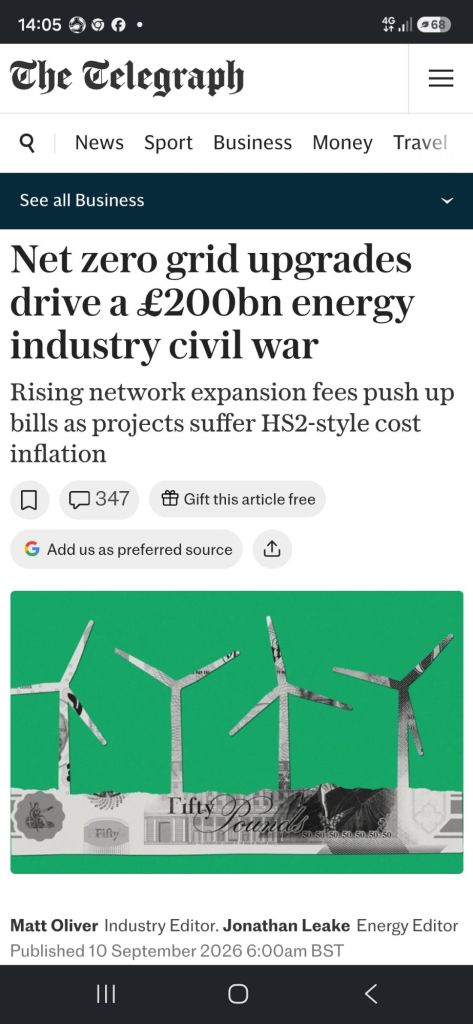
Having gone back through the material I sent Jonathan Leake over the course of 2026, my view is that today’s Telegraph investigation follows remarkably closely the line of inquiry I had been putting directly in front of him for months.
I want to be precise about that. I cannot prove that Jonathan used my work as the source of his article, and I would not accuse him of simply lifting my research. A journalist of his experience will have spoken to industry figures, regulators, companies and other sources.
But the chronology matters.
On 3 February I sent him The Map NESO Failed to Read. The central argument was simple: a connection date is not the same thing as a physical delivery date. I argued that Britain was prioritising generating capacity on paper while the steel, transformers, substations and cables needed to carry that electricity were years behind.
That distinction is now one of the central themes of the Telegraph investigation.
On 14 May I went much further. I sent Jonathan a specific Scottish Grid Delay Evidence Pack entitled How Clean Power 2030 is slipping by 3–6+ years.
I identified Eastern Green Link 1, Eastern Green Link 2, EGL3, EGL4, Spittal–Peterhead, Beauly–Spittal–Loch Buidhe, Beauly–Blackhillock–Peterhead and Beauly–Denny.
I did not merely list the projects. I laid out the investigative test: compare the date the infrastructure was said to be required with its real planning, procurement, construction and supply-chain position.
I specifically identified EGL2 as a central test case, with a 2029 requirement but major cable, converter and construction risks.
I also told Jonathan to examine supplier dependencies including NKT, Prysmian, Hitachi, Siemens and transformer availability.
And I posed the question directly:
How many Scottish transmission projects originally required for 2030 are now realistically slipping into the 2030s?
That is extraordinarily close to the question at the centre of the Telegraph article published on 10 September.
The Telegraph now asks how far behind Britain’s Great Grid Upgrade actually is. It then examines NESO documentation and reports that 64 of around 90 projects considered necessary for the Clean Power programme have dates beyond 2030.
It highlights EGL2 — needed by 2029 but now associated with a December 2035 date.
It highlights Beauly–Denny-related works extending into 2036.
It examines Spittal–Peterhead.
It examines Loch Buidhe–Spittal.
It examines the very Scottish transmission programme I had urged Jonathan to investigate four months earlier.
Then, on 16 June, I sent him something even more important: the underlying evidence.
I supplied Jonathan with the June 2026 TWR report and TEC Register spreadsheets, together with my paper The Missing Truth Behind Clean Power 2030 and its references.
My covering email explicitly told him that the TWR and TEC data were lagging behind the stated estimates and that this needed exposing nationally, particularly because the same problem existed in Scotland.
My analysis showed network reinforcement dates extending into 2035, 2036 and 2037.
I warned against assuming that an early contractual or effective date meant that the physical reinforcement was actually built, commissioned and capable of carrying full output.
That distinction — between a stated requirement and a credible physical delivery date — is now at the heart of the Telegraph investigation.
My June paper also identified another problem: supply chain.
Transformers, HVDC cable, switchgear, reactors, circuit breakers and specialist engineering resources were not infinitely available. Britain was trying to accelerate dozens of major electricity projects at the same time as other countries were competing for the same factories and components.
Today’s Telegraph article devotes substantial attention to exactly that issue, including the escalating price of transformers and cables, production bottlenecks and NKT’s involvement in Scottish transmission projects.
Then came the money.
On 24 June I sent Jonathan my UK Energy Infrastructure Cost Brief.
I had reconstructed the scale of electricity transmission expenditure and placed it at roughly £70–76 billion. I also warned that the public could not properly reconstruct individual project costs because important allowances remained commercially confidential.
One of the phrases in my report was:
“Project-level transparency remains poor.”
Today’s Telegraph article repeatedly returns to precisely that problem.
Industry executives call the system opaque and impenetrable. EDF says there is insufficient information to understand the scale and causes of cost increases. Individual project finances are hidden on commercial-sensitivity grounds. The article questions whether Ofgem can adequately scrutinise escalating expenditure.
Again, this is not merely agreement about Net Zero in general. It is the same underlying governance problem.
In July I then sent Jonathan successive versions of The Machine Laid Bare, including an audited version. That expanded the argument beyond individual projects.
My contention was that political targets were being translated into network requirements, network requirements into regulated investment, and regulated investment into infrastructure commitments — without Parliament or the public ever seeing one complete account of the financial and physical consequences.
What is especially significant now is that EDF, Octopus, Centrica and other major industry voices are raising variations of the same concern.
EDF is effectively saying that changing generation assumptions, delays and escalating costs mean parts of the programme should be reassessed before sunk costs make a change of direction impossible.
That is an important development because it moves the criticism beyond campaigners and outside analysts.
Finally, on 28 August — less than two weeks before the Telegraph article — I sent Jonathan further affordability analysis.
I argued that the real affordability calculation had to include network charges, balancing and constraint costs, financing, subsidies, public expenditure and the future cost of rebuilding the electricity system.
The Telegraph article now makes network charges one of its main subjects and highlights projected increases for both households and industrial consumers.
So what is my conclusion?
I do not think it would be responsible to say: “Jonathan Leake copied my work.”
There is no evidence proving that.
But I do think the evidence supports something much more substantial than saying we simply happened to reach the same conclusion.
Over a period of more than seven months, I repeatedly supplied the Telegraph’s Energy Editor with the argument, the project names, the analytical method, the Scottish evidence, the underlying NESO/TWR/TEC data, the transmission-cost work, the supply-chain problem and the affordability consequences.
And on 10 September, the Telegraph published a major national investigation covering many of those same projects, asking many of those same questions and reaching many of the same broad conclusions.
Perhaps the most revealing comparison is this.
In May I asked Jonathan:
How many Scottish transmission projects supposedly required for 2030 are really slipping into the 2030s?
In September, the Telegraph went into NESO’s records and reported that 64 of around 90 supposedly essential projects have delivery dates after 2030.
That is why I believe the work I sent him mattered.
Whether it prompted the investigation, contributed to it, confirmed what he was hearing elsewhere, or simply helped point him towards the records, only Jonathan can answer.
But the dated email trail establishes beyond doubt that these were not conclusions I reached after reading the Telegraph.
I was sending the Telegraph the evidence months before the Telegraph published the story.
And, ultimately, that matters more to me than claiming ownership of an article.
The important thing is that the issue is finally being exposed nationally: Britain is committing enormous sums to an electricity system whose political timetable, physical construction timetable and final cost increasingly do not align.
That is the warning I was trying to get into the national debate.
Now it is there.
Shane Oxer. Campaigner for fairer and affordable energy
 SAY NO TO THE DESTRUCTION OF OUR LAND
Leave a comment