How twenty years of climate politics became Britain’s governing orthodoxy , while the economic and engineering consequences were left for later.
The previous article, A Montage of Failed Ideology, looked at where Britain has arrived: extraordinarily expensive industrial electricity, almost £5 billion of household energy debt, food prices nearly 40% above their 2020 level, a third of the output of our main energy-intensive industries lost since 2021, factories closing and an electricity network struggling to keep pace with the political timetable.
But that raises a bigger question.
How did Britain get here?
It did not begin with Ed Miliband’s Clean Power 2030 programme.
It did not begin with Boris Johnson.
It did not begin with Theresa May’s Net Zero legislation.
And it certainly did not begin with the latest generation of solar farms, battery compounds and transmission lines now appearing across the countryside.
The foundations were laid nearly two decades ago, when climate change stopped being simply an environmental issue and became something much more powerful:
a political cause around which Britain’s main parties increasingly competed to demonstrate who could go furthest.
What followed was a remarkable period of cross-party escalation.
Targets became tougher.
Deadlines became closer.
Advisory institutions became embedded in government.
Entire departments were reorganised.
Energy policy became climate policy.
Transport policy became climate policy.
Housing policy became climate policy.
Agricultural policy became climate policy.
Industrial policy became climate policy.
Eventually the physical electricity system itself had to be redesigned around the targets.
The fundamental question is whether anyone ever stopped to ask what all of this would ultimately cost , or what would happen to the productive economy required to pay for it.
2006: DAVID CAMERON GOES TO THE ARCTIC
One of the most memorable moments came before David Cameron had even entered Downing Street.
In April 2006, the newly elected Conservative leader travelled with the WWF to Svalbard in the Norwegian Arctic.
The photographs were perfect political theatre: Cameron travelling by dog sled through a frozen landscape to inspect a retreating glacier.
He explained at the time that he had deliberately pushed the environment towards the top of the Conservative political agenda and described climate change as one of the world’s greatest threats. He wanted a greater sense of urgency and called for a cross-party approach extending beyond individual governments.
This was not simply an environmental fact-finding mission.
It represented a profound political change.
For years environmental politics had largely belonged to the left and environmental organisations. Cameron recognised that a modernised Conservative Party could compete for the same ground.
The message became encapsulated in the famous political rebranding:
Vote Blue, Go Green.
The competition was no longer between parties arguing about whether Britain should pursue aggressive climate policy.
Increasingly, the competition became about which party could demonstrate the greater environmental commitment.
That distinction would prove enormously important.
Because once all the major parties accepted the destination, serious political examination of the destination itself became increasingly difficult.
2006–2007: AL GORE CHANGES THE LANGUAGE
Then came Al Gore.
An Inconvenient Truth transformed a complicated scientific subject into an enormously effective political narrative.
Released in 2006, the film used melting ice, rising seas, hurricanes, drought and dramatic imagery to present climate change as an immediate moral emergency.
Its influence reached directly into British public policy.
In February 2007, the Government confirmed that a climate-change teaching package containing An Inconvenient Truth was being made available to schools. Parliamentary records show the package formed part of a wider programme intended to embed sustainability and climate awareness in education.
The film subsequently became the subject of a High Court challenge.
The judgment is worth understanding properly because it is frequently misrepresented by both sides.
Mr Justice Burton did not rule that climate change was false or that Gore’s entire film was scientifically worthless. He said the film was substantially founded upon scientific research and fact.
But he also regarded it as a political film, identified nine areas in which claims departed from or went beyond the scientific mainstream presented to the court, and required accompanying guidance so that schools did not improperly promote partisan political views.
That episode is important because it illustrates how quickly climate policy had moved beyond scientific assessment into public persuasion.
The issue was no longer merely: what does climate science tell us?
It was becoming:
How quickly can society be mobilised around it?
2008: ED MILIBAND TURNS AMBITION INTO LAW
The next transformation was much more important than any film or photograph.
It happened in Parliament.
Ed Miliband became Secretary of State for Energy and Climate Change in October 2008.
Within weeks, he announced that Britain’s proposed long-term greenhouse-gas reduction target would be increased from 60% to 80% by 2050.
He explicitly rejected the argument that the emerging economic crisis was a reason to slow down climate policy.
The resulting Climate Change Act 2008 created something unprecedented in British economic policymaking.
Carbon reduction was no longer merely a political aspiration.
It became a statutory architecture.
Successive governments would operate within legally defined carbon budgets. The Climate Change Committee would advise government on the pathway. Future ministers would inherit obligations created by their predecessors.
This matters because legislation changes the nature of political decision-making.
Once the destination is legally established, departments, regulators and eventually markets begin reorganising themselves around reaching it.
That is when climate policy began its transformation from one area of government policy into a framework affecting almost every area of government.
Energy generation had to change.
Transport would have to change.
Heating would have to change.
Industry would have to change.
Agriculture would have to change.
Land use would have to change.
And eventually the electricity network would have to change.
Britain had begun designing the destination.
The enormous question of how the country would physically and economically reach it was still developing.
2019: GRETA THUNBERG AND THE POLITICS OF EMERGENCY
A decade later another political transformation occurred.
The language changed from climate change to climate emergency.
Greta Thunberg arrived in Westminster in April 2019 amid the school climate strikes and Extinction Rebellion protests.
The response from Britain’s political establishment was extraordinary.
She met senior politicians and MPs including Michael Gove, Ed Miliband and Caroline Lucas. MPs applauded her presence in Parliament.
Michael Gove spoke about feeling a sense of responsibility and guilt.
Ed Miliband used an urgent question in the Commons to demand further government action on climate change and Extinction Rebellion. The parliamentary record confirms Thunberg was sitting in Parliament as that exchange took place.
Miliband went considerably further in his own writing that summer.
He argued that Net Zero by 2050 should represent the beginning of Britain’s ambition rather than its limit, and spoke of confronting how the economy was configured, how society consumed and ultimately creating a fundamentally different world.
Miliband enthusiastically embraced the political framing represented by the climate-emergency movement.
And he was far from alone.
Climate urgency had become a remarkable area of agreement across otherwise bitterly divided political parties.
THERESA MAY MAKES NET ZERO LAW
Just weeks later, Theresa May made perhaps the most consequential climate-policy decision of her premiership.
In June 2019 her Government changed Britain’s statutory 2050 target from an 80% reduction in greenhouse-gas emissions to 100% Net Zero.
Britain became the first major economy to put that commitment into law.
The significance cannot be overstated.
The legal destination had shifted again.
Not from 60% to 70%.
Not from 70% to 80%.
Britain had now committed itself to a complete Net Zero transformation of the economy.
Heating, transport, power generation, industry, buildings and land use would ultimately have to conform to it.
And yet the detailed UK Net Zero Strategy explaining many of the mechanisms for reaching that destination did not appear until 2021.
That sequence tells us something fundamental about the way Britain approached this transformation.
The destination was legislated before the complete engineering journey had been established.
The target came first.
Delivery followed.
BORIS JOHNSON: FROM BREXIT TO THE GREEN INDUSTRIAL REVOLUTION
Anyone imagining Conservative government would reverse this trajectory was quickly disappointed.
Boris Johnson embraced it.
His 2019 election platform committed the Government to dramatically increasing tree planting , around 30 million additional trees annually by 2025, expressed in policy as increasing woodland creation towards 30,000 hectares a year.
Then came the Ten Point Plan for a Green Industrial Revolution in November 2020.
Johnson promised £12 billion of government investment, up to 250,000 green jobs, huge offshore-wind expansion, hydrogen, carbon capture, electric vehicles, home-energy measures and accelerated tree planting.
He called it a Green Industrial Revolution.
The planned phase-out date for new conventional petrol and diesel cars was brought forward to 2030.
Offshore wind ambitions grew enormously.
COP26 in Glasgow became a centrepiece of British international diplomacy.
Johnson declared that Britain could pursue Net Zero while creating jobs and economic growth.
Once again, the promise was that environmental transformation and economic prosperity would move naturally together.
That assumption deserves far more scrutiny today than it received at the time.
Because while politicians were announcing the revolution, the underlying physical system was accumulating obligations.
More renewable generation required more transmission.
More electrification required more generation.
More variable generation required more flexibility, storage and dispatchable backup.
Closing conventional capacity increased the importance of what remained.
And all of that infrastructure had to be financed by somebody.
THEN ED MILIBAND CAME BACK
In July 2024, Ed Miliband returned to the department responsible for British energy policy , sixteen years after he had helped steer the Climate Change Act through its final stages.
Only now the ambition was far greater.
Miliband described climate change as a crisis and declared that the only way to guarantee energy security and permanently reduce bills was to accelerate Britain’s movement away from fossil fuels and towards clean power.
Within days he appointed former Climate Change Committee chief executive Chris Stark to lead a new Mission Control charged with delivering Clean Power 2030.
The resulting plan calls for approximately:
43–50GW of offshore wind,
27–29GW of onshore wind,
45–47GW of solar,
23–27GW of battery storage,
4–6GW of long-duration storage,
And rapid delivery of dozens of major network and enabling projects.
Government itself says electricity demand could at least double by 2050.
This is no longer environmental policy around the edges of the British economy.
It is the proposed reconstruction of its energy foundation.
TWENTY YEARS LATER, WE CAN NOW MEASURE THE RESULTS
And this is where history has to collide with reality.
The politicians who started this process could make projections.
We now have actual evidence.
The British Government acknowledged last month that in 2024 UK industrial electricity prices were the highest of every country in the relevant IEA dataset and more than double the EU-14 plus UK median for large and very large users.
The ONS found that real output from Britain’s principal energy-intensive manufacturing industries fell 33.6% between early 2021 and the end of 2024.
Basic metals and castings fell 46.5%.
Petrochemicals fell 30.2%.
Paper fell 28.9%.
Inorganic non-metallic products fell 30.6%.
The combined output of those industries reached its lowest level since the series began in 1990.
Household energy debt and arrears reached £4.79 billion in early 2026, 15% higher than a year earlier.
The Food and Drink Federation says a £100 grocery basket in January 2020 costs £138.60 today, and warns it could reach around £147.50 by July next year.
And Scotland now provides perhaps the clearest physical demonstration of the consequences of allowing generation policy to outrun network capacity.
A House of Commons committee reported that 96% of Britain’s curtailed renewable generation in 2025 occurred in Scotland, while NESO has identified the need for approximately another 10GW of Scotland–England transfer capacity.
These facts do not prove that climate policy alone caused every factory closure, every food-price increase or every household debt.
But they destroy the argument that the economic consequences can simply be ignored.
THE QUESTION NOBODY WANTED TO ASK
This is not an argument about whether the climate changes.
Nor is it an argument that Britain should pollute without restraint.
It is an argument about how public policy was made.
For twenty years Britain repeatedly asked:
How ambitious can our target be?
How quickly can we decarbonise?
How much renewable generation can we install?
How much further can Britain go than other countries?
The question that should have been asked with equal force was:
What will this do to energy affordability, industrial competitiveness, food production, land use, grid stability and national resilience?
And above all:
What will the complete system cost?
Not merely the wind turbine.
Not merely the solar panel.
Not merely the battery.
The whole system.
Generation.
Transmission.
Distribution.
Storage.
Balancing.
Curtailment.
Backup generation.
Interconnection.
Financing.
Reinforcement.
And eventually replacement and decommissioning.
That whole-system test should have been conducted before politicians repeatedly tightened the legal destination.
Instead, Britain appears to have done something much more dangerous.
It planned the political destination first and expected the engineering, the land, the grid, industry and the public to conform afterwards.
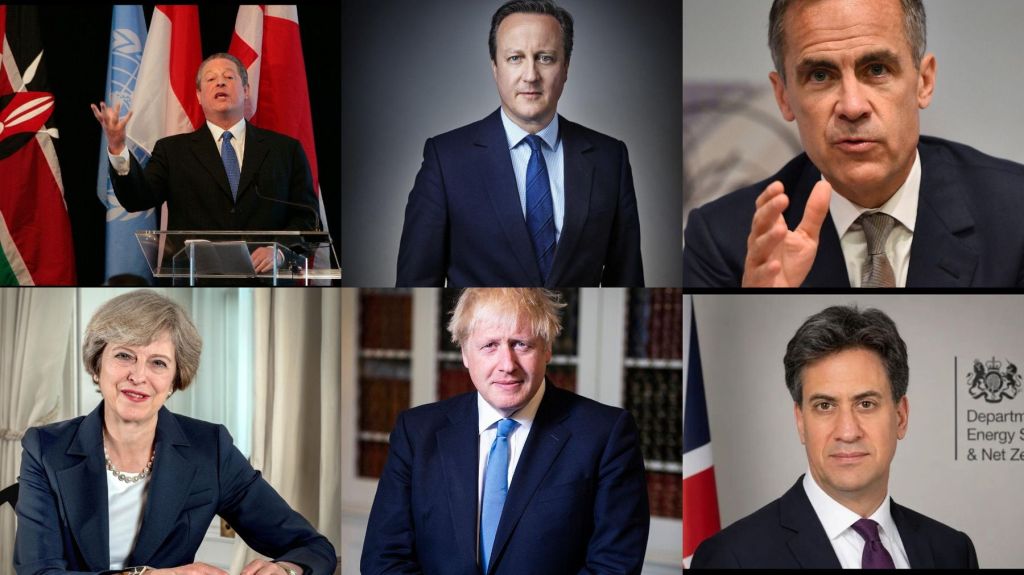
FROM GORE TO CAMERON, FROM MAY TO JOHNSON, AND BACK TO MILIBAND
That is the real story of the past twenty years.
Al Gore supplied the imagery and moral urgency.
David Cameron demonstrated that climate politics had become cross-party electoral territory.
Ed Miliband helped turn escalating carbon ambition into statutory architecture.
Greta Thunberg and the climate-emergency movement intensified the demand for urgency.
Theresa May transformed the 80% target into legally binding Net Zero.
Boris Johnson wrapped the project in the language of a Green Industrial Revolution and pushed it further.
And now Ed Miliband has returned to attempt Clean Power 2030 , potentially the most accelerated reconstruction of the British electricity system yet.
Different politicians.
Different parties.
Different decades.
But a remarkable continuity of policy.
For years, questioning the pace, cost or engineering assumptions behind that policy was too easily portrayed as questioning climate science itself.
That was a profound mistake.
Because climate science cannot tell Parliament what electricity mix provides Britain with the cheapest secure power.
It cannot decide how much industrial decline is acceptable.
It cannot determine whether a transmission project represents value for money.
It cannot decide whether Grade 2 farmland should carry solar panels.
It cannot tell a pensioner whether an energy bill is affordable.
Those are economic, engineering, social and political decisions.
And politicians are responsible for them.
THE RECKONING HAS ONLY JUST BEGUN
Twenty years after the photographs, speeches and promises began, Britain is finally in a position to judge the programme not by intentions but by outcomes.
We were promised a green industrial revolution.
We have instead watched major sections of energy-intensive industry contract.
We were promised cheaper energy.
Britain developed some of the highest industrial electricity prices in the developed world and households accumulated nearly £5 billion of energy debt.
We were promised greater resilience.
We now require an unprecedented transmission-building programme while paying to constrain renewable generation that the existing grid cannot always transport.
We were told the transition would create prosperity.
Families are paying almost 40% more for the food basket that cost £100 in 2020.
And the extraordinary part is that, confronted by mounting evidence that the engineering and economics have not kept pace with the political ambition, the response has repeatedly been the same:
Accelerate.
Perhaps, after twenty years, Britain needs to do something radically different.
Stop.
Audit what has actually happened.
Count the complete costs.
Measure the industrial losses.
Reassess security of supply.
Establish what firm generation the country genuinely needs.
Determine what grid infrastructure is physically deliverable.
And then build an energy policy around Britain’s needs rather than an inherited political timetable.
Because the great lesson of the past twenty years may prove remarkably simple:
A target can be written in an afternoon.
An energy system has to work every second of every day.
And Britain is beginning to discover the enormous cost of confusing the two.
Shane Oxer. Campaigner for fairer and affordable energy
 SAY NO TO THE DESTRUCTION OF OUR LAND
Leave a comment