Britain’s electricity grid needed renewal.
Britain’s power generation needed renewal.
Britain needed new nuclear capacity, new transmission infrastructure, new substations and a serious long-term plan for declining North Sea production.
The argument is not that Britain should have done nothing.
The argument is that Britain did things in the wrong order.
Since that fateful passage of the Climate Change Act in 2008, successive governments have increasingly designed energy policy around statutory emissions targets and deadlines.
The criticism is that subsidised intermittent generation was accelerated before the firm generation, storage and transmission infrastructure required to support the new system was ready.
In my view, that is where policy targets began to take precedence over common-sense system engineering.
We still need the gas
After billions of pounds of investment and years of renewable deployment, the Government’s own Clean Power 2030 plan expects Britain to retain around 35 GW of unabated gas capacity.
Why?
Because Britain still requires firm, dispatchable generation when renewable output is low.
The Government estimates that 40–50 GW of dispatchable and long-duration flexible capacity could be required by 2030, particularly during extended periods of low renewable generation. It says existing gas capacity remains crucial for electricity security and will continue to provide strategic backup. �
GOV.UK +1
That fact needs to be understood.
Wind generation is useful when the wind is blowing.
Solar generation is useful when sunlight is available.
But installed renewable capacity cannot simply be treated as equivalent to secure generating capacity.
When renewable output falls, something else must provide the electricity: gas, nuclear, storage, imports, demand reduction or another dispatchable technology.
So despite the enormous build-out of intermittent generation, Britain is still maintaining much of the firm generating capacity behind it.
That is not an argument that wind and solar produce no useful electricity. They plainly do.
It is an argument about whole-system cost and security.
If Britain has to construct enormous amounts of wind and solar while simultaneously retaining dispatchable generation, expanding storage, reinforcing the transmission system, constructing new substations and increasing interconnection, then the proper measure of cost is the cost of the whole system required to deliver reliable electricity, not merely the generating cost of an individual wind turbine or solar panel.
The infrastructure is now trying to catch up
This is where the situation becomes even more serious.
The National Audit Office reported on 11 September 2026 that delivering all the required transmission upgrades by 2030 will be “very challenging”.
Some projects are already forecast to arrive after 2030.
More importantly, the NAO says some new generation is likely to connect before the necessary grid upgrades are complete, increasing project and constraint costs borne ultimately by consumers. �
National Audit Office (NAO)
Think about what that means.
Britain’s old electricity infrastructure needed renewal.
Instead of renewing the secure system first and then adding generation as the infrastructure became capable of handling it, we have created a situation in which huge quantities of generation are being developed while the network needed to transport that electricity is still being built.
The Government itself estimates average energy investment of around £40 billion per year between 2025 and 2030 under the Clean Power programme. �
GOV.UK
That is why I describe the problem as targets before engineering.
The destination was determined politically.
The infrastructure is now being expected to catch up.
And gas still determines our vulnerability
Perhaps the biggest contradiction is that after nearly eighteen years of climate legislation, Britain remains enormously exposed to gas.
Gas still heats millions of homes.
Gas still supports British industry.
Gas remains one of the principal sources of dispatchable electricity when renewable generation falls.
Yet Britain has comparatively limited seasonal gas-storage capacity.
Centrica, which operates Rough , Britain’s largest gas-storage facility , warned this month that Rough was “practically empty” and said the UK remains particularly exposed to supply disruption and international price volatility.
Centrica says Rough represents around half of Britain’s gas-storage capacity. �
Centrica Plc +1
And now look at the live position.
At approximately 06:11 on 16 September 2026, the Terravolt system showed:
Combined Gas Storage: 28%
LNG Storage: 42%
Medium Range Storage: 53%
Long Range Storage: 0%
That is a live snapshot rather than proof that Britain is about to run out of gas. Britain has LNG terminals, pipelines and access to international markets.
But that is precisely the point.
We remain dependent upon those international markets.
And when international gas prices rise, British consumers remain exposed.
Now we head towards winter
Ofgem has already confirmed that its typical household price cap will rise 4% to £1,723 from 1 October 2026.
The average direct-debit gas unit rate rises from 7.33p/kWh to 7.97p/kWh. �
Ofgem +1
And the outlook for January is potentially much worse.
Bloomberg Economics is now forecasting that the January 2027 price cap could increase by around £427 — approximately 25% — taking the typical annual bill to roughly £2,150.
That remains a forecast, not the final Ofgem determination, and wholesale markets could move before the January cap is set.
But it is a warning that cannot simply be ignored. �
EnergyNow +1
So Britain approaches winter with:
an electricity network undergoing one of the largest rebuilding programmes in its history;
major transmission projects struggling against the 2030 timetable;
continued dependence on approximately 35 GW of gas-fired capacity for security;
poor seasonal gas-storage resilience;
high international gas prices;
an October household price-cap increase already confirmed;
and a Bloomberg Economics forecast suggesting a further increase of around 25% could follow in January.
This is the question Net Zero policy has to answer
Current wholesale increases are being driven heavily by geopolitical events and international energy markets.
Government supporters of the current strategy also make an important counterargument: greater domestic renewable generation should eventually reduce Britain’s exposure to imported fossil fuels and their volatile prices.
That is the case they make.
But after nearly eighteen years of climate legislation, the obvious question remains:
Why is Britain still so vulnerable to the price of gas?
If the objective was greater energy independence and protection from volatile fossil-fuel markets, why can another international gas shock still move so quickly into British household bills?
Why are we simultaneously:
building enormous quantities of intermittent generation;
retaining tens of gigawatts of gas generation;
building enormous quantities of new transmission infrastructure;
developing batteries and other flexibility;
remaining dependent upon imports;
and facing household bills potentially moving back towards levels associated with the previous energy crisis?
Those are legitimate questions about the design and sequencing of the transition.
Britain needed renewal , but it needed the right renewal
Britain’s electricity grid needed renewal.
Britain’s power generation needed renewal.
But renewal should have started with a very simple question:
What does Britain physically need to provide reliable, affordable and secure energy?
From there we could have determined the firm generation requirement.
We could have secured the gas needed during the transition.
We could have replaced ageing nuclear capacity.
We could have rebuilt strategic gas storage.
We could have strengthened the grid.
And then we could have introduced additional generation where it reduced whole-system costs without weakening security.
Instead, the criticism of the current pathway is that Britain began with a legally determined emissions destination and then expected the electricity network, generating system, planning system, supply chains, consumers and countryside to conform to the timetable.
The consequences are increasingly visible.
The transmission system is struggling to catch up.
Firm gas generation remains essential.
Long-duration low-carbon alternatives are not yet deployed at sufficient scale to replace it.
Gas storage remains weak.
Consumers remain exposed to international fuel markets.
And the cost of rebuilding the entire system continues to rise.
That is why the central debate should no longer be reduced to whether somebody is “for” or “against” renewable energy.
The much more important question is:
DID BRITAIN PUT THE TARGET BEFORE THE ENERGY SYSTEM NEEDED TO DELIVER IT?
Britain needed an energy transition.
What remains open to serious scrutiny is whether we chose the right transition, in the right order, at a cost consumers could afford.
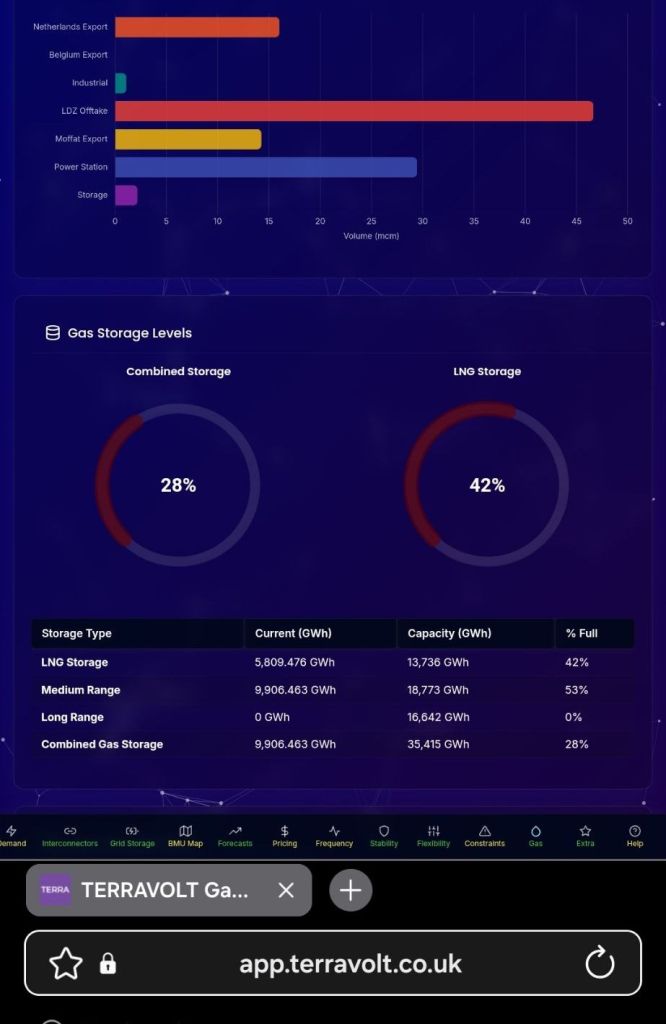
Live Terravolt gas-system data at approximately 06:11 on 16 September 2026 showing Combined Gas Storage at 28%, LNG Storage at 42%, Medium Range at 53% and Long Range at 0%.
Shane Oxer. Campaigner for fairer and affordable energy
 SAY NO TO THE DESTRUCTION OF OUR LAND
Leave a comment