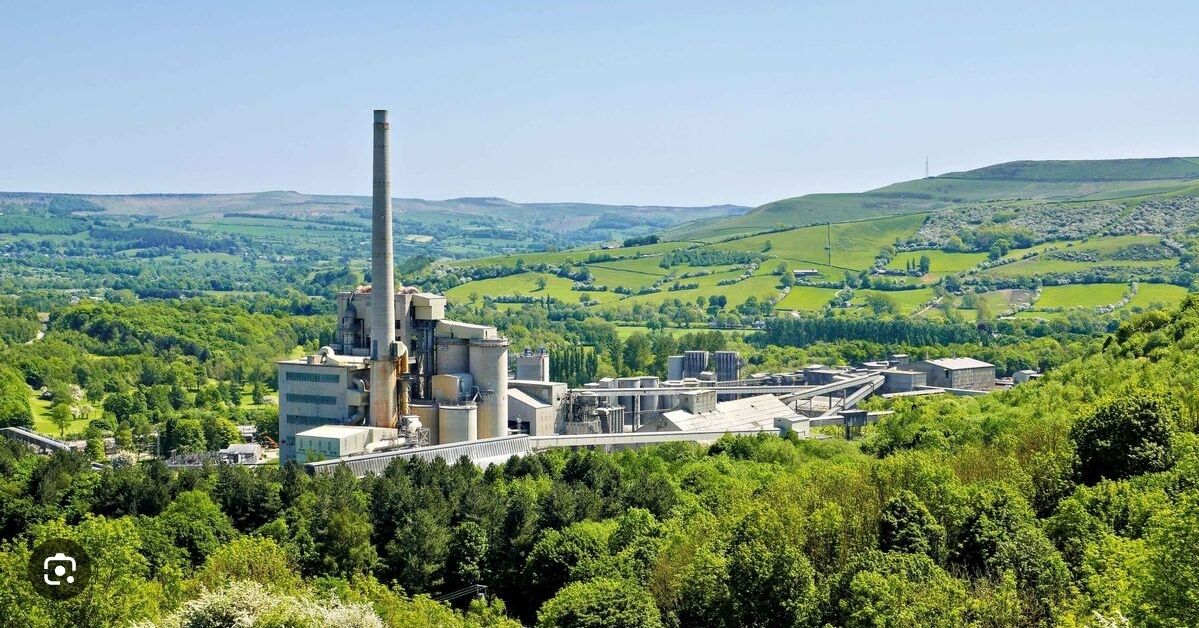
a beautiful view about to be destroyed by a experiment in ideology
The Peak Cluster carbon-capture scheme is being presented as a £59.6 million project intended to protect British cement and lime production.
That description is deeply misleading.The £59.6 million is only the development-stage funding required to advance the scheme through engineering, planning and towards a possible final investment decision.
Almost half of it £28.6 million , has already come from the taxpayer-owned National Wealth Fund.
Peak Cluster’s own website says that the pipeline and associated Morecambe carbon-storage project would together attract approximately £5 billion of investment.
This is therefore not a modest £59.6 million environmental project.
It is the opening stage of an enormous new industrial system involving capture equipment at four cement and lime works, compression facilities, above-ground installations, approximately 200 kilometres of new pipeline and an offshore network carrying carbon dioxide into former gas fields beneath the Irish Sea.
The pipeline corridor would cross Derbyshire, Staffordshire, Cheshire and the Wirral. Farms, communities and countryside would face years of surveys, uncertainty, compulsory acquisition risk and construction disturbance.
All of this would be undertaken , not to produce a single extra tonne of cement, generate electricity or improve Britain’s physical energy security,but to satisfy carbon targets imposed through government policy.
Cement production does present a genuine technical problem because carbon dioxide is released chemically when limestone is processed. But that does not justify an undisclosed financial commitment or give the Government a blank cheque to carve an experimental carbon-disposal network across four counties.
Before this scheme proceeds, the public deserves the full account.
What is the complete construction cost?
How much public money will be required?
Who will pay the pipeline and storage charges?
How much additional energy will capture and compression consume?
What happens if the capture plants underperform, the pipeline is delayed or the offshore store becomes unavailable?
Who carries the long-term liability once millions of tonnes of carbon dioxide have been injected beneath the seabed?
The Government’s own industrial carbon-capture model shows why these questions matter.
It allows Exchequer-funded contracts lasting up to 15 years, with payments capable of covering operating expenditure, transport and storage charges, repayment of capital expenditure and a return for investors.
In other words, the taxpayer may help develop the project, help make the investment commercially viable and then continue supporting its operation.
Meanwhile, communities are expected to accept the disruption, landowners are expected to live with uncertainty and the countryside is expected to accommodate yet another vast infrastructure corridor created to meet Net Zero targets.
Peak Cluster should not receive approval on promises, headlines and carefully selected job figures. Its promoters and the Government must publish the full capital cost, the anticipated public subsidy, the energy requirement, the realistic capture performance, the safety case and the complete lifetime liability.
Once again, Britain is being asked to commit the landscape and the public purse before the evidence has been placed openly before the people expected to pay the price.
Shane Oxer. Campaigner for fairer and affordable energy
 SAY NO TO THE DESTRUCTION OF OUR LAND
Leave a comment