
The same Alverdiscott grid point once intended to receive 3.6GW from Morocco is now being promoted for one of Europe’s largest AI campuses. Xlinks says there is “spare, highly reliable capacity”. Yet the public record still does not show a separately named 1.5GW data-centre connection, a clearly identified 1.8GW campus-battery agreement, the battery’s duration, quantified water demand or the complete infrastructure bill.

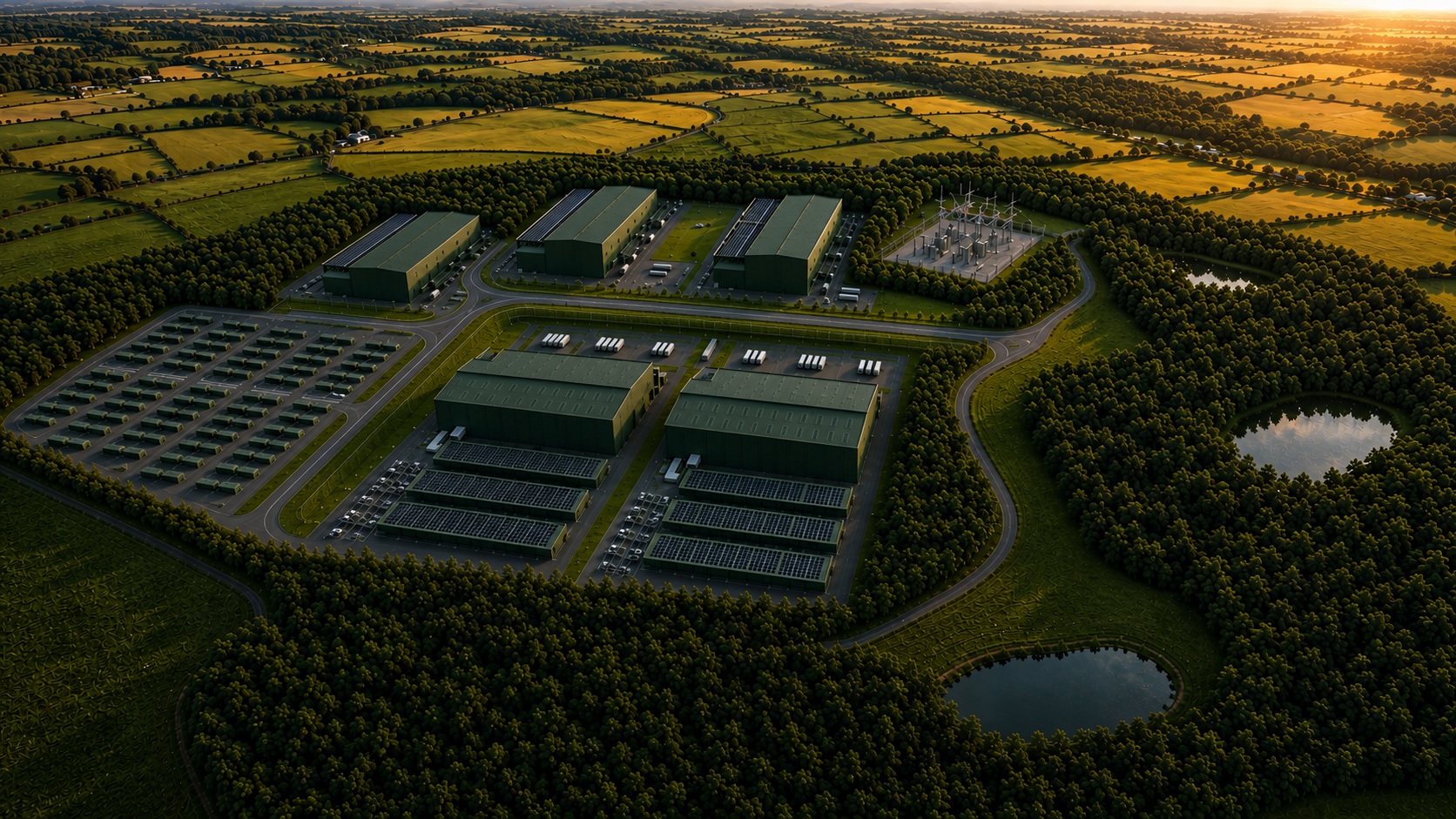
Xlinks’ illustrative aerial visualisation of the proposed Devon data campus. This is a promotional image, not a photograph or final approved design. It shows data halls, a battery compound, a substation, internal roads, security areas and landscaping set within the North Devon countryside. Image: Devon data campus/Xlinks.
First, the plan was to bring electricity into Britain.
Now, the plan is to consume it in North Devon on a power-station scale.
At Alverdiscott, between Great Torrington, Huntshaw and Weare Giffard, Xlinks is proposing an AI data-centre campus with up to 1.5GW of compute capacity and a separate 1.8GW battery-energy-storage system.
The developer places the capital investment at £12.2–£13.8 billion and says the campus could become one of the largest of its kind in Europe.
Campaigners say the complete site would cover approximately 850 acres of countryside, including a 96-acre battery compound, with five vast data-centre buildings reaching up to 40 metres.
Those are extraordinary figures.
But the most important numbers are the ones the public still cannot see.
Where is the firm electricity-import agreement for the data centre?
What is the campus’s total electrical demand once cooling, pumps, lighting, losses and other supporting systems are included?
How many gigawatt-hours can the 1.8GW battery actually store?
Can the data centre and battery import simultaneously — and if so, what is the maximum combined demand?
Which parts of the grid works designed for the Morocco interconnector would survive, which would change, who would pay for them, and what would be added?
And where is the complete public account of the land, water, grid, backup, replacement and decommissioning consequences?
NO GIGAWATT DATA CENTRE WITHOUT A GIGAWATT POWER PLAN.
FROM 3.6GW INTO BRITAIN — TO 1.5GW OUT OF THE GRID
The history matters.
Xlinks’ original Morocco–UK Power Project proposed approximately 7.5GWp of solar generation, 4GWp of wind and 22.5GWh of battery storage in Morocco.
Up to 3.6GW would be transmitted to Britain through an offshore route of approximately 4,000 kilometres, landing in North Devon and connecting at Alverdiscott.
The company’s own environmental report showed the complete chain: generation, storage and converter stations in Morocco; thousands of kilometres of high-voltage direct-current cables; a Devon landfall; a 14.5-kilometre onshore cable corridor; converter stations; alternating-current cables; and a new connection at Alverdiscott.

The original Morocco–UK route: 3.6GW of power was intended to travel approximately 4,000 kilometres before entering Britain through converter and grid infrastructure in North Devon. Image: Xlinks Morocco–UK Power Project. The detailed infrastructure chain appears in the project’s Preliminary Environmental Information Report.
On 26 June 2025, the Government announced that it would not continue considering support for the project through the requested 25-year Contract for Difference.
Its official statement said the proposal did not clearly align with the aim of building home-grown power, carried a high level of cumulative delivery, operational and security risk, and faced stronger alternatives at lower risk to billpayers and taxpayers.
Read the Government’s statement
That was not a cancellation of the company or the connection agreements.
Xlinks says the decision left the Morocco project without an off-take route, that it continues to explore alternatives, and that the project retains grid-connection agreements near Alverdiscott.
Read Xlinks’ current Morocco project account
Now the same corporate group is promoting the Devon data campus at the same strategic grid location.
This does not prove that the Morocco infrastructure has simply been transferred to the data centre.
It proves that the public needs a precise explanation of what is being retained, repurposed, amended or newly requested.
That explanation has not yet been published as one reconciled power plan.
850 ACRES OF COUNTRYSIDE
The developer’s live website does not currently state the total acreage or maximum building heights on its main project page.
Devon CPRE says information presented during early meetings identified:
- a total development area of approximately 850 acres;
- five data-centre buildings up to 40 metres high;
- a 96-acre, 1,800MW battery compound;
- an IT load of 1.5GW and a peak site load of 1.8GW;
- around 10 per cent Grade 3a agricultural land, with most of the remainder Grade 3b; and
- a construction period then expected to run from 2028 to 2034.
Read Devon CPRE’s account of the figures
The distinction between the data centre and the battery is important.
Xlinks says they are two separate projects, each capable of being built and operated independently, and each intended to have its own planning application.
Yet they are promoted together as a single campus and would both connect to the National Grid at Alverdiscott, while also being linked to each other through a private underground energy network.
That means the cumulative assessment must not stop at the boundary of either application.
The public needs to see the complete campus, complete grid connection and complete operating case.

The countryside around Huntshaw, within the wider area identified for the proposed campus. Xlinks’ updated location plan shows a large central data-centre, landscaping and potential community-facility area, with the separate battery site to the north-east; the developer says an earlier version of that plan contained inaccuracies. Photograph: Lewis Clarke/Geograph, CC BY-SA 2.0. View the developer’s current plan.
1.5GW IS NOT A NORMAL BUSINESS CONNECTION
The headline figure is 1.5GW of AI-optimised compute capacity.
One gigawatt is one thousand megawatts.
If a 1.5GW IT load operated continuously at full capacity for a year, the arithmetic would be:
1.5GW × 8,760 hours = 13.14TWh of electricity.
That is not a prediction of the campus’s actual annual consumption. Occupancy, utilisation and operating load would vary, and the development has not yet published a complete demand profile.
It is a transparent stress test of what the advertised capacity means at full use.
The comparison is remarkable.
The Government’s latest electricity statistics estimate that all data centres in Great Britain consumed 4.5TWh from the grid in 2024.
So the proposed campus’s 1.5GW IT load, if continuously used, would consume almost three times the annual grid electricity used by Britain’s entire data-centre sector in 2024.
It would also equal approximately 4.5 per cent of all electricity generated in the UK in 2025.
Using Ofgem’s current medium typical domestic electricity consumption of 2,700kWh a year, 13.14TWh is equivalent to the annual electricity used by approximately 4.9 million typical households.
Again, this is an arithmetic comparison — not a forecast and not a claim that homes and data centres have identical demand patterns.
But Parliament cannot call 1.5GW a detail.
And 1.5GW may not be the top of the site’s demand.
Servers are not the only electrical load. Cooling, fans, pumps, power conditioning, lighting, security, network equipment and electrical losses all require energy.
Devon CPRE says Xlinks identified a 1.8GW peak site load during its early engagement.
At full continuous use, 1.8GW would represent 15.77TWh a year — more than three times Great Britain’s entire 2024 data-centre consumption and approximately the annual electricity use of 5.8 million typical households.
Read the Government’s 2026 electricity statistics
Read Ofgem’s current typical-consumption benchmark
“SPARE CAPACITY” IS A CLAIM — THE CONNECTION CASE IS THE EVIDENCE
Xlinks says the location benefits from “spare, highly reliable capacity at Alverdiscott substation” and a robust National Grid connection.
That is the developer’s case.
But a substation’s existence is not, by itself, proof of a complete, firm and deliverable 1.5GW-plus demand connection.
The latest public National Energy System Operator registers tell a more complicated story.
The 24 September 2026 Interconnector Register still lists two Xlinks 1 Ltd projects at Alverdiscott:
- Alverdiscott — 1,800MW, effective 30 August 2030;
- Alverdiscott 2 — 1,800MW, effective 30 August 2032.
Both are marked “Scoping” and both show zero current capacity.
Together, those are the two 1.8GW connection agreements behind the proposed 3.6GW Morocco scheme.
Examine the live NESO Interconnector Register
The latest public Transmission Works Register is equally revealing.
For the first 1.8GW Xlinks agreement, project PRO-001344, it lists:
- new cables between a new 400kV substation building and the existing transformers;
- rebuilding Alverdiscott into an adjacent double-busbar arrangement;
- reconfiguring overhead lines;
- uprating several wider transmission circuits; and
- works explicitly described as enabling the “generation connection of 1.8GW for Xlinks at Alverdiscott”.
Download the NESO Transmission Works Register
That is a published works package for bringing generation into the system.
It is not a published, separately identified works package for supplying a 1.5GW AI data centre and connecting a 1.8GW campus battery.
In the public registers examined for this investigation, there is no separately named Valeon project at Alverdiscott, no clearly identified firm 1.5GW data-centre import agreement, and no separately named 1.8GW Devon campus battery connection.
That does not prove that no applications, amendments or commercially confidential discussions exist.
Nor does it mean that Alverdiscott has no electricity supply or no potential capacity.
It means the publicly available evidence still does not allow residents to reconcile the promotional claim with a complete connection case.
The developer should publish:
- the project number and connection date for the data-centre demand;
- the maximum firm import capacity in MW and MVA;
- whether the connection is firm, interruptible or phased;
- the separate project number and import/export rights for the campus battery;
- the maximum permitted simultaneous import of the data centre and battery;
- the transformers, bays, cables and wider reinforcements required;
- which Morocco-related works remain necessary;
- who pays each element; and
- a clear single-line diagram of the final arrangement.
Without that, “spare capacity” remains a headline rather than a public engineering account.

Existing pylons crossing the countryside near Huntshaw, within the area of the proposed campus. The issue is not whether electricity infrastructure already exists; it is whether the public has been shown the complete new demand, reinforcement and cost case. Photograph: Lewis Clarke/Geograph, CC BY-SA 2.0.
A 1.8GW BATTERY — BUT FOR HOW LONG?
A battery’s power rating tells us how quickly it can charge or discharge.
It does not tell us how much energy it can store.
The missing number is the battery’s capacity in megawatt-hours or gigawatt-hours.
For a 1.8GW battery:
| Assumed duration | Stored energy | Theoretical time supporting a 1.5GW load before losses |
|---|---|---|
| 1 hour | 1.8GWh | 1.2 hours |
| 2 hours | 3.6GWh | 2.4 hours |
| 4 hours | 7.2GWh | 4.8 hours |
| 8 hours | 14.4GWh | 9.6 hours |
These are illustrations, not claims about the proposed equipment.
Xlinks has not stated the battery’s duration on the main public project page.
Without that figure, nobody can test the claim that the battery would help underpin the campus’s reliability during a grid disruption.
A battery is not a source of primary energy.
It must first be charged.
If a 1.8GW battery were able to charge at full power while a 1.5GW compute load was also operating, the combined import could theoretically reach 3.3GW before the rest of the campus load and losses.
That is not a forecast that it will happen. The connection may cap, phase or control simultaneous demand.
But the public material should say so.
It should also disclose expected cycling, degradation, augmentation, replacement, fire-water arrangements, emergency access, end-of-life treatment and the lifetime cost of maintaining 1.8GW of storage.
£13.8 BILLION IS NOT THE COMPLETE SYSTEM BILL
Xlinks estimates capital investment of £12.2–£13.8 billion.
It also forecasts:
- 2,000–3,500 construction jobs;
- 600–1,200 permanent operational roles; and
- an annual economic contribution of approximately £3.3–£3.6 billion.
Read the developer’s investment claims
Those figures deserve examination.
But an estimate of capital invested in a development is not the same as a reconciled account of what the complete energy system will cost.
The public still needs to know whether the £12.2–£13.8 billion includes, excludes or only partly includes:
- the full 1.8GW battery and its energy duration;
- replacement battery cells and power electronics over the campus life;
- the final Alverdiscott substation design;
- wider transmission reinforcement;
- private underground cable routes;
- backup generation or other resilience systems;
- cooling plant and water infrastructure;
- network charges and financing costs;
- landscape mitigation and habitat management;
- fire and emergency-service provision; and
- eventual decommissioning and land restoration.
It must also identify which costs fall on the developer, its customers, the network, electricity consumers or taxpayers.
An annual economic-contribution estimate is not a substitute for that ledger.
“LESS WATER” IS NOT A WATER PLAN
The developer says North Devon’s climate means the site would use less energy and water than many other locations.
It also refers to attenuation ponds intended to reduce freshwater use.
But the current public page gives no quantified figure for:
- average daily water demand;
- peak summer demand;
- the proposed water source;
- drinking-water versus non-potable requirements;
- drought restrictions;
- wastewater and discharge arrangements; or
- the water embodied in the electricity supplying the campus.
The Government’s own report on water use in AI and data centres warns that cooling and electricity generation can create a significant water footprint and that existing water-resource plans do not adequately account for rapidly growing AI infrastructure.
Read the Government-hosted report
Different cooling designs can produce radically different results.
That is precisely why generic assurances are not enough.
North Devon needs the site-specific litres-per-day figure before consent, not after construction.
A UNESCO BIOSPHERE IS NOT AN EMPTY SPACE ON A GRID MAP
The proposed campus lies within the North Devon UNESCO Biosphere Reserve.
In September, UNESCO confirmed that the compatibility of the proposal with sustainable-development objectives would be relevant to the continuing assessment of the area’s classification.
The North Devon Biosphere Partnership has said it is assessing the environmental and economic implications and currently neither supports nor opposes the scheme.
Read the Independent Bulletin account
The site is not an abstract parcel beside a convenient substation.
It is farmland, hedgerows, valleys, lanes, homes, habitats and a tourism landscape.
If the development is genuinely capable of being screened, that should be demonstrated from representative viewpoints against the full 40-metre maximum height — not merely through a sunset visualisation surrounded by mature woodland.
If the landscape can absorb 850 acres of industrial development, the evidence should show it.
If it cannot, no amount of green shading on a site map changes that fact.
THE CONSULTATION IS STILL MOVING
The developer’s live website says the consultation has been extended.
Public Information Days originally planned for July were postponed, new dates remain to be announced, and separate planning applications for the data centre and battery are now expected “in the new year”.
Read the current consultation information
That gives Xlinks an opportunity to publish the missing evidence before residents are asked to respond to final proposals.
The standard should be simple:
Show the power plan. Show the water plan. Show the grid works. Show the duration. Show who pays.
MAKE THEM SHOW THE EVIDENCE
My Parliamentary petition asks Parliament to suspend Climate Change Act targets and undertake a full independent national impact assessment of the statutory programme.
The Devon proposal shows why that assessment cannot look only at power generation.
Britain is simultaneously electrifying transport and heating, closing firm generating capacity, expanding intermittent renewables, building batteries and encouraging gigawatt-scale AI demand.
Those decisions meet on the same grid.
The assessment must therefore include:
- the electricity generation required for new industrial demand;
- the network and substation reinforcement;
- storage measured in both MW and MWh;
- firm capacity, backup and resilience;
- water supply and drought consequences;
- agricultural land, habitats and landscape;
- lifecycle replacement and decommissioning;
- the allocation of costs between developers, consumers and taxpayers; and
- the cumulative effect on bills and energy security.
Devon is being asked to accept the land take now while the most important system questions remain unanswered.
That is the wrong order.
✍️ SIGN THE PARLIAMENTARY PETITION — MAKE THEM SHOW THE EVIDENCE
If you agree that no gigawatt-scale development should proceed without a complete and independently tested power plan, please sign and share the petition.
Whatever your view of AI, data centres or Net Zero, North Devon deserves more than promotional capacity claims.
It deserves the complete evidence and the complete account.
Shane Oxer
Campaigner for fairer and affordable energy
PRINCIPAL SOURCES
- Devon data campus — current proposal and consultation
- Xlinks — Devon data campus investment and employment claims
- Xlinks — Morocco–UK Power Project and retained Alverdiscott connection agreements
- UK Parliament — Government decision on support for the Morocco–UK project, 26 June 2025
- Xlinks — Morocco–UK Preliminary Environmental Information Report
- NESO — live Interconnector Register
- NESO — Transmission Works Register
- NESO — live Transmission Entry Capacity Register
- DESNZ — Digest of UK Energy Statistics 2026, Chapter 5
- Ofgem — typical domestic electricity consumption benchmark
- Devon CPRE — early project scale and load information
- Government-hosted report — Water use in AI and Data Centres
- Independent Bulletin — North Devon UNESCO Biosphere questions
- Geograph — Huntshaw countryside and pylons
Leave a Reply