
MAKE THEM SHOW THE EVIDENCE
£258 BILLION
The illustrative gross installation bill for twenty million heat pumps at unchanged median benchmark prices. Wider network costs need separate accounting. This is not a complete UK transition bill.
Heat pumps and EVs need suitable homes, workable electricity connections and money households can actually find. A national target delivers none of those by itself.
Shane Oxer · 9 October 2026 · Opinion supported by published evidence

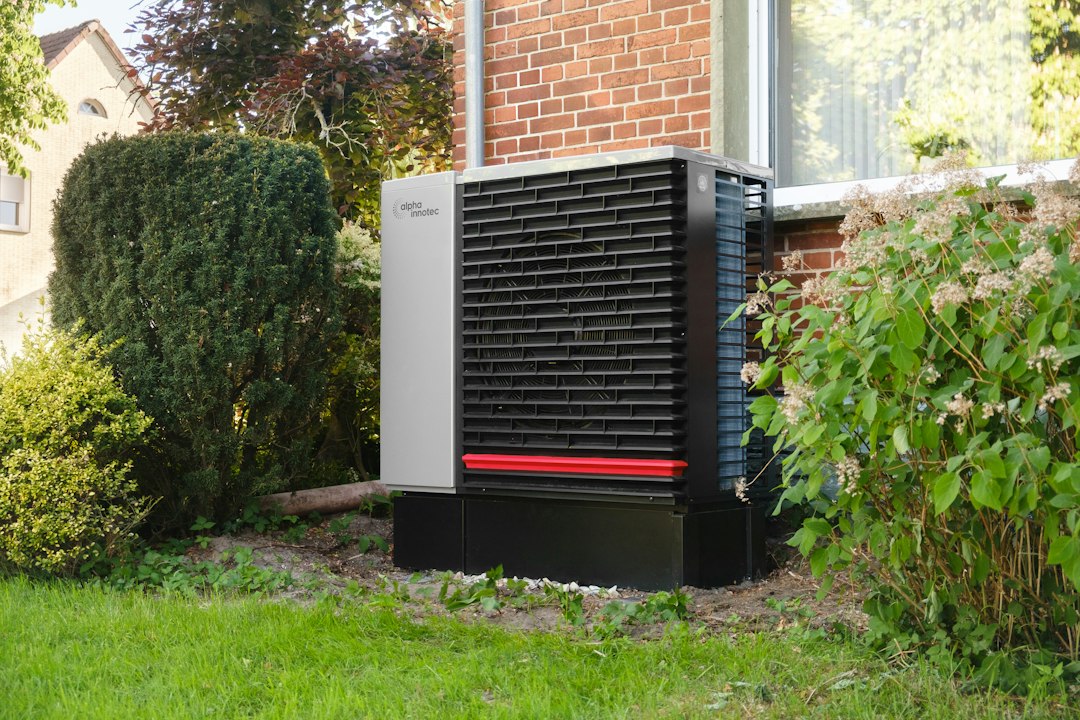
Illustrative heat-pump installation. Space, siting and the electricity supply must be assessed for each home. Photo: alpha innotec / Unsplash.
THE HOUSEHOLD IS WHERE THE PLAN MEETS REALITY
The Climate Change Committee recommends the pace of change. DESNZ designs policies and funding to deliver it. Households then face the installation, disruption and bill.
That is why their programme can seem detached from reality. A national pathway has to survive a much harder test: will it work in this house, on this electricity supply, at a price this family can afford?
A TWENTY-SIX-FOLD LEAP NEEDS MORE THAN AMBITION
Official figures recorded 53,263 certified domestic heat-pump retrofits in 2025. The CCC recommends around 1.4 million annually by 2035.
That requires roughly a twenty-six-fold increase. Installers, surveyors, electricians, equipment suppliers and network crews must all keep up. Publish the delivery programme—and what happens when it falls behind.
£258 BILLION FOR TWENTY MILLION INSTALLATIONS
At the published median installation price, one million heat pumps represent approximately £12.9 billion.
Against a £3,500 gas-boiler replacement benchmark, the additional upfront capital is approximately £9.4 billion per million installations.
Twenty million installations at unchanged benchmark prices would mean roughly £258 billion gross. That is an illustration, not a national forecast—and wider network investment still needs its own account.
THE GRANT MOVES THE BILL
The median installation leaves a household paying £5,408 after the standard £7,500 grant, where eligible. Exceptional property work can increase that amount.
Taxpayers fund the grant. Households fund the balance. The installation still has to be paid for.
Nor can every home accept the same solution. Space, hot-water storage, radiators, permissions, tenure and electrical capacity all affect the work required.
THE HEAT PUMP AND EV SHARE THE SAME ELECTRICITY SUPPLY

Illustrative United States substation. Additional heating and charging demand needs local network capacity checks. Photo: American Public Power Association / Unsplash.
Government research estimates that 3.1–4.7 million properties in Great Britain have looped electricity supplies.
One DNO reported £2,500–£6,000 per unlooping job. One million such jobs would therefore represent £2.5–£6 billion. Complex jobs can cost more.
But properties are not jobs. The engineering quantities must be established, and costs already funded through network allowances must be counted once.
Cables, feeders and substations need assessed capacity and dated upgrade programmes. A grant approval is no substitute for an adequate connection.
THE CCC'S OWN QUALIFICATIONS UNDERCUT THE SALES PITCH
The CCC acknowledges that many households would face additional lifetime costs by switching to a heat pump alone under current conditions.
Its stronger savings cases can depend on solar panels and flexible tariffs. It also acknowledges that some households cannot access those options.
Those qualifications belong beside every headline promise of savings. A family cannot spend a benefit that depends on equipment, space or flexibility it does not have.
EV CHARGING HAS AN ACCESS PRICE

Access to affordable charging affects the household calculation. Illustrative photograph: CHUTTERSNAP / Unsplash.
The CCC says about one-third of homes lack off-street parking. That matters when cheaper charging depends on a driveway.
A home charger costs around £1,000 to buy and install under the Energy Saving Trust's guide. One million new installations would therefore represent approximately £1 billion, before major supply upgrades.
Public charging sites need their own equipment, connections, land and construction. Show the cost and availability for households without home charging.
THIS IS DECADES OF WORK
For an illustrative twenty million retrofits, one million installations a year means twenty years. Half a million annually means forty years.
That excludes the initial build-up to those rates. These are throughput calculations, not predicted completion dates.
A credible timetable must show annual output, workforce capacity, equipment availability and local network readiness. Writing 2050 at the end of a chart does not demonstrate any of them.
THE TREASURY ALSO HAS A BILL TO REPLACE
Fuel duty raised £24.6 billion in 2025/26. It will not disappear overnight, and it covers more than private cars. But electrification changes that revenue base.
The proposed EV mileage charge shows that Government recognises the problem. The remaining test is whether replacement taxes, charging costs and network charges leave the promised household savings intact.
Publish the revenue bridge alongside the household calculation. A tax adjustment must not be hidden from the affordability argument—or added to equipment costs as though it were another purchase.
MAKE THEM SHOW THE EVIDENCE
CCC and DESNZ should put their models, assumptions and delivery plans through independent scrutiny. Parliament needs the costs, the infrastructure, the timescale and the consequences for households with restricted options.
Until those national calculations are reconciled with funded local delivery, scepticism is justified.
Before households are asked to change their homes and cars, make the institutions demonstrate that their programme is affordable and deliverable.
Evidence and calculation note
Evidence note: Figures checked for the scrutiny files on 9 October 2026. Heat-pump prices are from England and Wales BUS redemptions in April–June 2026; the boiler comparator is an indicative Energy Saving Trust benchmark, not a matched quote. Twenty million installations is an illustrative volume. Capital scaling holds benchmark prices constant and excludes finance, maintenance, future replacements and operating savings. Unlooping prices are reported job examples, not universal quotations. Existing network allowances and capital grants must not be added again to gross installation costs. This article does not establish a 100-year minimum transition or that heat pumps and EVs are universally unsuitable.
Sources
CCC: 2026 progress report and household analysis
Energy Saving Trust: boiler costs
DESNZ: looped supplies and unlooping
Leave a Reply