
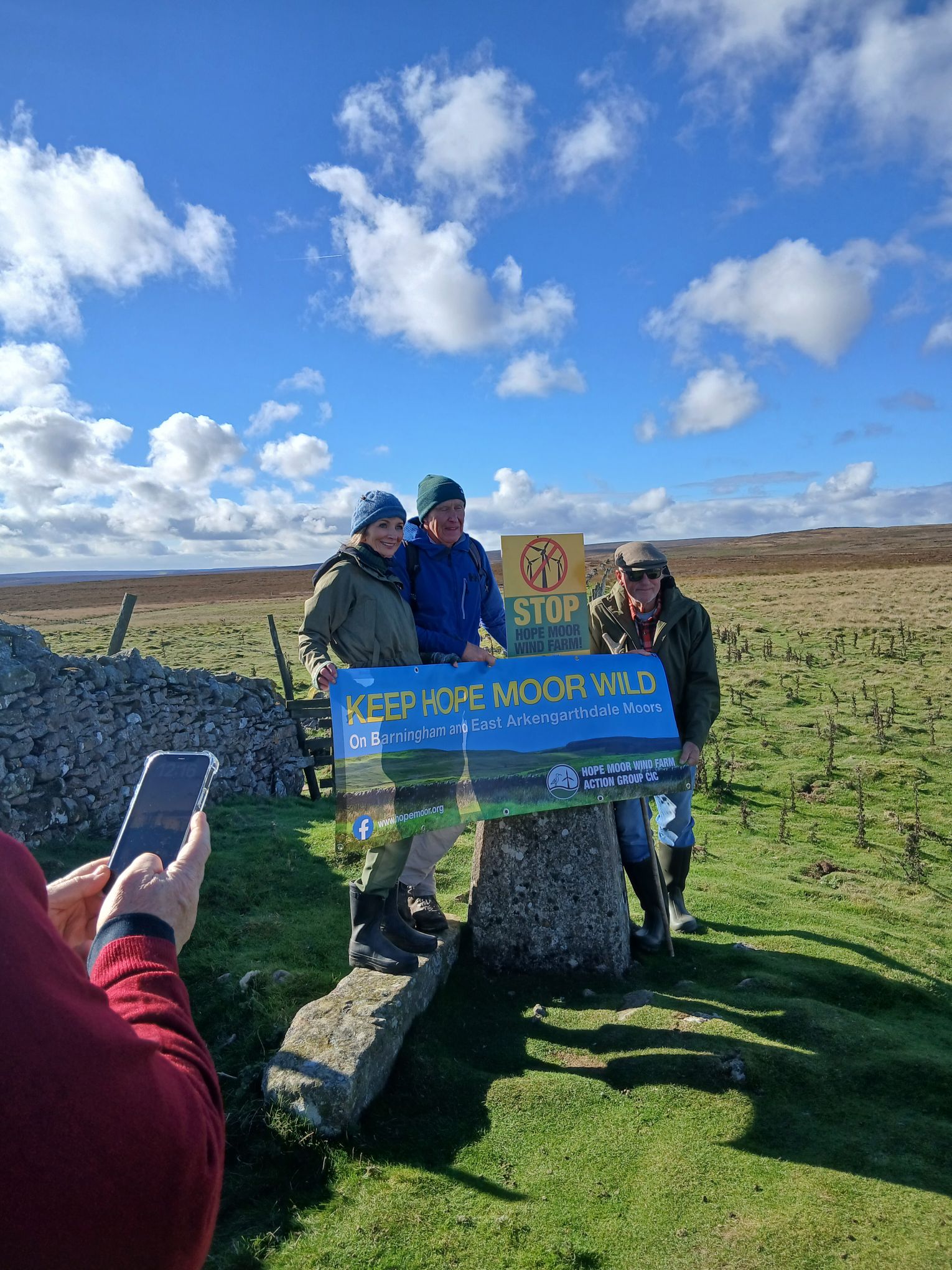
Led by Lord Ian Botham, organised by Suzy Wilson and joined by mountaineer and environmentalist Alan Hinkes OBE, today’s walk brought the campaign onto the moor itself.
Today I walked in memory of a courageous lady — Mary Elizabeth Mann.
I have written before about her determination to defend Barningham Moor and challenge the powerful interests promoting wind development. Walking there today brought that earlier struggle back into focus.
Mary understood that a landscape can be defended when ordinary people gather the evidence and refuse to be brushed aside. Today, hundreds came to stand up for this one.

Hundreds on the moor.
One clear message.
Suzy Wilson deserves real credit for organising today’s walk. Bringing people together takes work, persistence and a belief that the countryside is worth the effort.
Lord Ian Botham led the walk, bringing national attention to a campaign rooted in this place. Alongside him were people prepared to give their Sunday to protecting it.
At the trig point, Suzy, Lord Botham and Alan Hinkes OBE stood with a banner that put the case plainly:
KEEP HOPE MOOR WILD.
Those four words were backed by the landscape around us: the wide views, the stone walls, the rough ground and the open sky.

Alan Hinkes: a voice for the environment
Alan Hinkes OBE’s presence deserves particular recognition. An exceptional mountaineer, he is also an environmentalist, with a lifetime of experience in mountains and open country.
That matters. The landscape, its wildlife and the experience of being outdoors all belong in the environmental argument.
The Hope Moor Action Group records his view that this remote moorland is the wrong location for a development of this scale.
For me, his involvement reinforces a principle that should guide every decision here: protecting the environment means taking the place itself seriously.

23 turbines.
Up to 200 metres high.
Fred. Olsen Renewables’ current design proposes 23 turbines.
Their proposed maximum height is 200 metres to the blade tip.
That scale deserves close scrutiny. Standing on the moor, it is easier to understand why people want proper evidence of what the development would mean for the views, the ground beneath it and the countryside around it.
The site lies outside the Yorkshire Dales National Park, close to its north-eastern boundary. The Park Authority has asked for fuller assessments of effects on landscapes, tranquillity, wildlife, heritage and the visitor economy.
These are substantial questions. They need answers while the proposal can still change.


Excavation. Steel. Concrete.
The work beneath the turbine.
The proposed turbines would reach up to 200 metres at the highest blade tip. That is the overall maximum height, including the blades.
The supplied construction photographs bring another part of the development into view: the work needed beneath a turbine. The excavation screenshot appears in the peatland section below.
The supplied screenshots come from a separate project described as being near Wick, in Caithness. They show excavation and ground preparation, cable ducts, steel reinforcement, formwork and concrete pours.
These pictures make the engineering visible. They also make clear why communities need to see the construction plans alongside illustrations of turbines on the skyline.
The height of the Wick turbines has not been verified. Neither have the foundation dimensions or material quantities shown here. The pictures illustrate a construction sequence; they do not establish the design or footprint proposed for Hope Moor.
For Hope Moor, publish the site-specific foundation plans. Show the excavation areas and depths, the quantities of concrete and steel, the access roads, drainage works and the land needed during construction.
Show what the ground surveys say about peat, habitats and water. Then explain the restoration commitments, how they would be enforced and who would pay.
Two hundred metres above the ground is only part of the story. The public deserves the whole picture.
Imagine this excavation on peatland

Look at the excavation in these photographs. Then imagine works of this kind cutting into peatland.
Turbines proposed at up to 200 metres high bring a construction footprint: foundations, crane areas, access roads, cable trenches and drainage. Where those works cross peat, the consequences need to be assessed together.
Peat stores carbon. Excavating it, or draining the ground around it, can release that carbon and damage the habitat. The disturbance can extend beyond the hole itself through changes to the way water moves across the moor.
The Scottish Government’s research explicitly accounts for carbon lost from excavated peat and surrounding areas affected by drainage.
And NatureScot warns that putting excavated peat back over earthworks is not, by itself, enough to restore a functioning peatland habitat or protect its carbon.
For Hope Moor, publish the peat-depth surveys alongside every proposed foundation, road, crane area and cable trench. Show how much peat would be removed, where drainage would change and how the habitat would be protected. Then demonstrate that the restoration promises can work.
A promise to protect the climate must face scrutiny of what happens to the ground beneath our feet.
Source of the supplied construction photographs: Facebook post shared by Shane Oxer. These are illustrations from a separate project, not photographs of works at Hope Moor. The exact location, soil type, dimensions and turbine height have not been independently verified; the photographs do not establish Hope Moor’s foundation design or peat impacts.
Show us the whole development
The turbines are part of a much larger construction project. Access routes, construction areas and electrical connections also need to be understood.
On its own website, the developer says the grid connection point will be confirmed later. It says the connection route and method will be pursued through a separate application.
That leaves communities asking how the pieces will fit together. Where would the electricity go? What additional works would be required? What land would they affect?
Show the roads and the largest deliveries. Show the construction areas. Show the electrical equipment and the connection route.
Then show what it costs, what is included, what is missing and who pays.
The developer promises landscape and habitat mitigation. Those promises need to be tested against the surveys, the final design and enforceable commitments.
The view beyond the moor

One of today’s photographs appears to pick out wind turbines and larger industrial structures on the distant skyline. The haze prevents a reliable identification of any particular power station.
For me, that view underlines why the combined effect of developments matters. Each proposal should be assessed alongside the infrastructure already there and other schemes being planned.
The National Park Authority has specifically asked for a wider assessment of views and the cumulative effects of other proposed wind developments. The public should be able to see that evidence before decisions reshape another horizon.
Mary’s lesson still holds
Writing about the earlier Barningham campaign, Mary put it simply: “Truth was our strength.”
That is the lesson I carried onto the moor today. A successful campaign needs people willing to read, question and persist. It needs evidence that can be checked.
My thanks to Suzy, Lord Botham, Alan and everyone who helped organise the day or came to walk. Today’s turnout gave this landscape a public voice.
Mary stood up for Barningham Moor. Today, hundreds carried that determination forward.

A LOCAL CAMPAIGN. A NATIONAL DEMAND.
MAKE THEM SHOW
THE EVIDENCE.
Our petition calls for Climate Change Act targets to be temporarily suspended until Parliament has considered an independent national assessment of their full costs and impacts.
What will the programme cost? What will it require from our countryside? What will it mean for bills, industry, food and energy security?
More than 5,000 people have already signed. At 10,000 signatures, the Government must respond.
Please sign, share and help us reach that next milestone.
SIGN AND SHARE THE PETITIONhttps://petition.parliament.uk/petitions/780321
Support the Hope Moor Wind Farm Action Group and take part in the next consultation.
For Hope Moor. For Mary Mann’s memory.
For the countryside we pass on.
Sources and photograph notes
This is Shane Oxer’s account of the walk on Sunday 11 October 2026. The attendance description and the identification of the three people in the trig-point photograph are his eyewitness account. Mary Mann’s remembrance is his personal dedication.
- Cicerone: Alan Hinkes’s biography, including his environmental work.
- Hope Moor Wind Farm Action Group: campaign, event and Alan Hinkes’s position.
- Developer: current turbine layout and proposed mitigation.
- Developer: construction access and separate grid connection application.
- Yorkshire Dales National Park Authority: turbine height, location and assessment concerns.
- Elizabeth Mann: Force 10 Companion Guide, printed page 49.
- Our earlier tribute to Mary Elizabeth Mann.
- Petition 780321: wording, signature progress and response threshold.
Project sources checked 11 October 2026. The current design may change. The Park Authority is seeking further evidence and has not yet adopted a final position supporting or opposing the proposal. The petition page showed 5,349 signatures when checked.
Seven photographs from today’s walk and the excavation screenshot are included. The skyline image is 15970.jpg; the possible turbines and larger structures remain unidentified. These photographs are views from the walk, rather than verified photomontages of the proposed development.
Construction photographs were supplied by Shane Oxer from a post by Alan Wilson in the Scottish Electricity Generating Stations group. The excavation screenshot is reproduced above; the wider construction sequence can be viewed in the linked Facebook post. The post describes a project near Wick. The precise project, turbine height, foundation dimensions and material quantities have not been independently verified. They are illustrative examples from a separate project. The comparison diagram in the original post is omitted because its figures have not been verified.
Leave a Reply