Finland’s experience should be compulsory reading for every planning inspector, councillor and government minister considering industrial development on Britain’s peat-covered moorlands.
Between the 1930s and the 1980s, Finland drained approximately 4.7 million hectares of peatland , principally to support commercial forestry. The consequences did not become fully apparent overnight. They emerged gradually, as drained peat was exposed to oxygen, began decomposing and released carbon that had accumulated over thousands of years.
A 2023 study in Biogeosciences estimated that emissions from 4.3 million hectares of Finnish forestry-drained peatland increased from approximately 1.4 million tonnes of CO₂ in 1990 to 7.9 million tonnes in 2021. In southern Finland, the trees growing on these drained soils were no longer sufficient to compensate for the emissions from the peat beneath them.
Finland drained its peatlands for trees, not wind turbines. The comparison must therefore be made carefully. But the underlying warning is directly relevant:
Alter the hydrology of peatland, lower or redirect its water table, and the environmental consequences can continue for decades.
The danger does not arise only from the footprint of a turbine tower. It comes from the entire construction system: access roads, crane hardstandings, foundations, cable trenches, borrow pits, substations, construction compounds, culverts, drainage channels and repeated heavy-vehicle movements.
England’s current National Policy Statement for renewable energy recognises precisely this risk. EN-3 states that peat disturbance can alter hydrology, damage biodiversity and release CO₂. It says applicants should rule out other locations before building on peatland, avoid deep peat, undertake detailed peat surveys and justify why infrastructure must be placed there. It also requires layouts and construction methods to minimise disturbance from roads, tracks and associated infrastructure.
Scout Moor II
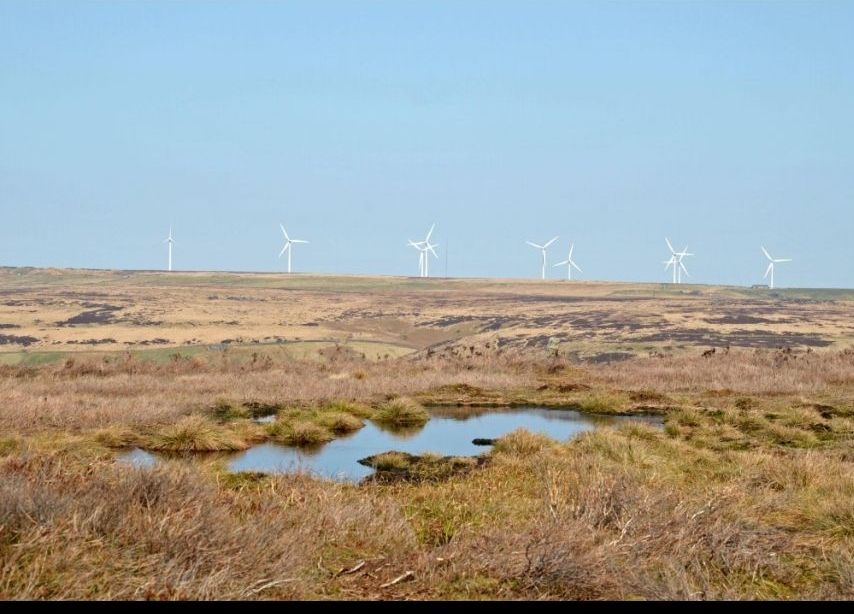
Scout Moor II is currently proposed as a development of 17 turbines, each reaching up to 180 metres, with a generating capacity of up to 100MW. The developer says turbine numbers have been reduced, infrastructure has been adjusted to avoid deeper peat and moorland restoration would cover substantially more land than the permanent development footprint.
Those promises must be tested against the physical engineering works.
The project documentation anticipates turbine and access-track construction, drainage systems, hardstandings and other infrastructure. Earlier assessment material recorded peat probing across the proposed infrastructure footprint and stated that micrositing would seek to avoid peat , particularly peat deeper than one metre , “if possible”. It also recognised that the carbon calculation would need to include peat depth, drainage, foundations, hardstandings, access-track dimensions, concrete volumes and the time needed for restored bog vegetation to recover.
That is the critical point. A broad promise to restore other parts of the moor cannot replace a transparent calculation of what will be excavated, compressed, drained or permanently fragmented.
Restoration elsewhere may produce genuine benefits, but it does not automatically recreate the hydrology, accumulated carbon or ecological function lost at a particular turbine foundation or along a permanent track.
Walshaw Moor
The warning is even more pronounced at the proposed Calderdale Energy Park on Walshaw Moor.
The current design includes up to 34 turbines , 32 reaching 200 metres and two reaching 150 metres. The preliminary design anticipates reinforced concrete foundations at least four metres deep, large crane hardstandings, underground cable trenches and a substantial onsite substation. New cut tracks, floating tracks and existing tracks would be used throughout the development.
The developer’s Preliminary Environmental Information Report contains several important admissions:
Ground disturbance from tracks, turbine foundations, crossings and earthworks could alter drainage and create new water-flow pathways.
Peat and carbon loss will occur where peat is excavated for foundations and other infrastructure.
Detailed peat-volume calculations had not been completed at the preliminary-report stage.
The development boundary is estimated to contain approximately 22 million cubic metres of peat, holding around 890,000 tonnes of carbon.
The developer also reports approximately 36 kilometres of proposed new access track, of which around 11 kilometres may be constructed as floating track. “Floating” does not mean environmentally neutral. Such tracks still impose weight, compress vegetation, affect water movement and can divide a functioning hydrological unit.
Walshaw Moor therefore cannot be assessed simply by comparing the permanent square metres occupied by turbine bases with the number of hectares proposed for restoration. Peatland operates as a connected water system. Disrupting one part can influence conditions beyond the immediate construction footprint.
Natural England describes functioning blanket bog as a system dependent on waterlogged conditions. Healthy bog stores carbon, retains water and can help reduce downstream flood peaks. Restoration depends on reinstating the hydrological conditions that allow the whole system to function.
Hope Moor
Hope Moor is also at a crucial pre-application stage.
Its scoping proposal covers approximately 1,111 hectares and includes up to 23 turbines, each potentially reaching 200 metres. Based on the indicative configuration, capacity could reach approximately 165.6MW. Access tracks, hardstandings, turbine foundations, borrow pits, construction compounds, underground cabling and watercourse crossings would all be required.
The initial peat survey is particularly significant. It recorded:
An average peat depth of approximately 0.54 metres.
A maximum recorded depth of 4.91 metres.
Roughly 48% of survey probes encountering peat deeper than the 30-centimetre threshold used in the assessment.
The deepest deposits are concentrated in parts of the western site, although peat is also present elsewhere. The developer says proposed turbine locations have been positioned to avoid deep or near-natural peat where possible. But the final track network, construction areas and associated infrastructure remain essential to the assessment because avoiding deep peat beneath the turbine itself does not eliminate impacts from the route needed to reach it.
The scoping report also acknowledges that, because of the number of watercourses across the site, some crossings cannot be avoided. That makes the eventual hydrology, drainage and peat-management evidence central—not peripheral—to deciding whether the location is acceptable.
The Finland lesson
Finland did not set out to create a climate problem. It wanted timber, employment and economic development. Drainage was presented as practical land improvement.
Only decades later did the full carbon consequences become evident.
The same mistake must not be repeated under a different banner. Calling infrastructure “green” does not make every location environmentally sustainable. Renewable generation cannot be treated as a licence to damage one of Britain’s largest natural carbon stores.
For Scout Moor II, Walshaw Moor and Hope Moor, decision-makers should require, before consent:
Complete peat-depth and condition mapping along every turbine base, track, trench, hardstanding, compound, borrow pit and drainage feature , not merely averages across the wider site.
Independent catchment-scale hydrological modelling, examining water-table changes, runoff, erosion and downstream flood consequences during construction, operation and decommissioning.
A transparent whole-life carbon calculation, publishing all assumptions concerning displaced generation, peat excavation, peat drying, drainage distance, concrete, transport, restoration success and future climate conditions.
A genuine avoidance test, demonstrating why less environmentally sensitive locations cannot provide the proposed generation capacity.
Legally enforceable restoration and monitoring, supported by independent oversight, measurable hydrological outcomes and sufficient financial security to repair damage if mitigation fails.
The burden of proof must rest with those proposing to disturb the peat , not with communities being asked to trust assurances that everything will eventually be restored.
Peat is not vacant land. It is not simply a surface covering that can be lifted, stored and replaced. It is a living hydrological system, a carbon archive, a wildlife habitat and part of the natural flood protection upon which downstream communities depend.
Finland’s experience shows that the environmental bill for disturbing peat may not arrive during construction. It may emerge slowly, year after year, long after the developers, contractors and decision-makers have moved on.
Shane Oxer — Campaigner for fairer and affordable energy
 SAY NO TO THE DESTRUCTION OF OUR LAND
Leave a comment