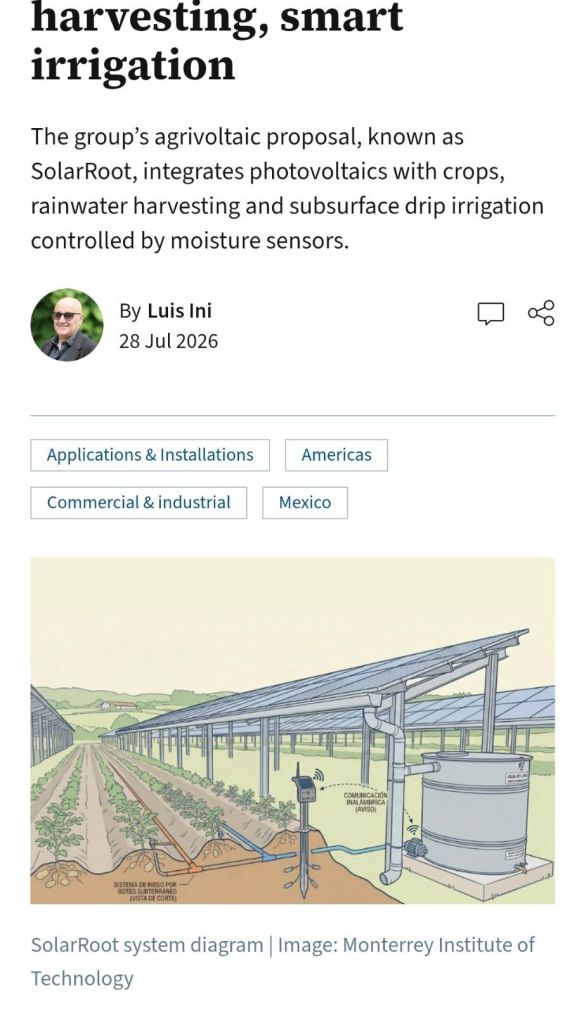
Mexico’s proposed SolarRoot system demonstrates what genuine innovation could look like: solar panels raised above productive crops, combined with rainwater collection, moisture monitoring and targeted irrigation. Food production remains central, while electricity is an additional benefit.
The proposal is still at the evaluation stage , it is not yet a working commercial project , but its underlying principle is sensible: if agricultural land is used for solar, agriculture should remain a genuine and measurable primary activity.
Across Europe, similar thinking is gaining ground. Agrivoltaics allows crops and electricity generation to share the same land, while France already requires qualifying car parks to incorporate shade structures , often photovoltaic canopies. The European Commission’s Joint Research Centre has concluded that agrivoltaics deployed on just 1% of the EU’s agricultural area could theoretically exceed the EU’s 2030 solar-capacity target.
Meanwhile, Britain continues receiving applications for enormous, conventional ground-mounted developments covering productive fields.
Why? Because fields are generally cheaper and easier for developers:
one landowner rather than numerous roof owners;
standardised rows of panels installed rapidly;
fewer structural complications;
easier maintenance and security;
economies of scale;
one large grid connection and one commercial project.
That may maximise the developer’s return, but it does not necessarily maximise the value of scarce British land.
The Government knows alternatives exist. Its own Clean Power 2030 plan identified up to 15 GW of potential solar capacity on warehouse roofs, while its Solar Roadmap promised a “rooftop revolution” and further examination of solar canopies over car parks. Yet the Government has largely discussed and consulted while field-scale schemes continue advancing through the planning system.
This is the policy Britain needs:
Roofs first , homes, factories, warehouses, supermarkets and public buildings.
Car parks and developed land second , generate electricity while providing shade and EV charging.
Brownfield and contaminated land next, where environmental and restoration issues permit.
Genuine agrivoltaics only where compatible with British crops and conditions, with enforceable agricultural-output requirements.
Productive farmland last, after developers prove that reasonable non-agricultural alternatives are unavailable.
This is not an argument against every solar panel. It is an argument against sacrificing food-producing countryside simply because covering fields is the easiest and most profitable option.
Britain does not lack roofs, car parks or previously developed land. It lacks a planning system prepared to tell developers where solar should go.
Shane Oxer. Campaigner for fairer and affordable energy
 SAY NO TO THE DESTRUCTION OF OUR LAND
Leave a comment