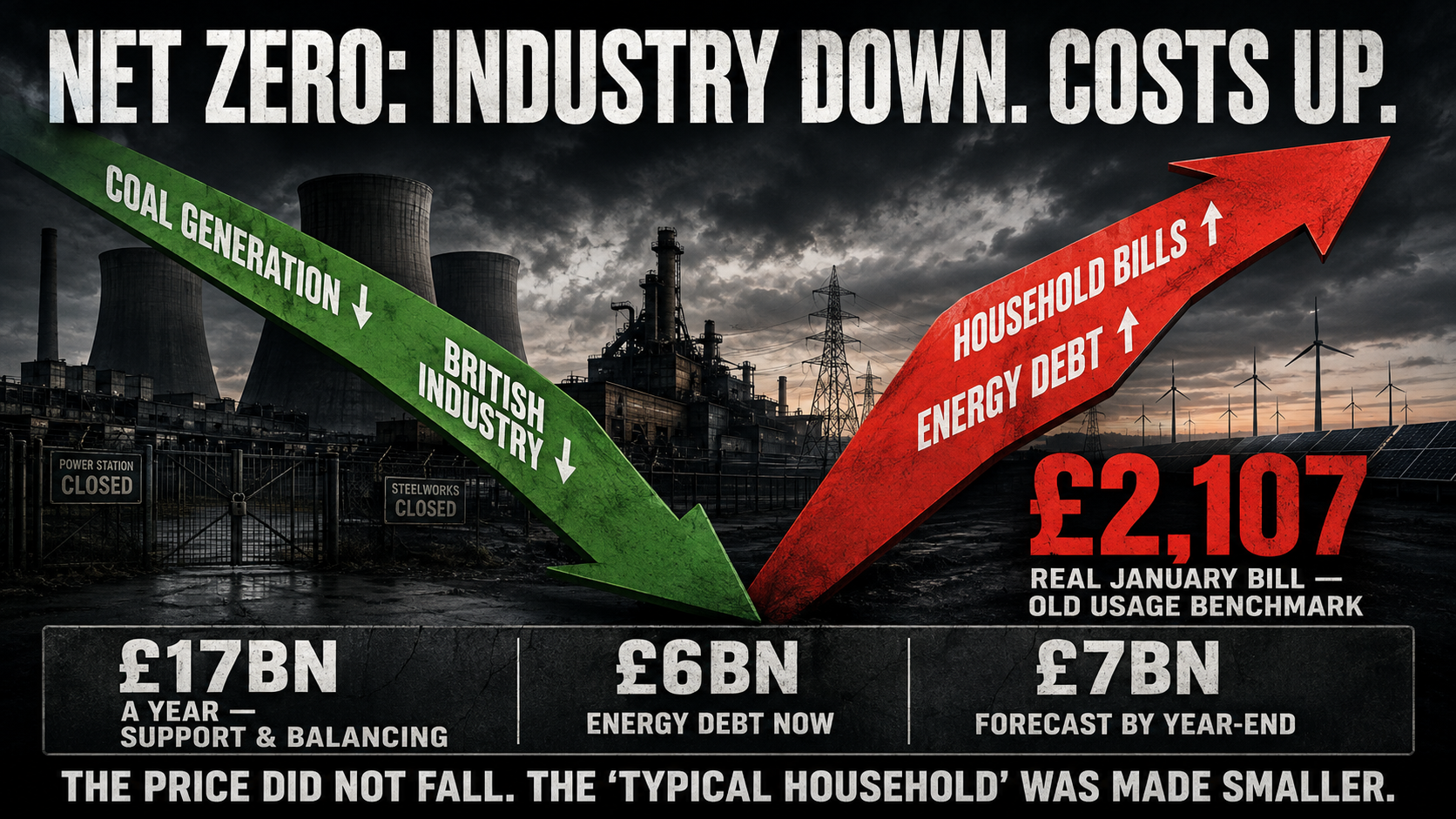
The widely reported figure of £1,872 is based on Ofgem’s newly reduced definition of household consumption. Ofgem cut the assumed annual usage of a “typical household” from 2,700 to 2,500 kWh of electricity and from 11,500 to just 9,500 kWh of gas.Using the same consumption benchmark previously employed by Ofgem, Cornwall Insight forecasts a January 2027 bill of £2,107.43.
The price has not been reduced: the statistical household used to publicise it has been made smaller. Cornwall Insight
Ofgem’s own figures demonstrate the effect.
July’s headline figure of £1,663 was £1,862 on the previous benchmark. October’s advertised £1,723 is actually £1,935 on that same like-for-like basis. Ofgem
Behind those household bills sits an energy system consuming approximately £17 billion every year in levy-funded support and balancing costs.
The Office for Budget Responsibility estimates environmental levies,including renewable-support contracts and the Capacity Market , at £14 billion in 2025/26. NESO recorded a further £2.7 billion of electricity-system balancing costs in 2024/25.
That balancing bill is not incidental. It is the cost of constantly matching supply and demand, managing network congestion, constraining generation and procuring replacement power and essential system services.
NESO says balancing costs increased by 10% in 2024/25, while thermal-constraint costs alone rose by 64% to £1.7 billion. It projects that total balancing costs could reach approximately £8 billion in 2030 if the required network programme is not delivered successfully and on time.
Meanwhile, households are already buckling under the burden. Domestic energy debt is estimated to have reached a record £6 billion, involving more than three million customers and averaging approximately £1,800 for each indebted account.
Energy UK warns that the total is on course to reach £7 billion by the end of 2026.
This debt does not disappear. Bad-debt recovery is already adding approximately £50 a year to the typical dual-fuel bill and around £140 for standard-credit customers. If total debt reaches £7 billion, Energy UK estimates it could add another £10–£15.
People who can still pay are consequently charged more to recover the debts of those who cannot , pushing still more households towards arrears.
Britain is therefore trapped in a vicious circle:
higher wholesale prices, enormous support commitments, rising balancing and network costs, increasing household debt and then additional charges to recover that debt.
The honest January comparison is not £1,872.
On the consumption level previously called typical, it is already £2,107.43. That is before the full future cost of the transmission expansion, storage, backup generation, financing, regulated returns and asset replacement required by the present energy strategy is recovered.
Government cannot claim that bills are falling simply by reducing the amount of energy assigned to its imaginary “typical household.” Families pay for the units they actually consume—and the underlying price of keeping Britain’s increasingly expensive electricity system operating continues to rise.
 SAY NO TO THE DESTRUCTION OF OUR LAND
Leave a comment