Why are we industrialising the countryside before we have exhausted the land we have already developed?
Look at these two photographs. They represent two radically different versions of Britain’s energy future.
SOLAR CAR PARK
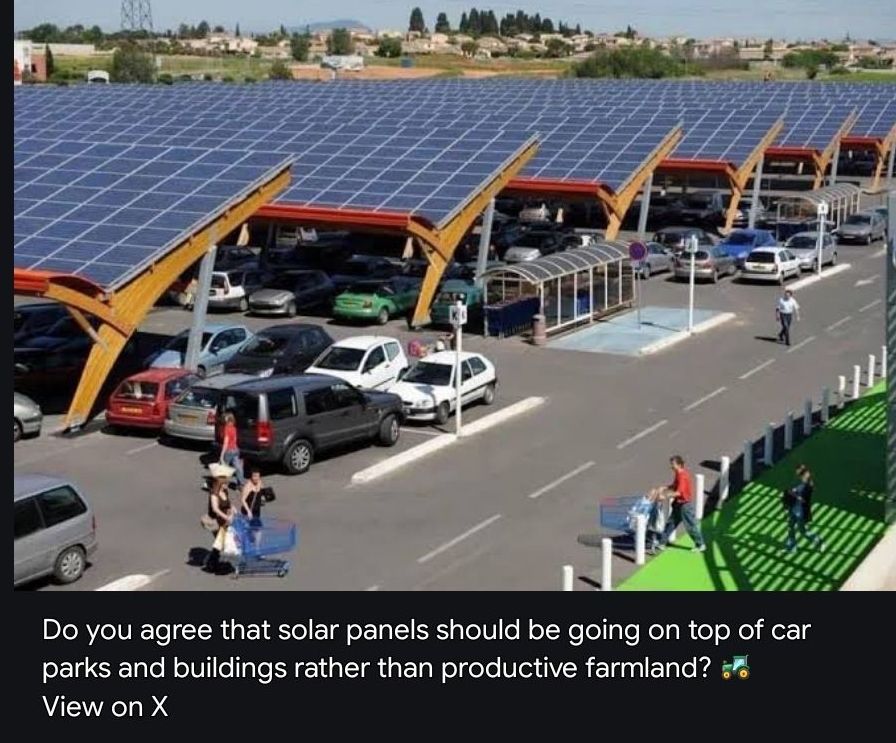
The first shows solar panels incorporated into a car park. The land has already been developed and covered in tarmac. Cars can continue to park underneath, drivers gain shelter from sun and rain, and electricity can potentially be generated close to where it is consumed. No additional field is taken out of normal use, no rural landscape is transformed and no village suddenly finds itself looking across acres of industrial energy infrastructure.Now look at the second photograph.
LARGE-SCALE SOLAR FARM
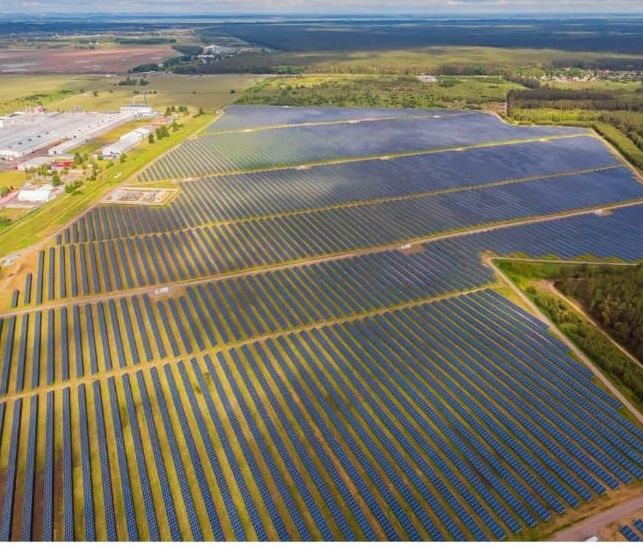
This is the other face of the solar revolution: field after field of panels, security fencing, access roads, inverter stations, transformers, substations, underground cables and, increasingly, huge battery storage compounds. Electricity generation is no longer simply being added to the landscape. In places, electricity infrastructure is becoming the landscape.That contrast raises a question that Ed Miliband, DESNZ and the renewable-energy industry cannot simply brush aside:
if Britain possesses enormous areas of roofs, car parks, warehouses, factories, industrial estates and previously developed land, why are we preparing to transform such vast areas of the countryside?
This Is No Longer About a Few Solar Farms
For years, opponents of large-scale solar have been reassured with apparently reassuring national percentages. We have repeatedly been told that solar will occupy only a very small proportion of Britain’s land. Looked at from Whitehall, a fraction of one per cent can indeed sound insignificant.
But the latest official land-use evidence makes clear that the issue is becoming much bigger than one technology or one isolated planning application.
The Government’s 2026 Land Use Framework projects around 129,000 hectares being used for solar and wind by 2035, equivalent to roughly 1% of England’s total land area and around 2% of England’s utilised agricultural area.
More importantly, the Government acknowledges that the land requirement associated with meeting energy objectives beyond 2035 could exceed 2% of England.
Separate DESNZ Net Zero modelling has gone further still. Its future scenarios examined combinations of solar and onshore wind requiring between 2% and 5% of the UK’s land area, depending on the pathway followed.That does not mean that 5% of Britain will literally be covered edge-to-edge with solar panels and turbine bases. Wind developments in particular retain land between turbines that can sometimes remain in agricultural use.
That distinction matters and should be stated clearly.But it does not make the physical transformation insignificant. Wind farms require turbines, foundations, tracks, substations and grid connections. Solar developments can dominate entire fields. Both require electrical infrastructure to move their power. When transmission corridors, substations, battery storage, reinforcement works and associated development are considered alongside generating sites, the true issue becomes obvious.
Britain is making a major national land-use decision through energy policy.
DESNZ Already Knows There Is Another Way
What makes the situation harder to justify is that DESNZ itself has acknowledged the enormous potential of land we have already developed.When the department examined solar car parks, it described them as an underused opportunity.
That should have been the beginning of an obvious national principle:
before covering more countryside with industrial-scale generating equipment, squeeze as much generation as reasonably possible from surfaces whose original environmental value has already been lost.
Car parks are only one example. Britain has vast warehouse roofs, logistics centres, factories, shopping centres, supermarkets, hospitals, schools, council buildings and industrial estates. Every new commercial development presents another opportunity to build generation into the structure from the beginning.
Instead of treating this as a central pillar of solar policy, the Government decided in May 2026 not to proceed, at that point, with its proposed mandatory approach to solar canopies on new outdoor car parks. Ministers have since stressed that they still support greater deployment of solar over car parks, but the national mandate was dropped.
That decision exposes a much bigger contradiction.
Why Is the Countryside Treated Differently?
When rooftop or car-park solar presents commercial, structural or practical difficulties, government appears willing to acknowledge those difficulties. There are concerns about construction costs, disruption, grid connections, ownership, structural suitability and commercial viability.Yet when rural communities object to enormous energy developments, the language suddenly changes.
They are told about national need, energy security, legally binding targets, critical infrastructure, accelerating planning decisions and removing barriers to deployment.
That raises an uncomfortable question.
Why should inconvenience or additional cost protect an already-developed car park, while national necessity is invoked to justify the transformation of countryside?
If the climate and energy emergency is sufficiently serious that communities must accept major industrial development around their homes, then surely it is serious enough to justify demanding more from supermarkets, distribution centres, commercial landlords, public bodies and developers constructing enormous new buildings.
The hierarchy ought to be obvious:
use the land we have already industrialised before industrialising more of the land we have not.
Yet that principle still does not sit firmly enough at the centre of British energy policy.
Follow the Economics and the Pattern Starts to Make Sense
This does not require conspiracy theories. Nobody needs to claim that every renewable-energy developer is behaving improperly or that ministers personally profit from every solar development.
The more important issue is structural.
Large infrastructure projects attract capital because they can become investable assets. Developers acquire or lease land, secure planning permission and grid arrangements, raise finance, construct the project and then generate a return from the electricity produced.
Landowners can receive substantial rents.
Contractors receive construction work.
Equipment suppliers sell panels, inverters, transformers and batteries. Financial institutions provide capital. Network companies receive regulated investment for infrastructure. Government gets additional generating capacity towards its political and statutory objectives.
There is nothing mysterious about any of that. It is how major infrastructure markets operate.
But the economics naturally favour scale.
Imagine trying to create hundreds of megawatts of generating capacity across thousands of separate roofs. Every building may have a different owner, tenant, lease, roof structure, insurance policy, electrical system, financing arrangement and connection requirement.
Now compare that with acquiring control over several hundred or several thousand acres through a comparatively small number of land agreements and developing a single large project.
From a developer’s perspective, the attraction is obvious.What is commercially efficient for the developer, however, is not necessarily environmentally efficient for Britain.
That is the distinction government policy has failed to address adequately.
The Cheapest Megawatt Can Carry a Very Expensive Landscape Cost
Energy policy increasingly revolves around numbers: cost per megawatt-hour, gigawatts installed, connection dates, construction schedules, investment totals and carbon budgets.
Landscapes do not fit neatly into spreadsheets.
Neither does the value of an open horizon.
Nor the character of a historic village.
Nor the cumulative impact of several developments surrounding one community.
Nor the loss of the sense that farmland and countryside are fundamentally different from industrial estates.
These effects are real even when nobody attaches a monetary figure to them.
A large solar development may look inexpensive when judged solely according to the cost of constructing generation. But if the lowest-cost development model requires using more countryside because rooftop, car-park and brownfield alternatives cost more, then the apparent saving is partly achieved by transferring an environmental cost onto somebody else.
The developer does not necessarily pay that cost.
The community does.
National Percentages Hide Local Reality
This is why the constant use of small national percentages can be so misleading.People do not experience energy development as a percentage of Britain.They experience it outside their kitchen window.
A community can have solar developments to one side, a battery compound to another, a new substation nearby and transmission infrastructure crossing the wider landscape, while government can still truthfully say the total represents only a tiny percentage of national land.
Both statements can be mathematically correct.Only one describes what the resident actually experiences.That is why cumulative impact is becoming one of the most important issues in the energy debate. Development is not necessarily spread evenly across Britain. It gravitates towards suitable grid connections, available land, willing landowners and areas where developers believe consent can be obtained.
The result can be enormous concentrations of infrastructure in particular parts of the country.A tiny national percentage can therefore produce a profound local transformation.
Solar Is Only the Beginning of the Land Requirement
A solar farm cannot simply be placed in a field and considered in isolation. Its electricity has to travel somewhere.That can require new cabling, transformers and substations. Larger volumes of intermittent generation can require reinforcement elsewhere in the network. Battery storage may be developed nearby. Transmission lines may have to be upgraded or constructed.
Offshore generation creates its own substantial onshore infrastructure requirement.
Britain is consequently engaged in something much bigger than constructing individual renewable projects.
We are redesigning the physical electricity system.
And once that is understood, the debate over land becomes impossible to separate from the debate over generation technology.
Different generating systems create different land requirements.
Different technologies require different grid architectures. Different political targets produce different infrastructure programmes.
Those are choices, not laws of nature.
Government’s Own Modelling Shows There Are Alternatives
Perhaps the most important point in the entire argument is that DESNZ’s own scenario work acknowledges that the scale of land required for solar and onshore wind depends upon the energy pathway Britain chooses.
Greater nuclear generation, for example, can alter that requirement substantially.That means the question cannot simply be framed as: “Do we need renewable electricity?”
The proper question is: what combination of generation gives Britain reliable electricity, reasonable costs, energy security and lower emissions while causing the least unnecessary damage to land and landscape?
That is a completely different debate.
A country choosing more nuclear, more rooftop generation, strategically retained dispatchable generation and less dependence upon enormous quantities of land-intensive generation will have a different physical footprint from a country trying to obtain very large proportions of its electricity from dispersed wind and solar.
Once again, those consequences arise from policy choices.And if policy choices determine how much countryside is required, ministers should be required to justify those choices openly.
This Is Where the “Money, Money, Money” Question Matters
The accusation should not be that Net Zero is simply some secret scheme to make government rich. That is too easy to attack and distracts from a much stronger case.
The real problem is that Britain has constructed a system in which enormous amounts of capital have to flow into energy infrastructure to meet government targets.
Developers and investors naturally pursue projects capable of producing returns. Government naturally wants projects capable of being delivered quickly.
Network companies build the infrastructure required to accommodate them.
That creates powerful commercial momentum.
And when protecting the countryside makes projects more expensive, slower or more complicated, environmental protection risks becoming the obstacle rather than the objective.
That is where the public is entitled to ask:
who carries the consequences of the cheapest development model?
The developer receives a return.The landowner receives rent.The contractor receives payment.The investor owns an asset.Government records progress towards its target.
But the community keeps the development.For decades.
If Net Zero Is Environmental Policy, Protecting the Environment Must Come First
Nobody should need to oppose every solar panel to recognise the absurdity of covering productive or valued countryside while enormous areas of existing development remain available.
A rational hierarchy would be straightforward.Britain should maximise solar on suitable rooftops, warehouses, factories, commercial estates, public buildings and car parks.
Brownfield and previously developed land should carry a far greater share. New commercial developments should be designed from the beginning to produce electricity where technically appropriate. Only after those opportunities have been properly assessed should large-scale development of agricultural and undeveloped countryside be regarded as necessary.
That does not mean every roof is suitable or that rooftop generation alone can replace every proposed solar development.
It means the burden of proof should be reversed.
Developers should have to demonstrate why large-scale countryside development is necessary, rather than communities repeatedly having to prove why their countryside deserves protection.
Two Photographs, One Uncomfortable Question
Look again at the two photographs.The first takes something Britain has already built and makes it work harder.The second takes something fundamentally different — open land and countryside — and turns it into generating infrastructure.
Both produce electricity.But only one requires the landscape itself to surrender.And now we know from Government’s own modelling that Britain’s energy pathway could ultimately involve land requirements measured not in a few isolated fields, but in percentages of the country.
That changes everything.The argument is no longer merely about whether one particular solar farm should receive planning permission. It is about the cumulative physical transformation of Britain being produced by energy choices made at national level.
So before another wave of countryside is committed,
Ed Miliband and DESNZ should answer a very simple question:
Why are we industrialising the countryside before we have exhausted the land we have already industrialised?
If the answer is that countryside solar is cheaper, tell the public.
If it is faster to develop, tell the public.
If investors prefer larger projects, tell the public.
If the 2030 target requires speed that makes rooftop deployment inconvenient, tell the public.
But do not present the resulting landscape transformation as though there were no alternative.
There are alternatives.
There are technological choices.
There are land-use choices.
There are different energy mixes.And there are different ways of measuring cost.
Because the cheapest project for a developer is not necessarily the cheapest decision for Britain.
When the accounting is eventually done, we should not measure Net Zero merely in gigawatts installed and billions invested.
We should also count the acres transformed, the communities surrounded, the agricultural landscapes altered and the additional infrastructure required to make the system work.
Then the public can decide whether this really is environmentalism — or whether somewhere along the way, the race for targets, investment and returns became more important than protecting the environment,Net Zero was supposedly created to save.
Shane Oxer. Campaigner for fairer and affordable energy
 SAY NO TO THE DESTRUCTION OF OUR LAND
Leave a comment