From Shetland’s peatlands to the agricultural Lowlands, Scotland is being rebuilt around an electricity system designed to move vast quantities of renewable power south. The turbines are only the beginning. Behind them come roads, substations, converter stations, subsea cables and hundreds of kilometres of new pylons , while some of the communities hosting this transformation remain among the most fuel-poor in Britain.
By Shane Oxer
There can be few better illustrations of the contradictions in Britain’s energy policy than Shetland. The islands now host one of the largest onshore wind farms in the country and are connected to mainland Britain by a 600MW high-voltage electricity link. More offshore wind is proposed, a second transmission link is being developed and yet, according to the Scottish Government’s latest local figures, 40 per cent of Shetland households were in fuel poverty across 2022–24. The median amount needed to lift a fuel-poor Shetland household out of fuel poverty was £2,890 a year , the highest figure recorded by any Scottish local authority.
That contrast deserves more attention than it receives. An island group capable of exporting hundreds of megawatts of electricity to the British mainland still has four households in every ten classified as fuel poor. Scotland as a whole is hardly in a position to boast: the latest national survey estimated 732,000 Scottish households, 28.7 per cent of the total, were in fuel poverty in 2024, including 357,000 in extreme fuel poverty. More than four-fifths of Scottish households still used mains gas as their principal heating fuel.
Meanwhile, the transformation of Scotland’s landscape is accelerating.
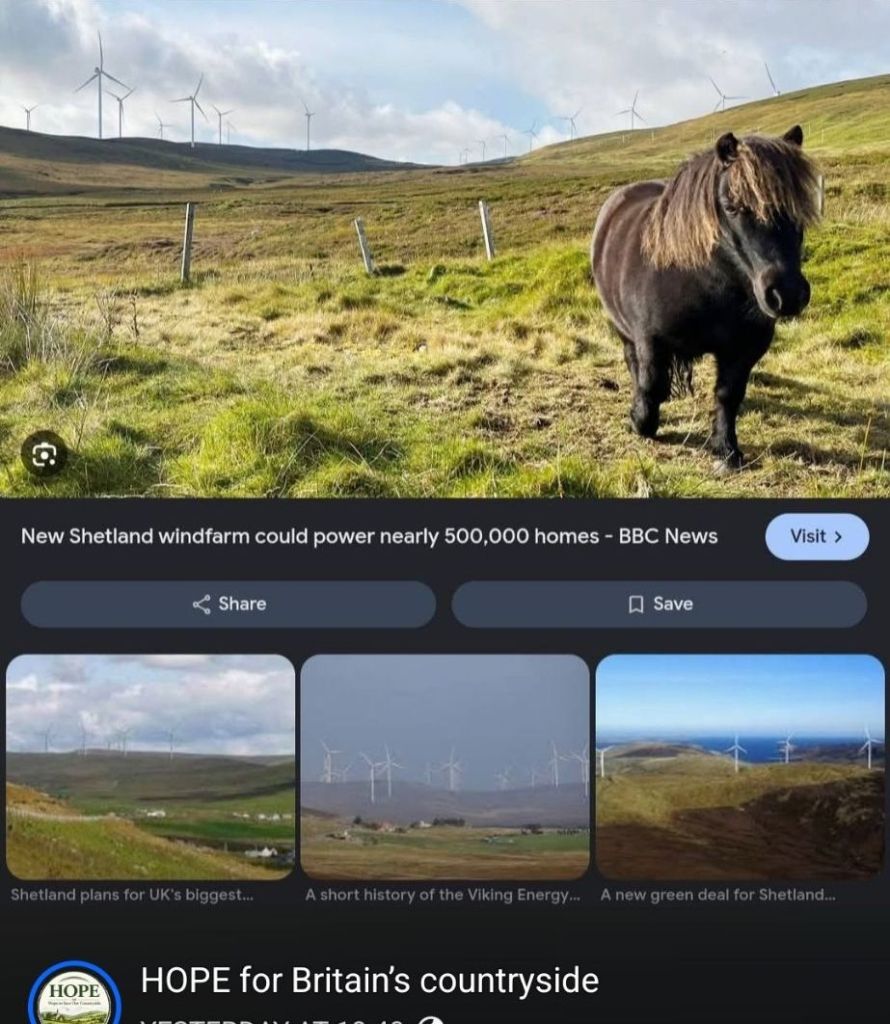
Stand among the hills of central Mainland Shetland and the word “transition” stops being an abstract political expression. Viking Energy Wind Farm consists of 103 turbines with 443MW of installed capacity. SSE Renewables became its sole owner in 2019 and the project became fully operational in September 2024. Its developer expects it to generate around 1.8TWh annually.
Those are the figures normally found in the press release. The engineering figures tell a rather different story.
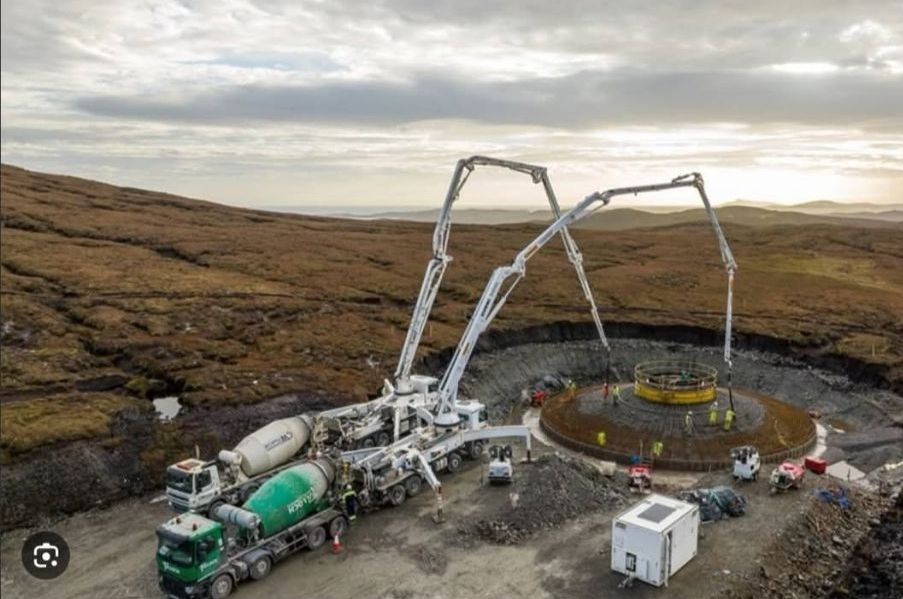
The civil works included approximately 69 kilometres of on-site roads, another two kilometres of new public road, roughly 71,000 cubic metres of concrete, more than 11,000 tonnes of reinforcement, over 800 kilometres of installed cable and approximately 1.5 million cubic metres of rock extraction and processing. Viking itself records more than 70 kilometres of access infrastructure and around 478 kilometres of high-voltage electrical cable, before fibre-optic and earthing cables are counted.
Much of the development lies within an extensive peat landscape. The developer says parts of that peat were already heavily degraded and points to an approved programme intended to restore more than 260 hectares of damaged peatland. That mitigation deserves to be recorded. So does the fact that turbine bases, tracks, cables and associated works had to be constructed across a peatland environment in the first place.
One turbine foundation alone required about 700 cubic metres of concrete; the project then had to repeat the exercise another 102 times.
This is not an argument about whether one likes the appearance of wind turbines. It is an argument about honesty in how Britain describes its energy transformation. The phrase “clean energy” encourages us to imagine that the infrastructure somehow arrives without quarrying, concrete, roads, steel, cables or substantial changes to land. It does not. Renewable generation may have no fuel combustion at the turbine, but constructing an electrical system around remote and weather-dependent generation is intensely physical.
Nor did the disruption end when the last Viking turbine was erected. Producing electricity in Shetland is of little use to consumers in Glasgow, Manchester or Birmingham unless that electricity can be transported to them. Viking therefore underpinned an entirely separate piece of infrastructure: the 260-kilometre Shetland HVDC link, running from a new converter station at Kergord to Noss Head near Wick in Caithness. The link has a capacity of 600MW and was fully energised in August 2024, connecting Shetland to the Great Britain transmission system for the first time.
The word “offshore” begins to look rather misleading at this point. Electricity may be generated on an island or hundreds of kilometres out in the North Sea, but it does not remain offshore. It comes ashore. It needs landfalls, converter stations and substations. From those substations it needs transmission lines, switching equipment, transformers and yet more land. Remote generation does not eliminate infrastructure. It moves the infrastructure somewhere else.
And Britain is preparing to repeat the process on an even greater scale.
SSEN Transmission is currently developing a second Shetland HVDC link. Its own project description says the scheme may require another marine cable between Shetland and Aberdeenshire, a converter station and 400kV substation in Shetland, another converter station and 400kV substation in Aberdeenshire, together with onshore underground cables and landfalls. As of September 2026 it remains at the project-assessment stage, but ground investigations are already under way in Shetland and Aberdeenshire and the company is consulting on mainland landfall locations.
Why another link? SSEN states plainly that a number of new onshore and offshore generators and other electricity users require connections in Shetland, and that NESO’s Beyond 2030 programme recommended another HVDC connection. In other words, the first vast piece of infrastructure creates the conditions for the next generation of projects, which in turn generates a requirement for another vast piece of infrastructure.
Off Shetland’s east coast, ESB is developing the Stoura floating wind project, with a proposed maximum capacity of about 500MW. Its seabed area is approximately 100 square kilometres, with the array planned tens of kilometres east of Shetland. The latest offshore scoping material allows for up to 40 floating turbines, together with offshore transmission equipment, anchors and mooring systems.
Stoura is only one part of Scotland’s offshore programme. ScotWind originally produced 20 option agreements totalling up to 27.6GW and £755 million in option fees. Crown Estate Scotland says the operating projects will also make annual multi-million-pound payments. These revenues are public revenues passed to the Scottish Government, not private income for King Charles III, and that distinction is important. But the commercial transformation of the seabed is equally important. An area of sea which previously generated no offshore-wind rent can, once government policy creates an enormous demand for development rights, become an asset capable of producing hundreds of millions of pounds in option fees and continuing annual income.
The INTOG leasing programme pushes the principle further. Crown Estate Scotland selected projects covering roughly 1,673 square kilometres of seabed — 139 square kilometres for innovation projects and 1,534 square kilometres for targeted oil-and-gas decarbonisation schemes. The prospective lease term is 25 years for innovation projects and 50 years for targeted projects.
The Scottish Government estimates that if the potential pipeline is fully deployed, the global capital value of ScotWind, INTOG and associated port and supply-chain projects could be around £100 billion. Its own underlying analysis places possible ScotWind project expenditure, excluding operating costs, at approximately £70.9 billion to £77.6 billion and estimates another £21 billion to £22 billion for INTOG if the wider programme developed on similar cost assumptions.
One hundred billion pounds is normally presented as an economic opportunity. Of course it is an opportunity , for developers, contractors, ports, manufacturers, lenders and investors. But investment of that magnitude is not a charitable donation to Scotland. Capital expects assets, contractual rights and returns. The important question is therefore not merely how much money is “invested”, but what infrastructure is required to make those investments productive, who owns that infrastructure and how its costs ultimately enter the energy system.
That brings us from Shetland to the Highlands.
SSEN Transmission says it now plans around £29 billion of new and upgraded transmission investment across northern Scotland over the next five years, describing it as one of the largest private infrastructure investment programmes in Scottish history.
Some of the numbers almost defy comprehension when viewed together. The current application for the Spittal–Loch Buidhe–Beauly 400kV line proposes approximately 173 kilometres of new main overhead line, with diversions and associated line works bringing the total to about 191 kilometres. The proposed supports are up to around 57 metres high. The case has now been referred to Scotland’s Planning and Environmental Appeals Division.
The route is not crossing some anonymous blank space on a government map. SSEN’s own environmental work identifies Class 1 and Class 2 peatlands, carbon-rich soils and the internationally significant Flow Country among the environmental constraints. Historic Environment Scotland originally objected to impacts on the settings of 28 scheduled monuments; following additional information it withdrew some of those objections, but the scale of the heritage issues itself illustrates the sensitivity of the country through which this infrastructure is proposed.
Then comes Beauly to Peterhead. The current application proposes approximately 186 kilometres of new 400kV double-circuit overhead line, with diversions and related works taking the total new overhead-line infrastructure to about 200.7 kilometres. The listed support height is 58 metres. That project, too, has been referred to the Planning and Environmental Appeals Division.
Then Kintore to Tealing. Its application proposes about 105 kilometres of principal new 400kV line, while associated works take the total overhead-line infrastructure to roughly 119 kilometres. The Energy Consents Unit lists a maximum support height of approximately 71.7 metres. It, too, has been referred to the appeals division.
Add the total infrastructure figures in those three applications and the result is approximately 511 kilometres of new and associated overhead-line works.
Half a thousand kilometres.
Across Caithness, Sutherland, the Highlands, Moray, Aberdeenshire and Angus.
This is the part of the Net Zero programme that rarely makes it into the photograph of a graceful turbine turning against a blue sky.
Nor are the concerns confined to people objecting to the view. SSEN’s own consultation report for Kintore–Tealing records concerns over the loss of prime agricultural land from community councils, landowners, occupiers, local residents and NFU Scotland. It also records concerns about impacts on communities, landscape, environment, businesses and tourism.
We should be careful with the word “devastation”. It is an assessment, not a unit of measurement. But there is no need to exaggerate when the dimensions themselves are so enormous. Hundreds of kilometres of high-voltage line, lattice towers approaching the height of a twenty-storey building in some locations, vast substations, converter stations, access arrangements and construction compounds constitute an industrial transformation of the landscape by any ordinary meaning of the word.
And the development does not stop at the Highland line. On 1 April this year, SP Energy Networks began a five-year programme of up to £12 billion to expand and upgrade the transmission network across central and southern Scotland. The company openly calls it a “rewiring programme”.
Put SSEN’s approximately £29 billion northern programme beside SP Energy Networks’ up-to-£12 billion programme and Scotland’s two transmission regions are describing programmes totalling as much as £41 billion over the current five-year period.
Forty-one billion pounds.
And these are network programmes, not the total cost of Scotland’s wind farms, solar farms, batteries, ports or other generation assets.
Who pays? In the regulated network system, the answer eventually reaches the billpayer. Ofgem sets the allowed revenues network companies can recover under the RIIO framework. Its own explanation says network companies charge suppliers regulated prices for using the networks and that this money pays for maintaining, operating and upgrading them. Ofgem has previously estimated network charges at around 20 per cent of consumers’ energy bills.
So when somebody describes a £29 billion or £12 billion network programme merely as “investment”, remember what investment means in a regulated monopoly. Ofgem determines what revenue the network owner is allowed to earn. That revenue is recovered through network charges. Those charges enter the electricity system and ultimately the bills paid by households and businesses.
This does not mean consumers simply receive a £41 billion invoice tomorrow morning. Network assets are financed and recovered over long periods, and Ofgem regulates allowed costs and returns. But neither is the infrastructure free simply because the expenditure is described as private investment.
Somebody always pays.
And that brings us back to Shetland.
Across 2022–24, 40 per cent of households there were in fuel poverty. The median fuel-poverty gap was £2,890. Yet on and around those same islands sits a 443MW wind farm, a 600MW export cable, developing offshore wind rights, new substations and preparations for another transmission link.
That does not mean Viking caused Shetland’s fuel poverty. It plainly did not. Island energy costs, housing, incomes and heating arrangements have their own complicated causes.
It means something more uncomfortable.
Hosting energy infrastructure and enjoying affordable energy are not the same thing.
A community can live beside the generating asset and still struggle to heat its homes. A landscape can provide the site. Landowners can sign leases. A developer can own the wind farm. A transmission company can build the cable. Institutional capital can finance the system. Yet the ordinary household at the bottom of that chain still buys energy under the same wider market and regulatory structures as everyone else.
Even Viking’s land arrangements illustrate the point about ownership that began this series. Shetland Islands Council says that it owns Busta Estate and is one of 14 landowners who entered long-term lease agreements with the wind-farm developer. The project provides a community-benefit fund of around £2.2 million a year, and those local benefits should be acknowledged. Half of Viking’s capacity – 220MW – also secured a 15-year Contract for Difference at £46.39/MWh in 2012 prices, indexed for inflation.
So once again the chain can be followed.
The landowner provides access to the land. The developer owns the generating asset. The project obtains a long-term revenue mechanism. The transmission company builds the regulated infrastructure. The network earns allowed revenue. The electricity enters the national system. Consumers pay their bills.
Scotland’s seabed follows a related pattern, although the owner-side revenue is public. Crown Estate Scotland grants the development rights. Developers acquire exclusive opportunities over areas of seabed. Capital finances projects worth billions. New transmission infrastructure is required to bring the electricity ashore and southwards. Crown Estate Scotland’s revenue profits go to the Scottish Government; private developers and investors seek their own returns from the projects.
The question is not whether every link in that chain is illegitimate. It is whether Scotland was ever given a clear picture of the whole chain at once.
A turbine application is considered as a turbine project. A cable is a cable project. A substation is a substation application. A 400kV line is another consenting process. Another wind farm appears in another marine plan. Another transmission link arrives in Beyond 2030. Each is assessed within its own regulatory box.
But the person standing in the Highlands does not experience them as separate spreadsheets.
They experience the cumulative physical system.
Wind farms offshore. Wind farms onshore. New landfalls. Converter stations. New substations. New access roads. New transmission corridors. Existing lines diverted. More generation connects, requiring more network capacity, enabling more generation to connect.
That is why describing the changes simply as a collection of renewable-energy projects misses the point.
Scotland itself is becoming energy infrastructure.
Its islands provide the wind resource. Its seabed provides the development area. Its peatlands and hills provide the routes. Its agricultural countryside carries the pylons. Its communities host substations and converter stations. Its ports are expected to service the offshore industry. Billions of pounds of capital are deployed to convert those natural and geographical advantages into financial and electrical assets.
There will be winners. Construction workers will earn wages. Scottish contractors will obtain orders. Ports can gain investment. Landowners receive rents. Communities receive benefit funds. Crown Estate Scotland sends its profits into the public finances. Those benefits are real.
But benefits do not erase costs.
They do not make a 60-metre pylon invisible. They do not return a field occupied by a substation to agriculture. They do not make hundreds of kilometres of transmission line disappear from a landscape. They do not change the fact that every regulated network asset eventually requires consumers to finance allowed revenues through the energy system.
And they certainly do not explain how an energy-rich island group such as Shetland can simultaneously have one of Scotland’s highest fuel-poverty rates.
That is the paradox at the heart of Scotland’s Net Zero experiment.
A country extraordinarily rich in energy resources is being asked to accept an equally extraordinary industrial transformation in order to exploit them. The sea is leased. The land is optioned. The turbines rise. The cables come ashore. The pylons march south. Billions are invested and billions must ultimately earn a return.
Yet the promise made to the public was not merely that Britain would possess more electricity infrastructure.
It was that this transformation would deliver cleaner, more secure and ultimately more affordable energy.
That claim now has to survive contact with the accounts.
Scotland’s official statistics say 732,000 households were in fuel poverty in 2024. Shetland’s recent local-authority average was 40 per cent. At the same time, Scotland is looking at transmission investment programmes of up to £41 billion, an offshore-wind pipeline whose potential capital value has been estimated by its own Government at around £100 billion, and one of the greatest expansions of electricity infrastructure in its modern history.
Those numbers should be printed alongside one another every time another politician celebrates the amount being invested.
Because expenditure is not the same as prosperity.
Generation is not the same as affordability.
And investment is not the same as free money.
In the first article in this series we started with a tenant farmer and asked what happens when government policy dramatically changes the economic value of the land beneath his feet. Scotland reveals the same phenomenon on a national scale. Here the scarce assets are not simply individual farms. They are wind, land, peatland, coastline, seabed and the corridors through which electricity can be moved.
The same questions therefore apply.
Who controls the asset? Who receives the lease? Who owns the project? Who finances it? Who earns the regulated or commercial return? Who lives with the infrastructure?
And who pays?
Scotland is being rewired before our eyes. The engineering plans are public. The investment figures are public. The lease arrangements are public. The fuel-poverty figures are public.
Nobody needs a conspiracy theory.
They merely need to put the documents next to each other.
Shane Oxer — Campaigner for fairer and affordable energy
 SAY NO TO THE DESTRUCTION OF OUR LAND
Leave a comment