
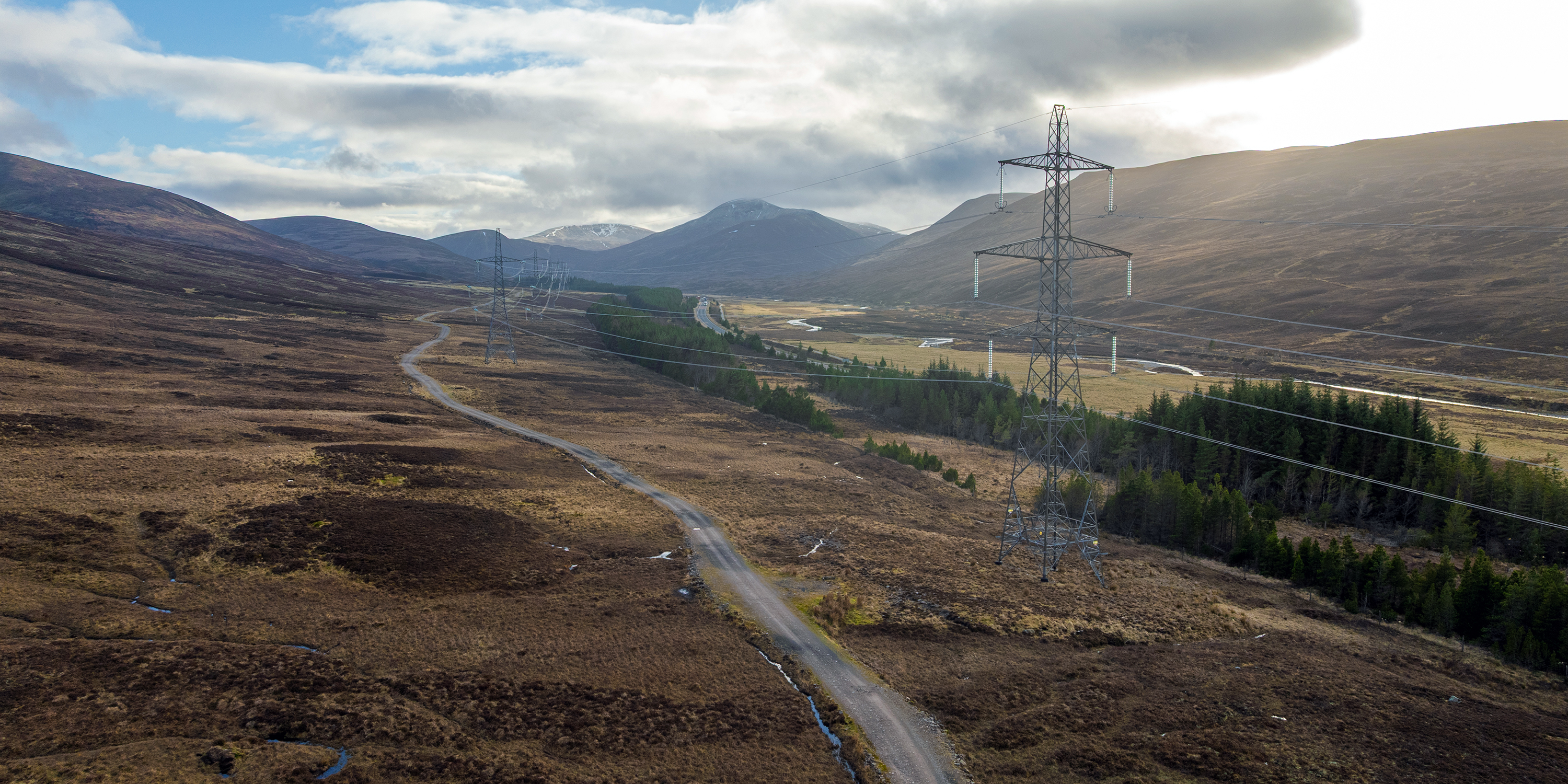
From Caithness and Sutherland to Orkney, Shetland, Skye, the Western Isles and the Great Glen, one of Britain’s largest concentrations of new electricity infrastructure is taking shape. The towers, cables, substations and batteries are becoming physical. The complete cost still is not.
By Shane Oxer — Campaigner for fairer and affordable energy
Across the Highlands and Islands, the electricity network is no longer being altered one isolated project at a time. It is being reconstructed through a connected programme of lines, cables, substations, converter stations and storage — while the public cost evidence remains scattered across separate projects, regulators and developers.
New 400kV overhead lines. Subsea HVDC cables. Underground cable corridors. Converter stations. Vast new substations. Battery-storage compounds. Transformers. Voltage-control equipment. Roads, bridges, temporary compounds and worker accommodation.
Viewed individually, they appear as separate projects.
Viewed electrically, they form an increasingly interconnected system stretching from the Western Isles and Shetland through Caithness, Sutherland, Ross-shire, the Great Glen and Moray into the wider British transmission network.
Viewed physically, that programme means steel, concrete, excavation, cable trenches, industrial electrical compounds and hundreds of kilometres of permanent infrastructure across some of Scotland’s most distinctive landscapes.
Viewed financially, the harder question is not whether the programme costs billions. It is how many billions belong to the complete system.
The May 2025 study commissioned by Highlands and Islands Enterprise and the Highlands and Islands Regional Economic Partnership identified £20.00 billion of potential investment in “Supporting Infrastructure: Grid” alone. Grid represented 20% of the entire £100.35 billion regional transformational investment pipeline identified by the researchers. After adjusting projects for their development status, the grid figure was still approximately £16 billion.
That £20 billion is not money already spent and it is not a final audited bill. HIE’s research was substantially based on projects identified during fieldwork between April and December 2024. It is a regional investment pipeline, not a consolidated public expenditure account.
Its significance is that £20 billion was already visible before the regional ledger was complete.
The figure is therefore a starting point, not an answer.
Since that 2024 evidence base was assembled, the programme has continued to grow.
In April 2026, SSE set out a £29 billion-plus transmission investment programme across the wider north of Scotland, centred on eleven major projects — five offshore and six onshore. SSE says more than £29 billion of investment has received Ofgem approval and five of the eleven “mega projects” were already under construction.
The £20 billion HIE figure and SSE’s £29 billion-plus figure are not two sums that can simply be added together. Their geographical definitions differ and major projects overlap.
The overlap does not make the figures less significant.
It exposes the central accounting problem:
The electricity system is being built as one system. It is still being costed in fragments.
[Source: Highlands and Islands Enterprise — Regional Transformational Opportunities report]
[Source: SSE — £29bn+ north of Scotland transmission programme]
£20 BILLION — BEFORE THE ACCOUNT IS COMPLETE
Start with what can already be priced.
The completed Caithness–Moray transmission link cost around £970 million in 2013/14 prices. SSE says the project included a 113km subsea HVDC cable between Spittal and Blackhillock, converter stations at both ends, works at eight substations and two overhead-line reinforcement projects.
The first Shetland HVDC Link adds another major cost block. Ofgem’s final Project Assessment allowed £641.8 million of capital expenditure in its cost assessment, including approximately £517 million in the principal engineering construction category.
The Orkney–Caithness connection is now an estimated investment of more than £900 million. It requires two new substations, around 14km of underground cable across Orkney and 53km of subsea cable across the Pentland Firth.
The Skye reinforcement is described by Balfour Beatty as a project of around £690 million, involving a new 137km 132kV double-circuit connection between Fort Augustus and Edinbane together with sealing-end compounds and associated works.
Three Highland battery projects for which developer-commissioned assessments publish comparable construction estimates add another £336 million: approximately £136 million at Spittal, £100 million at Rigifa and £100 million at Knocknagael.
Those selected projects alone expose more than £3.5 billion of identifiable project cost or regulatory allowance.
That is not the Highlands and Islands bill. It is only the visible floor.
It comes from a relatively small group of projects for which comparable published figures can already be recovered.
Missing from that floor are the complete costs of the Western Isles and Spittal–Peterhead HVDC schemes; the Spittal–Loch Buidhe–Beauly, Beauly–Peterhead and Kintore–Tealing 400kV overhead-line programmes; many of the new 400kV substations; most of the Highland battery pipeline; and the long-term financing, maintenance, replacement and decommissioning costs of the system.
The gap between a visible floor of a few billion pounds and HIE’s £20 billion regional grid pipeline is exactly why the rest of the infrastructure has to be brought into one account.
[Source: SSE — Caithness–Moray completion and final cost]
[Source: Ofgem — Shetland HVDC Link Project Assessment]
[Source: Balfour Beatty — c. £690m Skye Reinforcement Project]
THE THREE OVERHEAD-LINE CORRIDORS — 464 KILOMETRES BEFORE THE DIVERSIONS
The northern grid build is not one overhead line. It is three.
SSEN Transmission is progressing three major new 400kV overhead-line corridors as part of its Pathway to 2030 programme:
Spittal–Loch Buidhe–Beauly: approximately 173km of main new overhead line, plus around 18km of permanent diversions to existing 132kV and 275kV circuits.
Beauly–Peterhead: approximately 185km of new overhead line, linking the proposed Fanellan substation near Beauly with Greens near New Deer and the Netherton Hub near Peterhead. The steel lattice towers are expected to average around 57 metres in height.
Kintore–Tealing: approximately 106km of new overhead line, running through the new Hurlie and Emmock substations, again on steel lattice towers expected to average around 57 metres.
Together, the three principal routes amount to approximately 464km of main new 400kV overhead line. Include the 18km of permanent diversion works associated with Spittal–Loch Buidhe–Beauly and the total rises to approximately 482km.
Kintore–Tealing lies south of the Highlands and Islands proper, but it forms part of the same wider transmission chain carrying electricity onwards through the north of Scotland. A complete system account cannot stop at an administrative boundary while the infrastructure continues south.
[Source: SSEN Transmission — Spittal–Loch Buidhe–Beauly 400kV Connection]
[Source: SSEN Transmission — Beauly–Peterhead 400kV Overhead Line]
[Source: SSEN Transmission — Kintore–Tealing 400kV Connection]
CAITHNESS AND SUTHERLAND — 191 KILOMETRES OF NEW OVERHEAD INFRASTRUCTURE
The proposed Spittal–Loch Buidhe–Beauly 400kV connection shows what the next phase means when a strategy line reaches the ground.
SSEN Transmission’s current proposal involves approximately 173km of new 400kV overhead line, carried on steel lattice towers averaging around 57 metres in height. Permanent diversions of existing 132kV and 275kV circuits add approximately another 18km, taking the proposed development to around 191km of new overhead-line infrastructure. The average distance between the main 400kV towers is expected to be around 338 metres, although final spacing will vary with terrain and design.
A strategic network map reduces that corridor to a coloured line.

The landscape carries the real project.
Tower foundations. Access tracks. Crane positions. Construction compounds. Lay-down areas. Heavy plant. Tree clearance. Drainage. Road movements. Then the permanent towers and conductors themselves.
[Source: SSEN Transmission — Spittal–Loch Buidhe–Beauly 400kV Connection]
And the line does not end at the towers.
At Spittal sits the Banniskirk Hub. Near Loch Buidhe sits Carnaig. Near Beauly sits Fanellan.
Banniskirk combines a new 400kV outdoor substation with an HVDC converter station. Carnaig is another proposed 400kV substation required to connect the new line into the existing Loch Buidhe network. Fanellan is more complex again: SSEN says it is intended to connect the Western Isles HVDC scheme, the new Spittal–Beauly line, the Beauly–Peterhead reinforcement, the existing Beauly/Wester Balblair substation and the Beauly–Denny line.
The word “substation” does not describe what these sites have become.

They are major industrial electrical hubs, and their footprint sits on top of the transmission corridors that connect them.
Fanellan demonstrates the cumulative problem even more clearly. SSEN’s consultation material gives an indicative AC-substation platform of roughly 525m by 305m, before the associated HVDC converter installation, temporary construction areas, storage compounds and road works are considered.
The same system is also acquiring additional voltage-control infrastructure. In September 2026, SSEN was consulting on a new STATCOM voltage-support facility at Knocknagael, an extension of the existing 275kV substation, a short underground 275kV connection and new shunt reactors at Knocknagael and Farigaig.
This layer rarely appears in simplified descriptions of “new grid”. The towers are visible. The generation is visible. Behind them sit the less visible systems required to control voltage, maintain stability and move electricity through a changing network.
Those costs are part of the system too.
WESTERN ISLES — 165 KILOMETRES OF CABLE BEFORE THE CONVERTER STATIONS
Move west and the towers largely disappear.
The engineering does not.
The Western Isles HVDC Link requires a new converter station and AC substation near Stornoway, approximately 4km of underground HVDC cable to Arnish Point, 81km of subsea HVDC cable between Lewis and Dundonnell on the mainland and approximately 80km of buried HVDC cable from Dundonnell to another converter station near Beauly.
That is roughly 165 kilometres of subsea and underground HVDC cable for one connection before the converter stations and wider AC works are counted.
An underground cable may disappear from view after construction. The construction itself does not.
SSEN’s current construction updates describe new access arrangements, track improvements, tree felling, temporary compounds, hardstanding areas, cable storage, earthworks and drainage along the mainland corridor. In September 2026 the Lewis Hub works had reached the point of controlled trial rock blasting at Arnish Moor.
[Source: SSEN Transmission — Western Isles HVDC Link]
Then comes the price of the cable system.
In January 2026, SSEN Transmission awarded NKT contracts worth a combined €2 billion for the design, manufacture and installation of the 525kV HVDC cable systems for Western Isles and Spittal–Peterhead. SSE described the award as the largest single contract SSEN Transmission had ever issued.
The distinction matters.
€2 billion is not the cost of those two complete projects.
It is the cable-system contract alone.
The converter stations remain. The substations remain. The transformers remain. The civil engineering remains. The roads, platforms and network-integration works remain.
The €2 billion award does not close the cost account. It shows how large the account already is before the rest of the projects are added.
[Source: SSE — €2bn Western Isles and Spittal–Peterhead cable contracts]
ORKNEY AND SHETLAND — ISLAND CONNECTIONS AT NEAR-BILLION-POUND SCALE
Orkney gives the same warning in a different form.
SSEN estimates investment in the Orkney–Caithness 220kV subsea link at more than £900 million. The project requires a new Finstown substation, around 14km of underground cable across Orkney, a 53km subsea cable beneath the Pentland Firth and a new mainland substation at Dounreay.
The £900 million-plus figure becomes more revealing when translated into what had to be built.

At Finstown, SSEN says around 100,000 cubic metres of rock was removed and crushed during the first year of delivery, with much of it reused to form the level substation platform. The works also included earthworks, drainage, concrete foundations and steel structures.
By September 2026, installation of the 14km underground land cable had begun, with 27 large cable drums being moved into position along the route between Finstown and Warebeth.
[Source: SSEN Transmission — Orkney Link]
Shetland provides the HVDC equivalent.
The first Shetland project required a major subsea link between Caithness and Shetland plus converter infrastructure and associated works. Ofgem’s assessment settled on a £641.8 million allowed engineering total.
The point is not that every island connection costs the same. It is that individual island links now sit comfortably in the hundreds-of-millions — and, in Orkney’s case, above £900 million.
And that is the present generation of projects, not the end of the programme.
SKYE AND THE GREAT GLEN — ANOTHER £690 MILLION CORRIDOR
The Skye 132kV Reinforcement Project adds another major corridor to the regional total.
Balfour Beatty describes it as a project of around £690 million. Its first phase involved detailed development of a new 137km double-circuit route between Fort Augustus and Edinbane, with associated sealing-end compounds connecting sections of overhead and underground infrastructure.
Skye is not one of the giant HVDC links. It is a regional reinforcement scheme.
Yet it still approaches three quarters of a billion pounds.
Placed beside Orkney, Shetland, Caithness–Moray, Western Isles and the new 400kV spine, the pattern is no longer difficult to see.

The Highlands and Islands are not receiving one expensive grid project. They are absorbing several overlapping generations of transmission infrastructure, each with its own corridor, compounds, programme and cost base.
BLACKHILLOCK — WHEN THE GRID BECOMES A BATTERY FIELD
At Blackhillock, the system changes form again.

The towers give way to rows of battery containers and power-electronic equipment.
Zenobē secured £101 million of debt financing for the original 200MW/400MWh first phase of Blackhillock. That £101 million should not be presented as the total final capital cost of the full site: it is financing for Phase One.
That distinction is essential.
Finance is not capex. A cable contract is not the whole project. A regulatory allowance is not necessarily final expenditure. And a programme total cannot be added again to every project already inside it.
Blackhillock is also only one part of the Highland storage build-out.
Developer-commissioned socioeconomic studies for Spittal, Rigifa and Knocknagael estimate construction costs of approximately £136 million, £100 million and £100 million respectively.
Three projects: approximately £336 million of planning-stage construction expenditure.
And construction is only the first layer.
The same studies estimate annual operations and maintenance expenditure of up to approximately £9.6 million at Spittal, £7.8 million at Rigifa and £7.7 million at Knocknagael. All three explicitly state that their OPEX assumptions include annualised expenditure for repowering and battery-cell replacement.
Together, those assumptions amount to approximately £25.1 million every year.
Apply those planning-stage assumptions simply across their stated 30-year operating period and the undiscounted total is approximately £753 million of O&M and annualised repowering expenditure.
Add the roughly £336 million construction estimates and those three BESS projects alone imply about £1.09 billion of construction plus simple 30-year O&M expenditure under the developers’ own assumptions.
This is not a discounted present-value calculation, a household-bill forecast or a complete lifetime cost. It excludes financing and non-domestic rates. It simply carries the developers’ own published assumptions through consistently.
The result shows why the cost of the new system cannot sensibly stop on commissioning day.
[Source: Zenobē — Blackhillock battery financing]
[Source: Field — Spittal BESS Socio-Economic Impact Assessment]
£300 MILLION — BEFORE THE ELECTRICAL WORKS ARE EVEN COUNTED
Some of the most revealing Highland figures are not attached to electrical equipment at all. They are attached to getting the programme built.
When SSEN Transmission signed the Highland Social Value Charter in November 2025, the company identified £6 billion of transmission investment across the Highland region.
Alongside that came commitments for more than £200 million of investment in roads and bridges and more than £100 million in Highland housing, as well as support for more than 500 permanent homes.
Those figures show how far the build-out extends beyond pylons, cables and substations.
Transformers have to reach substations. Cable drums have to reach cable corridors. Steel, concrete, aggregates, cranes and earth-moving equipment have to reach remote sites. Roads have to accommodate construction traffic and abnormal loads. Bridges may need upgrading. Workforces have to be housed. Temporary compounds, park-and-ride sites, storage areas and welfare facilities appear alongside the permanent works.
At this scale, the logistics of grid construction become a major infrastructure programme in their own right.
That does not mean every pound spent on a road or home should automatically be added again to the transmission bill. Some expenditure may already sit inside wider project budgets and some assets may deliver lasting local benefits.
But the ledger must show where those costs sit.
Without that reconciliation, the public cannot know whether it is seeing the whole cost or only the most obvious electrical components.
[Source: SSE — Highland Social Value Charter commitments]
£950 MILLION — ANOTHER NETWORK BENEATH THE TRANSMISSION GRID
The transmission system is only one layer of the electricity network across the islands.
In February 2026, SSEN Distribution announced a framework for up to £950 million of future investment in subsea electricity cables serving Scotland’s islands. The framework runs for an initial five years, with the option of a further three.
Again, the distinction matters.
The £950 million is a framework ceiling, not £950 million already spent, and it cannot simply be added to HIE’s £20 billion or SSE’s £29 billion-plus without reconciling scope.
It nevertheless identifies another substantial cost stream beneath the high-voltage transmission programme.
Transmission sits in one regulated account. Distribution sits in another. Private BESS sits elsewhere. Road, bridge and housing commitments sit somewhere else again. Cable contracts sit inside larger project budgets.
Physically they converge. Financially they remain separated.
[Source: SSEN Distribution — £950m subsea cable framework]
£29 BILLION — THE TRANSMISSION PROGRAMME BEHIND THE PROJECTS
Return to SSE’s £29 billion-plus programme and the scale of the accounting gap becomes clearer.
The company says the eleven-project package is required because northern Scotland contains a large share of Britain’s expected clean-power generation while containing less than 5% of the population within the transmission licence area. The purpose of the build-out, in SSE’s account, is to move greater volumes of electricity to centres of demand, strengthen the network and enable further generation to connect.
Those claimed benefits belong in any proper assessment.
So do jobs, contracts, community benefit and local infrastructure.
But none of them turns £29 billion into a complete Highlands and Islands account.
Because £29 billion is the wider transmission programme — not a reconciled whole-system bill for this region.
Private storage expenditure sits elsewhere. Distribution expenditure sits elsewhere. Some enabling expenditure may be inside transmission budgets; some may sit outside. Operating and replacement costs come later. Beyond-2030 reinforcement follows behind.
Even some of the largest individual project budgets remain difficult to see in public because published regulatory documents can disclose percentages of project funding without disclosing the complete commercial project value.
The £29 billion figure therefore matters as the size of the transmission backbone — not as the final answer.
THE MONEY IS VISIBLE. THE COMPLETE ACCOUNT IS NOT.
HIE identified £20 billion of potential supporting-grid investment from a pipeline substantially assembled during 2024, with a status-adjusted figure of approximately £16 billion. SSE now describes a £29 billion-plus wider north-of-Scotland transmission programme. Western Isles and Spittal–Peterhead carry a €2 billion cable-system contract. Orkney exceeds £900 million. Skye is around £690 million. Caithness–Moray cost about £970 million in 2013/14 prices. The first Shetland HVDC Link carried a £641.8 million Ofgem allowance.
Storage and enabling works add further layers. Three battery developments with detailed public cost assumptions indicate around £336 million of construction expenditure before their estimated O&M, repowering and cell-replacement costs. Highland transmission commitments include more than £200 million for roads and bridges and more than £100 million for housing. The island distribution network has a framework for up to £950 million of subsea-cable investment.
Those numbers cannot simply be added together.
Some overlap. Some are whole-project costs. Some are regulatory allowances. Some are contracts inside larger projects. Some are financing. Some are forecasts or framework ceilings. Some are expressed in historic prices.
That is not a flaw in the evidence.
It is the central finding.
The money is visible in separate HIE studies, SSE programmes, Ofgem determinations, project pages, battery assessments, procurement awards and distribution contracts. What is missing is the reconciled ledger that joins them together.
The electrical system itself is easier to follow.
Western Isles reaches a converter station. The converter station reaches Fanellan. Fanellan reaches the 400kV network. That network reaches Spittal, Blackhillock, Fort Augustus and the wider north-of-Scotland system. Around it sit voltage-control equipment, storage, roads, bridges and construction logistics.
Separate projects on paper. One system in operation.
WHERE IS THE COMPLETE ACCOUNT?
The question is no longer whether enough numbers exist. It is why they have not been reconciled into one public account.
That account should show the complete capital requirement across the Highlands and Islands; the share of SSE’s £29 billion-plus programme physically attributable to the region; what is already contained within HIE’s £20 billion pipeline; and what has been added since the underlying 2024 evidence was assembled.
It should show the full cost of Western Isles once the cable, converter stations, substations, civil works and integration are brought together; the costs of Banniskirk, Carnaig, Fanellan, Blackhillock 2, Bingally, Fort Augustus and the other major nodes; and the aggregate capital and replacement cost of the Highland battery pipeline.
It should also reconcile distribution reinforcement, road and bridge enabling works, financing, operations, repowering, equipment replacement and eventual decommissioning — while making clear where costs overlap and where they do not.
The infrastructure is no longer theoretical.
Blackhillock is operating and expanding. The Western Isles route is moving into construction. Trial blasting has taken place at the Lewis Hub. Orkney cable installation is under way. Finstown’s substation is rising from a platform created after roughly 100,000 cubic metres of rock were removed. New 400kV substations and transmission corridors are moving through consent and delivery.
The public can see the towers, trenches, substations and battery fields. The financial documents show billions being committed.
What the public still cannot see is one complete account.
£20 billion is not the final bill.
It is what one official regional investigation could already see in supporting grid infrastructure from a project pipeline substantially assembled by the end of 2024.
£29 billion-plus is not the final Highlands and Islands bill either. It is the wider transmission backbone now being built around the region.
Until those accounts are reconciled, the two headline numbers are signposts — not the answer.
The system is being built as one system. It should be costed as one system.
Shane Oxer — Campaigner for fairer and affordable energy
HYPERLINKED REFERENCES
2. SSE — £29bn+ transmission investment in the north of Scotland
3. SSE — Caithness–Moray completion and project cost
4. Ofgem — Shetland HVDC Link Project Assessment
5. SSEN Transmission — Spittal–Loch Buidhe–Beauly 400kV Connection
6. SSEN Transmission — Banniskirk Hub
7. SSEN Transmission — Western Isles HVDC Link
8. SSE — €2bn Western Isles and Spittal–Peterhead cable contract
9. SSEN Transmission — Orkney Link
10. Balfour Beatty — Skye Reinforcement Project
11. Zenobē — Blackhillock battery financing
12. Field — Spittal BESS Socio-Economic Impact Assessment
Leave a Reply