
The
Seventh Carbon Budget is law. The physical changes assumed beneath it
have scarcely been debated.
By Shane Oxer | Hope to Save Our Countryside

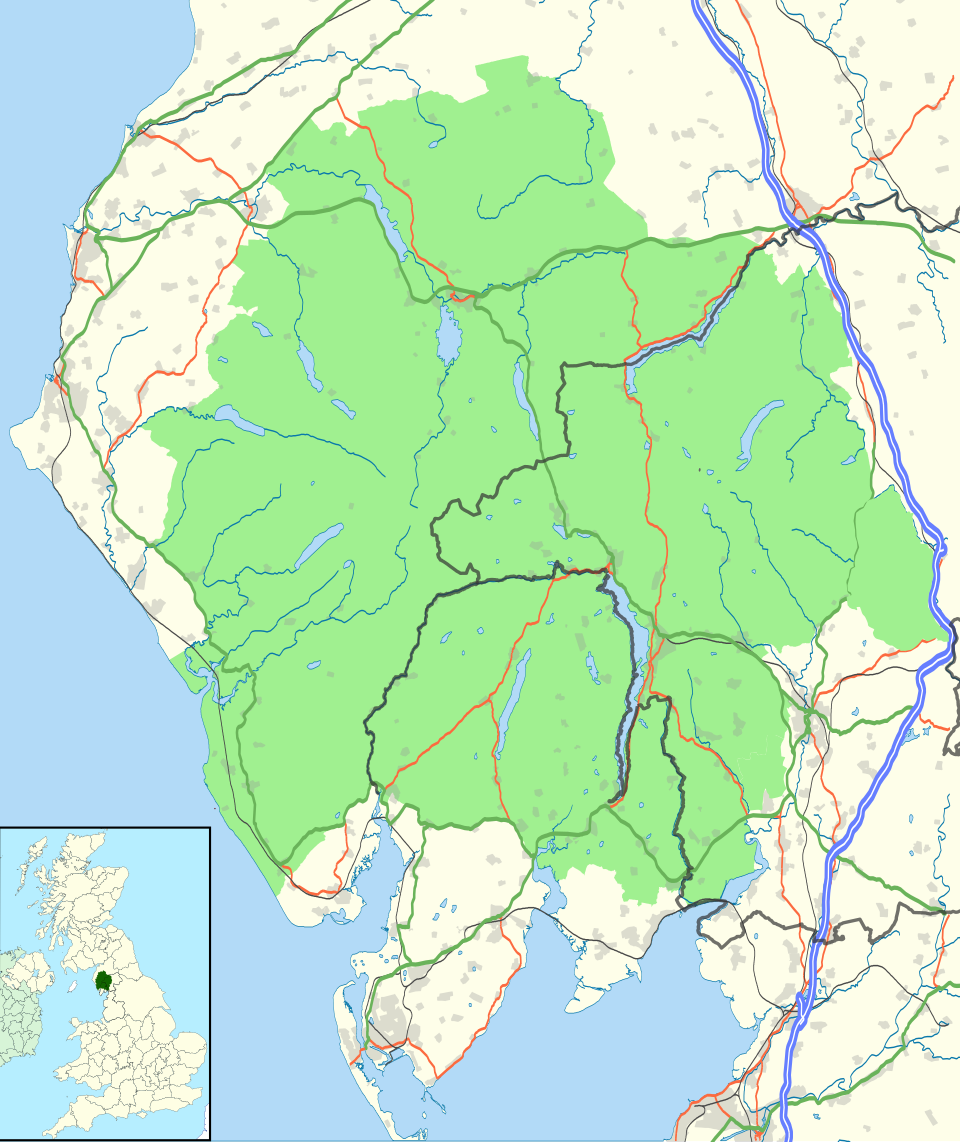
The Lake District National Park covers 236,200 hectares. The
Climate Change Committee’s pathway reaches 700,000 hectares of energy
crops across the UK by 2050 — an area almost three times as large. The
crops are not proposed for the park. Map: Wikishire/Hogweard
via Wikimedia Commons, CC BY-SA
4.0.

Look at the outline of the Lake District. Its fells, valleys, farms
and villages fill 236,200 hectares. Now imagine an area
almost three times its size.
That is the Climate
Change Committee’s figure for land planted with energy crops across
the United Kingdom by 2050: 700,000 hectares, or about
1.73 million acres. It is not a proposal to plant the
Lake District. The map is a scale comparison. The crops would be
scattered across the country — which is precisely why their cumulative
impact could be difficult to see.
And the land is only the beginning. In the same pathway,
cattle and sheep numbers fall by 27% by 2040 and 38% by
2050, against 2023. Average meat consumption falls by
25% by 2040 and 35% by 2050, against 2019. These are the
CCC’s own assumptions, sitting beneath the headline number of a
carbon budget.
What is being changed here is not merely how Britain generates
energy. It is what Britain grows, what it eats, what it imports
and whether its farms can survive the transition.
THE
NUMBER PARLIAMENT VOTED ON — AND THE LAND BEHIND IT
In June 2026, Parliament approved
the Seventh Carbon Budget: a legally binding UK emissions limit of
535 million tonnes of carbon dioxide equivalent over
2038–42. The Government
describes it as an approximately 87% reduction from 1990 levels.
The 700,000 hectares and livestock reductions are not
themselves statutory quotas. No law tells each farmer to cut a
herd by 38%. They are figures in the CCC’s Balanced Pathway,
the model used to advise how the target can be reached. That distinction
matters. So does the next question: how credible is a legal
destination if its assumed changes to land and food have not been
presented as one national, testable plan?
The CCC says just 13,000 hectares of miscanthus and
short-rotation coppice are currently recorded, while the starting area
for short-rotation forestry is unknown. From that small and partly
uncertain base, its model reaches 700,000 hectares across the three crop
types by 2050. CCC,
agriculture and land use.

Miscanthus near Bonby, Lincolnshire: an existing energy crop,
shown here to illustrate what the CCC means by dedicated planting. This
photograph does not identify land proposed for a future scheme.
Photograph: David
Wright / Geograph via Wikimedia Commons, CC BY-SA
2.0.

The crops include miscanthus, short-rotation coppice and
short-rotation forestry. They can supply fuel and industrial
processes. Some uses are coupled in the CCC pathway to carbon capture
and storage, which is meant to produce carbon removals as well as
energy. The pathway envisages shifting from imported biomass towards
mainly domestic energy crops and residues by 2050. CCC,
bioenergy pathway.
That requires more than a planting target. It requires suitable
fields, long-term contracts, harvesting equipment, vehicles, processing
capacity, markets and — for some of the claimed benefit — working carbon
capture infrastructure. Where is the joined-up cost and land map for all
of it?

Short-rotation coppice willow in Nottinghamshire, another example
of the type of crop in the pathway. Photograph: Katy
Walters / Geograph via Wikimedia Commons, CC BY-SA
2.0.
_willow_-_geograph.org.uk_-_848096.jpg)
WHERE THE LAND IS
EXPECTED TO COME FROM
The CCC does not hide the mechanism once one reads into the report.
It says lower livestock numbers release land for woodland, peatland
restoration and energy crops. In its analysis, reducing
livestock numbers accounts for 68% of the land released by
2040. It also assumes less food waste, improved crop yields and
changes in stocking density. CCC,
land-release measures.
That phrase — land released — deserves a pause. Land does
not become vacant when a herd shrinks. There may be a farmer whose
income depends on it, a tenant whose agreement restricts other uses, a
breeding flock developed over generations, a dairy with buildings and
finance to repay, and local businesses that rely on the farm’s
production.

Sheep grazing below Great Mell Fell in the Lake District. This is
a working agricultural landscape, not a location designated for energy
crops. Photograph: Christine
Johnstone / Geograph via Wikimedia Commons, CC BY-SA
2.0.
_Great_Mell_Fell_-_geograph.org.uk_-_5314464.jpg)
The CCC records that farmers it met across the UK raised concerns
about jobs, communities and the risk that falling domestic
livestock production could be replaced by imported meat and
dairy. Its model assumes a corresponding shift in consumer
diets to avoid that outcome. It also expects diversification and
financial incentives for farmers. CCC,
Seventh Carbon Budget, farming impacts.
Those are hypotheses that need testing. What happens if the public
continues buying much the same amount of meat? If domestic herds
decline, do imports rise? If they do, where are the overseas hectares
and supply-chain risks shown in the British account?
THE PROMISE TO PROTECT
FOOD PRODUCTION

Cattle grazing near Goonhavern, Cornwall. The Government’s
promise to maintain overall food production must be tested against what
happens to individual farming sectors and their supply chains.
Photograph: Tony
Atkin / Geograph via Wikimedia Commons, CC BY-SA
2.0.

The Government’s Land
Use Framework for England pledges to maintain overall food
production. It says greater productivity and more careful land
decisions can make that possible. It promises to examine reliance on
food imports in the 2027 UK Food Security Report,
including the risk of transferring demand for land overseas as “imported
hectares”.
This is a claim that should be tested against the CCC pathway, not
repeated as an answer to it. The frameworks are drawn on
different geographical and time boundaries: one is
England’s land-use policy; the 700,000 hectares and livestock figures
are UK-wide projections to 2050. Overall food output could also be
maintained while a particular livestock sector contracts. Farmers and
consumers deserve to see those changes clearly, rather than be assured
by an aggregate.
The question of payment is no footnote. The CCC examined 16 modelled
rural land-use transitions and found that most did not deliver a
private net benefit, even where its calculation showed wider
social benefits. It said government support would be needed to make the
returns and incentives work for farmers. CCC,
rural land-use archetypes.
So what will be paid, to whom, for how long, and from which public
budget? What happens when a tenant wishes to keep producing food but a
landowner sees a stronger return elsewhere?
A
NATIONAL PLAN CANNOT BE HIDDEN IN SEPARATE SPREADSHEETS
An energy-crop field, a solar farm, a new woodland, restored peat,
housing and a transmission corridor can each arrive with its own
appraisal. Some uses may overlap; others compete for the same land.
Adding every headline hectare would exaggerate the total. Ignoring the
combined pressure would conceal it.
That is why the public needs a single national land and food
account showing:
- where the proposed energy crops could realistically grow, by land
grade and existing use; - how woodland, peatland, solar, infrastructure and development claims
overlap; - what happens to cattle and sheep output, farm income and the wider
rural supply chain; - whether food imports, foreign land use and food-security risks
increase; - the full cost of incentives, processing, transport and any carbon
capture on which the model relies; and - what happens if yields, diet changes or planting rates fall
short.
Farmers may choose to grow energy crops. Woodland and peat
restoration can have benefits. Those possibilities do not relieve
Parliament of the duty to understand the combined consequences of the
pathway it has chosen.
Nearly three Lake Districts of energy crops. A model with 38%
fewer cattle and sheep. A legal carbon limit already approved. This is
about much more than energy.
MAKE THEM SHOW THE EVIDENCE.
The petition calls for a temporary suspension of the duties to
meet the statutory carbon budgets and 2050 target until Parliament has
considered an independent national assessment of their full costs and
impacts. Signing the petition does not itself change the law.
Leave a Reply