
Eighty-seven
large solar sites were already operating by Cornwall Council’s last
published count. Eight more had permission. Since then, three rejected
schemes covering roughly another 415 acres have been approved on appeal.
Yet there is still no single public account of the complete cost, the
cumulative landscape change or the grid infrastructure required.

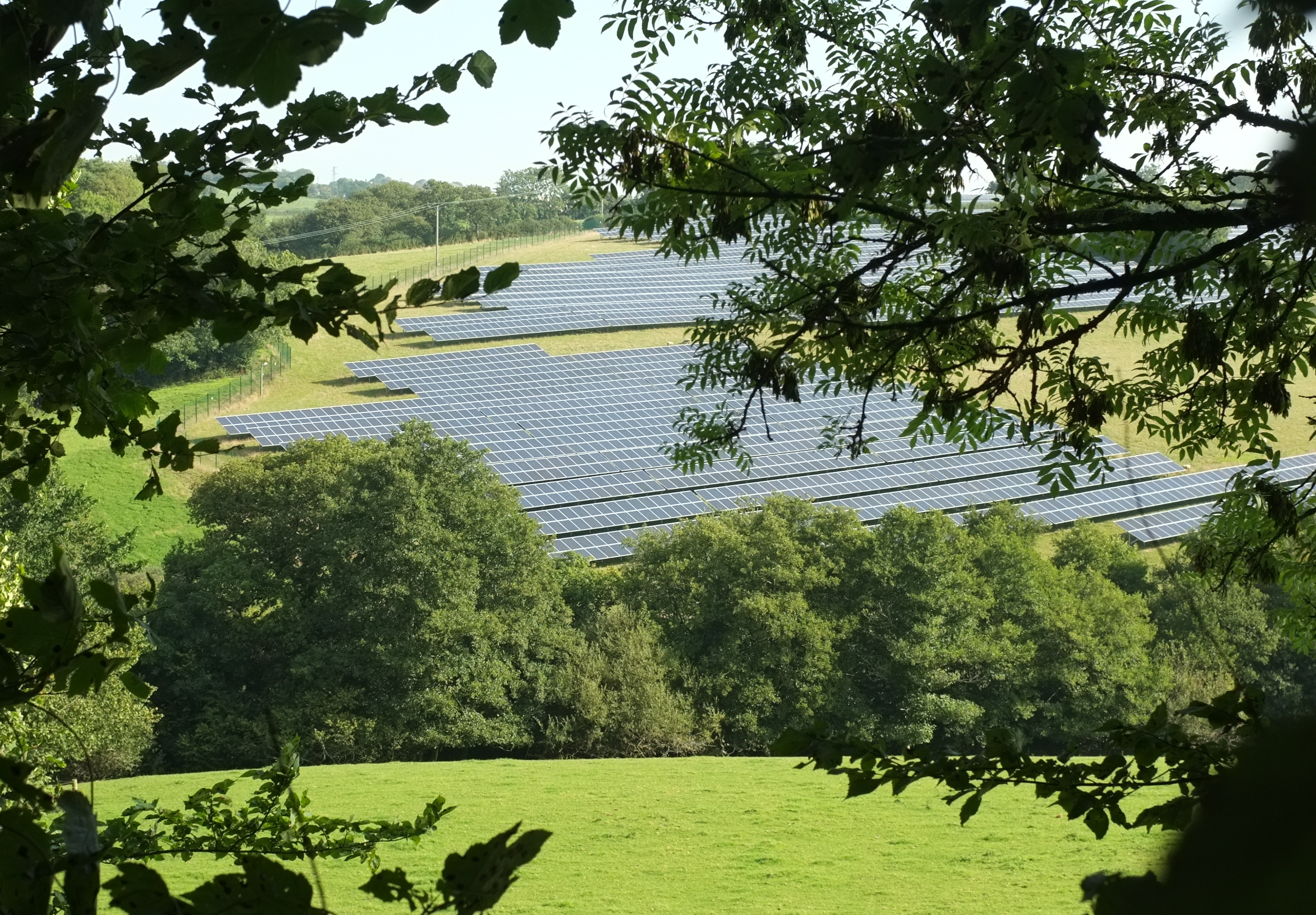
Pensipple Solar Farm at St Keyne, Cornwall. This is what
“temporary” energy infrastructure looks like across a Cornish valley:
ranks of panels, security fencing, tracks, transformers and electrical
equipment inserted into an agricultural landscape. Photograph: Derek
Harper/Geograph, CC BY-SA 2.0.

Cornwall’s solar transformation is not a future possibility.
It has already happened.
Field by field, parish by parish, the county has become one of
Britain’s principal locations for industrial-scale ground-mounted
solar.
The language used for each application is reassuringly local: one
farm, one cable route, one landscape plan, one temporary permission.
But viewed across the county, the picture is very different.
Dozens of generating sites.
Thousands of acres.
New substations, inverters, transformers, access tracks, security
fencing, battery compounds and underground cables.
And a planning system in which decisions made by Cornwall’s elected
councillors are repeatedly being overturned on appeal.
The central question is no longer whether one more solar farm can be
screened by a hedge.
It is this:
How much of Cornwall’s countryside has already been
committed, what will the complete build-out cost, and where is the
cumulative public account?
THE COUNCIL’S OWN
FIGURES ARE ONLY THE FLOOR
Cornwall Council publishes a renewable-energy ledger drawn from its
planning records.
The latest
document currently available on its website is dated August
2025.
It recorded 87 operational large-scale solar sites
with a combined capacity of 470.042MW, occupying
approximately 2,883 acres.
It also recorded eight approved but not yet operational
schemes, totalling approximately 109.538MW and
712 acres.
That means the Council’s published baseline already amounted to:
- 95 operational or approved large solar
developments; - 579.58MW of capacity; and
- approximately 3,595 acres of land.
That is more than five and a half square miles.
And it is not the present total.
The document predates several important appeal decisions that have
since added more consented land, solar capacity and battery
infrastructure.
THREE REFUSALS — THREE
APPEAL VICTORIES
Since the Council’s August 2025 snapshot, three schemes rejected by
Cornwall’s elected planning committee have been allowed on appeal.
MENEAR — 63 ACRES
The Menear proposal near St Austell consists of approximately
17MWp of solar generation and a 5MW battery
installation.
The application site covers approximately 25.5 hectares — 63
acres.
Cornwall councillors refused it after concluding that it would cause
significant harm to the landscape and affect what opponents described as
the last green fields in that part of the St Austell setting.
The refusal was overturned
on appeal in February 2026.
SPEEDWELL — ALMOST 200 ACRES
Speedwell Solar Farm at Gwinear would provide up to 40MW of
export capacity across 22 fields and almost 200 acres
of farmland.
Cornwall Council refused the scheme in February 2025.
The Planning Inspectorate allowed
the appeal on 19 March 2026.
The developer now expects construction in 2027–28 and operation in
2029.
Read
the Speedwell project account
TRERICE — 152 ACRES,
PLUS A 45MW BATTERY
Trerice, near St Dennis, would add 32MW of solar generation
and a 45MW battery-energy-storage system across 61.5
hectares — approximately 152 acres.
Cornwall councillors refused it in July 2025.
A government planning inspector overturned
that decision in August 2026.
Construction is currently expected in 2028–29.

The landscape beside the proposed Trerice development near St
Dennis. The consented scheme combines a 32MW solar farm with a 45MW
battery compound across approximately 152 acres. Photograph: Cornwall
Council, reproduced by the Cornish
Times.
Together, those three appeal decisions add approximately:
- 89MW of solar capacity;
- at least 50MW of battery capacity; and
- 415 acres of development sites.
Add them to Cornwall Council’s August 2025 baseline and the county
has approximately 668.6MW of operational or consented
large-scale solar across around 4,010 acres.
That is before the next refused scheme returns through the appeal
system.
TRELION —
ANOTHER 204 ACRES WAITING IN THE WINGS
Trelion would place up to 49.9MW of solar generation across
82.5 hectares — approximately 204 acres and 19 agricultural
fields near St Stephen.
The Council’s committee papers identified approximately 63.5
hectares of Best and Most Versatile Grade 3a agricultural land
within the site.
They also recorded:
- an intended operating period of 40 years;
- an 8.4-kilometre cable route to Indian Queens
substation; - cumulative landscape effects with other solar developments; and
- the displacement of seven skylark nesting sites, requiring off-site
compensation.
On 16 July 2026, Cornwall’s Strategic Planning Committee refused the
application by seven votes to three, finding that the
development would significantly harm the distinctive undeveloped
character and beauty of the site and its setting.
Read
the account of the refusal
EDF said it would review the decision before deciding what to do
next.
The recent history of Cornwall solar appeals is therefore impossible
to ignore.
The Council was told in 2026 that all six solar applications rejected
by its Strategic Planning Committee since July 2024 had subsequently
been allowed on appeal.
If Trelion follows the same route and ultimately gains consent,
Cornwall’s operational and approved large-solar footprint would rise to
approximately 4,214 acres, with capacity approaching
718.5MW.
The landscape has a local planning authority.
But increasingly, the final decision is being made elsewhere.
WHAT DOES 668.6MW OF SOLAR
COST?
There is no single published ledger showing the historic capital cost
of Cornwall’s operational solar fleet and the expected cost of every
consented development.
The projects were developed at different times, under different
commercial arrangements and with different connection requirements.
But the Government has published a current benchmark that allows the
scale to be tested.
Research commissioned by the Department for Energy Security and Net
Zero and undertaken by Arup gives total capital-cost assumptions for
large-scale solar above 5MW of:
- £526 per kWp in the low case;
- £659 per kWp in the central case; and
- £788 per kWp in the high case.
Those figures are in 2023 real prices and include pre-development,
construction and infrastructure cost assumptions.
Read
the Government-commissioned cost report
Apply those benchmarks illustratively to approximately
668.6MW of operational or consented Cornwall solar and
the present build-equivalent cost is:
- Low case: approximately £352 million
- Central case: approximately £441 million
- High case: approximately £527 million
This is not a claim that £441 million was actually paid for the
existing fleet.
Older sites were built under earlier cost conditions. Project
capacities may also be expressed on slightly different AC or DC
bases.
It is a transparent estimate of what capacity on this scale
represents when tested against the Government’s own present
benchmark.
And it is not the complete bill.
It does not provide a reconciled account of:
- the 50MW or more of battery capacity attached to the three appeal
schemes; - the duration and energy capacity of those batteries in
megawatt-hours; - separate cable routes such as Trelion’s proposed 8.4
kilometres; - distribution-network and substation reinforcement;
- land agreements and compensation;
- interest and financing during development and construction;
- constraint or curtailment exposure;
- replacement of inverters, transformers or batteries;
- operating and maintenance expenditure; or
- decommissioning and land restoration.
The same Arup report gives a central annual operating-cost assumption
of approximately £9,300 per MW.
Applied illustratively to 668.6MW, that is approximately £6.2
million every year — around £236 million over the
report’s central 38-year operating life, before financing and
without adjusting the annual figure for inflation.
Add that straight-line operating illustration to the central capital
benchmark and the figure approaches £677 million.
Again, that is not a project-by-project Cornwall forecast.
It is what becomes visible when the published fragments are brought
into one place.

A solar development near Hayle, Cornwall. The industrial
footprint extends beyond the panels themselves to fencing, access
tracks, transformer equipment and grid connections. Photograph: Philip
Halling/Geograph, CC BY-SA 2.0.

669MW ON THE
NAMEPLATE IS NOT 669MW OF FIRM POWER
Solar-project publicity almost always leads with nameplate capacity
and a calculation of how many homes might use an equivalent quantity of
electricity over a year.
That does not make solar generation worthless.
But it does not make it firm power either.
The Arup report uses a central net load-factor assumption of
12.2 per cent for large-scale solar.
Applied illustratively to 668.6MW, that produces approximately
715GWh over a year, equivalent to an average output of
around 81.6MW.
Output would not arrive as a steady 81.6MW.
It would rise and fall with daylight, season and weather, reaching
much higher levels at favourable times and nothing at night.
That variability is why the cost of the complete system cannot stop
at the solar-farm gate.
The public account must include the networks, flexibility, storage,
balancing and firm generation required to make the wider electricity
system work when solar output is low or absent.
THE
BATTERY HEADLINES CONCEAL THE MOST IMPORTANT NUMBER
Menear advertises a 5MW battery.
Trerice advertises a 45MW battery.
Those figures describe the maximum rate at which power can be
delivered.
They do not tell the public how much energy can be stored.
A 45MW battery lasting one hour contains 45MWh.
A 45MW battery lasting four hours contains 180MWh.
The difference is fundamental.
Yet the prominent public descriptions do not provide one reconciled
county-wide account of:
- battery duration;
- total megawatt-hours;
- expected cycling and degradation;
- replacement intervals;
- fire and emergency arrangements;
- augmentation costs; or
- eventual recycling and disposal.
Calling a battery “45MW” without its duration is like describing a
water tank by the width of its outlet while withholding the size of the
tank.
CORNWALL IS
STILL DEVELOPING THE LAND-USE FRAMEWORK
In April 2024, Cornwall Council passed a motion concerning farmland
and solar farms.
Its subsequent Land Use Study now proposes creating a monitoring
structure to track land-use change and a framework for future
decisions.
Read
Cornwall Council’s Land Use Study update
But while the framework is still being developed, the acreage keeps
moving through the system.
Applications are determined individually.
Appeals are considered individually.
Battery compounds are described separately.
Cable routes may arrive as separate applications.
Grid costs sit elsewhere again.
That is precisely how the cumulative transformation becomes difficult
for the public to see.

An existing solar development at St Stephen-in-Brannel. Trelion
would add another 204-acre scheme within the same wider parish landscape
if its refusal were overturned. Photograph: Jay
Pea/Geograph, CC BY-SA 2.0.

THE QUESTION IS NOT “ONE
MORE FIELD”
The defence of every individual scheme is that it supplies
electricity, supports national targets, lasts only 40 years and occupies
a small proportion of Britain’s agricultural land.
But Cornwall is not being asked to host one isolated scheme.
It already has around 4,000 acres of operational or consented
large-scale solar when the latest appeal decisions are added to the
Council’s published baseline.
It has battery compounds whose storage duration and lifecycle cost
are not consistently placed before the public.
It has projects requiring kilometres of new cables and access
works.
And it has local refusals repeatedly overturned without a complete
county-wide account being presented first.
The correct question is not whether each development can be made to
look tolerable when viewed alone.
It is whether Parliament, councils and communities have been shown
the cost and consequences of the complete programme.
They have not.
MAKE THEM SHOW THE EVIDENCE
My Parliamentary petition asks Parliament to suspend Climate Change
Act targets and undertake a full independent national impact assessment
of the statutory programme.
That assessment must include:
- the complete capital and lifetime cost;
- the grid and substation infrastructure required;
- storage capacity measured in both MW and MWh;
- balancing, constraint and backup costs;
- agricultural land and food-security effects;
- cumulative landscape change;
- equipment replacement and decommissioning; and
- the consequences for bills, taxpayers and energy security.
Cornwall shows exactly why project-by-project planning is not
enough.
The countryside is being transformed as one cumulative programme.
The evidence and the costs should be presented the same way.
✍️ SIGN THE
PARLIAMENTARY PETITION — MAKE THEM SHOW THE EVIDENCE
If you agree that Parliament should see the complete account before
more of the country is committed, please sign and share the
petition.
Whatever your view of solar power or Net Zero, Cornwall deserves more
than another isolated planning file.
It deserves the complete picture.
Shane Oxer
Campaigner for fairer and affordable energy
PRINCIPAL SOURCES
- Cornwall
Council — Renewable Energy Capacity Data, August 2025 - Cornwall
Council — Renewable Energy Maps - Cornwall
Council — Land Use Study update - DESNZ/Arup
— Onshore Wind and Solar Cost and Technical Assumptions - Planning
Inspectorate — Speedwell appeal case - Statkraft
— Speedwell Solar Farm - Statkraft —
Trerice Solar Farm - Cornish
Times — Trerice appeal decision - Anesco — Menear
Solar Farm - Cornish
Times — Menear appeal decision - Cornwall
Strategic Planning Committee — Trelion evidence - Councillor
Dick Cole — Trelion refusal
Leave a Reply