
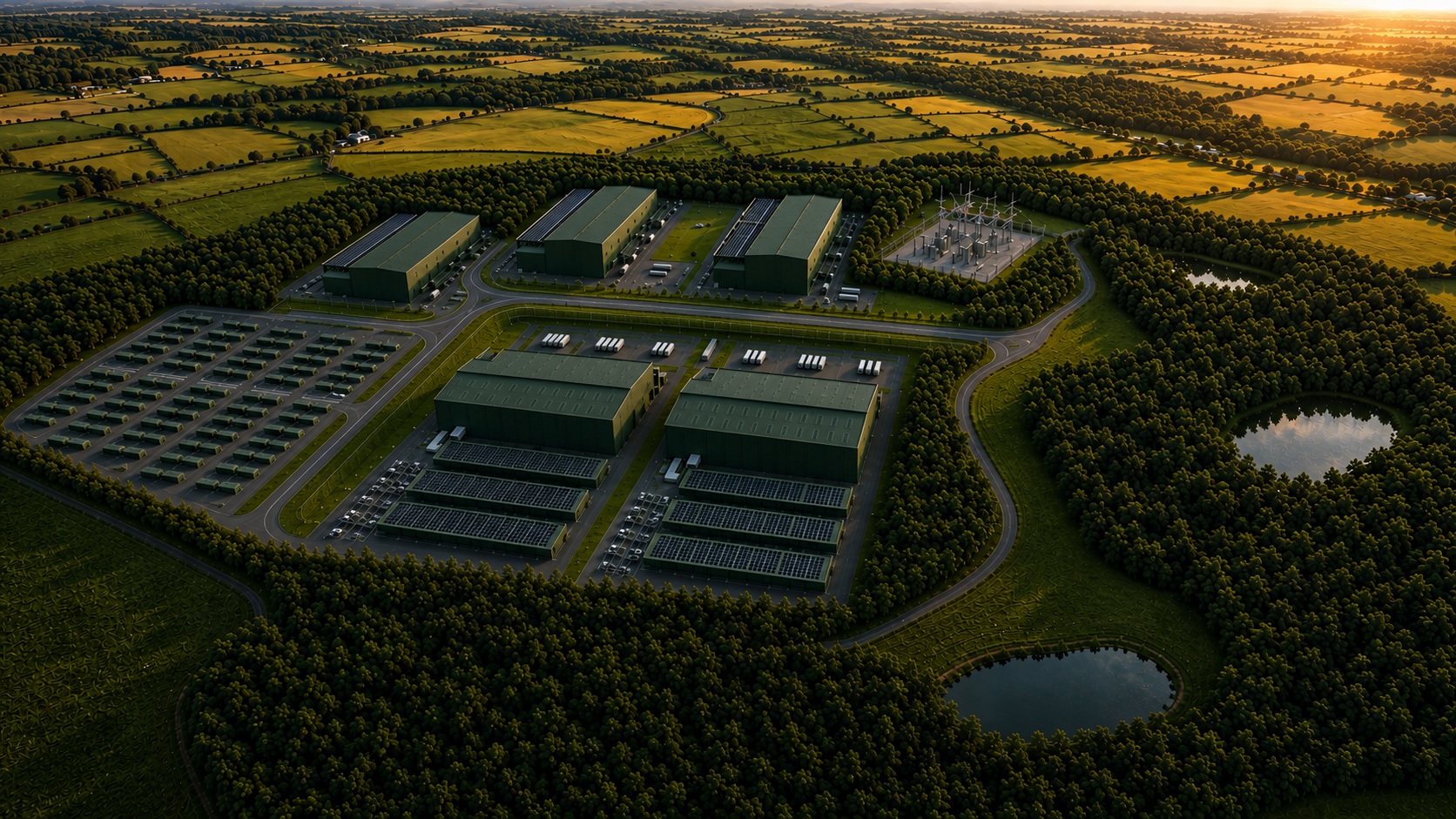
An AI campus and a possible Moroccan power link expose the scale of investment being discussed. The public deserves a complete account of construction, electricity payments and costs reaching British bills.
Our earlier Devon investigation asked where the power plan was for an enormous AI campus at Alverdiscott. Following the money raises another question: how much investment could sit behind this development, and how much of the payment chain could reach the public?

Tens of billions before a complete account
Xlinks puts the proposed Devon campus investment at £12.2–13.8 billion. Its publicity brings together an AI data centre and a large battery scheme, without publishing an individual construction price for each component.
The Moroccan power project’s April 2024 construction estimate was £22–24 billion. That covered the wider generation and transmission scheme, including storage, rather than being a price for the subsea cable alone.
If Morocco were revived alongside the Devon campus, adding those headline figures gives the following scale:
| Published investment figures | Amount |
|---|---|
| Full Moroccan power project | £22–24 billion |
| Devon campus investment | £12.2–13.8 billion |
| Combined headline figures | £34.2–37.8 billion |
The figures have different dates, and shared infrastructure must be reconciled to avoid counting it twice. They establish the scale being discussed. A revival needs a new budget showing what is included, what has changed and what remains outside the developer’s figures.
The current campus proposal takes its electricity from the National Grid. Morocco remains a possible later connection through a separate project. The combined figure above examines that revival scenario; it is not an announced joint construction contract.
The British works already carry a multibillion pound price
The Morocco project’s funding statement identified a UK construction subtotal of approximately £3.2 billion. It was already inside the Moroccan total: adding it again would inflate the bill.
| UK costs within the Moroccan estimate | Amount |
|---|---|
| Cables and converters with installation protection and civil works | £2.6 billion |
| Developer costs including administration insurance and advisers | £500 million |
| Land rights and compensation | £17 million |
| Published rounded UK subtotal | £3.2 billion |
These are substantial works before the Devon data halls and their own battery facility are considered. The public still needs a joined account explaining which substations, cables and network upgrades would be shared and which would be additional.

The campus could buy most of the Moroccan electricity
Devon CPRE’s account of developer meetings records a 1.8 GW peak site load, covering more than the computing equipment alone. If the campus drew that continuously, annual consumption would be approximately 15.8 million megawatt-hours. Actual consumption would depend on occupancy and operating demand.
Xlinks’ funding statement modelled UK delivery of approximately 24.3 million megawatt-hours annually. In the full-load campus scenario, roughly 65% of that expected electricity would be consumed by this one development, before extra storage losses in Devon.
That provides a plausible commercial fit. A large customer committing to buy electricity for many years could help an overseas power project secure finance. The supply agreement and an hourly operating assessment would establish how reliably the campus could be served.
The battery figure leaves an essential question unanswered
The published Devon battery rating is 1.8 GW. That measures how quickly it can supply electricity. The public project pages reviewed do not specify its usable stored energy or how long it could support the campus.
For illustration, a constant 1.8 GW demand over a 12-hour night requires 21,600 megawatt-hours delivered from storage. Charging losses and operational reserves would also need allowance. The batteries in Morocco and the batteries in Devon are separate systems, so their costs and responsibilities need separate entries.
Investors provide the capital and customers repay it
The original funding statement named development backers including TAQA, TotalEnergies, Octopus Energy, GE Vernova and the Africa Finance Corporation. The construction strategy combined investor capital and borrowing.
Investors expect returns, and lenders expect repayment with interest. The money comes back through electricity sales and charges to data-centre customers. Calling a project privately financed tells us who supplies capital at the start; its contracts determine who carries the costs over the following decades.
A revived subsidy contract could reach British bills
Xlinks sought a 25-year Contract for Difference. The Government declined further consideration of support in June 2025. Any revival on that basis would require a new agreement.
Under the usual contract mechanism, the generator receives a top-up when the reference electricity price falls below the agreed strike price. Suppliers fund those payments through a levy, and recover the cost through household and business electricity bills.
An illustrative average top-up of £40 per megawatt-hour, applied to the full expected Moroccan output, would mean about £970 million annually. Over 25 years, holding that gap and output constant, the total would be approximately £24.3 billion.
That example shows the scale of a possible payment obligation, not an agreed subsidy. Payments reverse when the reference price is above the strike price. A wholly private electricity purchase agreement would have a different payment structure and would not automatically create a national subsidy levy.
Electricity payments would continue for decades
Xlinks’ old strike-price guidance was £70–80 per megawatt-hour in 2012 money. A simple ONS inflation conversion gives approximately £105–120 in August 2026 money. A revived contract would need fresh pricing.
At that benchmark, the campus at constant 1.8 GW demand would require approximately £1.65–1.9 billion a year for electricity, before additional Devon storage losses and separately charged networks, levies and taxes. Its actual electricity contract has not been disclosed.
Applying the same benchmark to the whole Moroccan project gives roughly £64–73 billion of gross electricity payments over 25 years. This illustration holds prices constant in August 2026 purchasing power. Those payments recover Moroccan construction, finance, operating costs and returns; adding them to the construction total would count capital recovery twice.
The grid and public finance need their own account
NESO explains the separate charging routes for connections and the wider transmission network. Dedicated assets are charged to their users, while transmission investment is recovered through wider system charges. The campus’s contribution and any additional share falling on other electricity customers need a project-specific assessment.
Public investment has also been announced for cable manufacturer XLCC. The Scottish National Investment Bank’s announcement records an initial £20 million from the National Wealth Fund alongside its own £20 million, with approximately £67 million more conditional on milestones. These are investments in a broader cable business; neither their eventual cost to taxpayers nor their full attribution to the Devon proposal is established.
Publish the complete bill
The figures are published in separate places. What is missing from the public material reviewed is a reconciled account linking construction, finance, network works, electricity contracts and equipment replacements to the organisations and customers paying for them.
Before benefits are accepted at face value, councillors and Parliament should require the current budget and supply commitments. They should be able to identify every cost charged to the developer, every cost recovered from customers, and every public investment or guarantee.
Britain is discussing transformations on a scale of tens of billions while the public is left to assemble the payment chain. Our demand is straightforward: publish the evidence, publish the complete account, and show who pays.
Our petition for an independent national impact assessment specifically includes public and private costs, electricity bills, land and infrastructure, and demand from data centres. Sign the petition to suspend Climate Change Act targets and undertake a full national impact assessment.
Evidence and calculation notes
Construction figures retain their original dates and scopes; their combined sum is not a current quotation. The campus’s individual battery and equipment costs are not itemised in the quoted publicity. Replacements and operating costs require a lifetime budget, and financing items must be checked for inclusion before anything is added.
Annual campus demand assumes 1,800 MW for 8,760 hours. The Moroccan annual figure uses Xlinks’ published 3.6 GW × 8,760 hours × 77% model. The 65% comparison assumes all campus consumption comes from Morocco and precedes additional Devon storage losses; annual totals do not prove uninterrupted hourly supply.
The price conversion uses the ONS CPI index of 96.1 for 2012 and 143.6 for August 2026. Electricity payments and top-ups are undiscounted illustrations over 25 years with constant real prices and output. Gross electricity revenue is distinct from net subsidy, and neither is a published campus tariff.
Primary sources are linked beside the claims. Figures and project descriptions checked on 4 October 2026.
You must be logged in to post a comment.