Others have examined whether Britain came close to blackouts during the June heatwave. My analysis follows the money and asks why consumers were left paying millions to rescue a system that was supposedly prepared.
There are two ways to examine what happened to Britain’s electricity system during the extreme heat of June 2026.
The first is operational: Did the National Energy System Operator anticipate the conditions correctly, maintain the required security standards, and manage the system transparently?
The second is economic: what did the emergency intervention cost, who ultimately pays for it, and what does it reveal about the underlying design of Britain’s electricity system?
The Eigen Values roundup drew attention to The Times’ investigation into the operational side of the incident. My earlier analysis examined the second part: the extraordinary cost of securing emergency electricity, including imported power reportedly purchased for almost £1,400 per megawatt-hour.
Taken together, the two analyses expose a much bigger issue.
This was not merely an unusual evening in the control room. It was a warning about a national electricity strategy that is becoming increasingly difficult—and increasingly expensive—to operate.
What happened during the June heatwave?
The most serious questions concern the evening of 23 June 2026.
Electricity demand rose sharply as homes, offices, supermarkets, and public buildings increased their use of fans, cooling, and air-conditioning. At the same time, wind generation was low, solar output began declining during the evening, and generating capacity elsewhere in Europe was also under pressure.
Industry data indicated that system frequency fell below NESO’s normal operating range of 49.8Hz to 50.2Hz. The lowest reported figure was approximately 49.66Hz. That remained above the statutory lower limit of 49.5Hz, but it was nevertheless outside the normal operational range intended to provide a buffer against more serious instability.
Reports subsequently alleged that several system-security constraints were breached. Whistleblowers also raised serious questions about operational decision-making, record-keeping, and the involvement of corporate affairs personnel during the incident.
Those allegations remain under investigation and should not be presented as established findings. NESO maintains that the system operated securely, that no customer demand was disconnected, and that frequency and voltage remained within statutory limits.
However, the seriousness of the matter is demonstrated by Ofgem’s response.
On 17 July, Ofgem formally commissioned a post-event regulatory review covering the system event on 23 June, and the Electricity Margin Notices issued on 24 and 26 June. The review will examine operational decisions, market actions, record-keeping and possible breaches of the Grid Code, the Security and Quality of Supply Standard, and other relevant requirements.
That is not a routine public-relations exercise. It is an investigation into whether the electricity system was operated in accordance with the standards designed to protect the country from disruption.
The warning that was not expected
Only two months before the event, NESO’s Summer Outlook had presented a broadly reassuring picture.
Its public message was that Britain should have sufficient electricity throughout the summer 2026. The organisation placed considerable emphasis on the opposite problem: periods of surplus electricity and low transmission-system demand caused by strong renewable generation and embedded rooftop solar. NESO even introduced arrangements intended to encourage consumers to increase electricity use during periods of excess supply.
But the events of late June produced a very different challenge.
Instead of too much electricity, Britain suddenly faced tight evening margins. Instead of paying consumers to absorb surplus power, NESO had to make urgent requests for additional generation and imports.
According to The Times, NESO’s outlook had forecast peak summer requirements of approximately 29.7GW. On 23 June, reported demand reached approximately 35GW as cooling demand increased during the heatwave.
Forecasts will never be perfect. Electricity-system operators must constantly adjust their position as weather, demand, generator availability, and interconnector flows change.
But this was not a minor forecasting discrepancy.
If the reported figures are correct, the difference between the expected peak and the actual requirement was several gigawatts—the equivalent of multiple large generating units. That scale of error matters because the system must carry sufficient reserve not only to cover forecasting mistakes but also to withstand the sudden loss of a major generator, transmission circuit, or interconnector.
The question is, therefore, not whether NESO eventually found enough electricity.
The question is why the country arrived at that position with so little margin and at such enormous cost.
The £10–11 million rescue
On 24 June, NESO issued an Electricity Margin Notice indicating that it required an additional 1,900MW for the evening peak.
The notice was later withdrawn after extra supplies were secured. However, reports estimated that NESO agreed to pay approximately £1,400/MWh—nearly 20 times the average wholesale price recorded in June the previous year—to obtain around 1.7GW of imported electricity
The estimated cost of securing sufficient electricity that day was approximately £10 million, more than four times the usual daily balancing average. Subsequent reporting placed the cost of emergency interventions on one of the critical days at approximately £11.2 million. These remain reported estimates rather than the final audited cost that Ofgem’s review should establish.
That distinction matters, but it does not alter the central point.
Emergency electricity was available—but only at an exceptional price.
The public was told that supply had been maintained, which is true. But “the lights stayed on” is not a complete measure of success when the system had to pay extraordinary prices to make that happen.
A secure electricity system should be judged by three connected standards:
Can it meet demand?
Can it withstand credible failures?
Can it do so at a reasonable and sustainable cost?
Meeting only the first test, at almost any price, is not evidence of a properly functioning energy strategy.
Who pays the balancing bill?
NESO does not absorb these costs like an ordinary commercial company accepting a loss.
The costs of balancing supply and demand are recovered through Balancing Services Use of System charges. These charges ultimately feed through the electricity market and into consumer bills.
NESO’s own 2025 Annual Balancing Costs Report calculated that these charges contributed approximately 3.4 per cent of an average domestic electricity bill in 2024–25 , around £3 a month for a typical household. Ofgem has also confirmed that relevant NESO costs are recovered through BSUoS arrangements and are ultimately paid through consumers’ bills.
The individual June intervention will be spread across millions of customers and will not appear as a clearly labelled £11 million charge on household statements.
That does not mean the cost disappears.
It becomes another component within the increasingly complicated collection of wholesale, network, balancing, constraint, capacity, and policy costs paid by families and businesses.
This is precisely why examining only the operational outcome is insufficient.
NESO may be able to say that no homes were disconnected. But consumers are entitled to ask how much it cost to prevent that disruption, why those costs were necessary, and whether earlier preparation could have reduced them.
Imports are useful—but they are not guaranteed domestic capacity
Electricity interconnectors are valuable. They allow Britain to trade with neighbouring systems, export surplus electricity, and import power when it is economical to do so.
But imports must not be treated as though they are identical to secure generating capacity located within Britain.
The June heatwave affected much of Europe at the same time. Demand for cooling rose across the continent, wind conditions were weak, and some French nuclear output was restricted because high temperatures made reactor cooling more difficult.
Britain was, therefore, seeking additional electricity from neighbours facing their own system pressures. That competition contributed to the extraordinary prices paid for imported power.
The danger is clear.
An interconnector may have a physical capacity of 1GW or 2GW, but that does not guarantee the exporting country will always have spare electricity available. In a widespread cold spell, heatwave or low-wind weather system, several countries may need the same power simultaneously.
A cable is a route to electricity. It is not itself a source of electricity.
Britain therefore needs to distinguish between interconnector capacity and dependable supply. Imports can support national resilience, but they cannot replace sufficient domestic firm capacity.
Weather-dependent generation and the evening problem
The June event should not be reduced to the simplistic claim that renewable energy alone caused the problem.
Extreme heat affected several technologies. Gas turbines can lose efficiency in high temperatures. Thermal generating stations may suffer cooling limitations. Transmission equipment can also carry less electricity safely when ambient temperatures are already high.
But it would be equally misleading to pretend that the changing generation mix played no part.
On 23 June, solar generation was strong during the middle of the day. Yet solar output fell rapidly as the evening approached, precisely when demand remained elevated. Wind generation was also weak because the same high-pressure weather system producing the heat brought relatively still conditions.
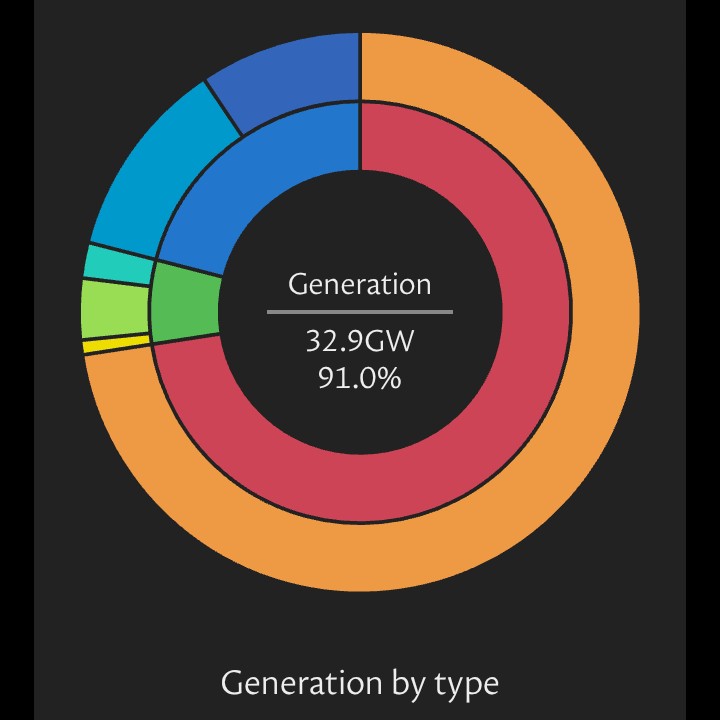
At around the evening peak, gas reportedly supplied more than half of Britain’s electricity. Nuclear, imports and the remaining wind generation contributed additional support, while solar had fallen almost completely away.
This is not an argument against every wind turbine or solar panel.
It is an argument against planning the electricity system as though installed renewable capacity is equivalent to dependable output.
A solar farm with a nominal capacity of 500MW cannot be assumed to provide 500MW after sunset. A wind farm’s installed capacity does not guarantee its output during still weather. Batteries can provide rapid frequency support and move limited amounts of electricity between different periods, but they must first be charged and their stored energy is finite.
The system must therefore maintain enough controllable generation, storage, reserve and network capability to cover the combined possibility of high demand, falling solar output, low wind, generator outages and restricted imports.
Those conditions are not unimaginable. June demonstrated that they can occur together.
Gas came to the rescue , again
One of the greatest contradictions exposed by the incident is Britain’s continuing dependence on gas-fired generation at the very moment policy is attempting to push it almost entirely out of routine electricity production.
Gas supplied the flexible output required during the critical evening period. It could be instructed to increase generation as solar fell and demand remained high.
That does not mean gas is immune from operational problems, nor that Britain should depend on gas alone. A resilient system requires diversity.
But it does mean that ministers must stop treating controllable generation as an embarrassing remnant of the past.
Until sufficient new nuclear generation, long-duration storage or another genuinely dependable technology exists at scale, gas remains an essential insurance policy. Closing dispatchable capacity before a proven replacement is operational would not eliminate the need for reliability. It would merely force Britain to purchase that reliability elsewhere , potentially at £1,400/MWh.
The sensible policy is a balanced system built around dependable domestic capacity: nuclear for long-term continuous generation, gas for flexible backup, appropriate storage, demand flexibility and renewable generation where it is technically and economically justified.
This is also a governance failure
The incident supports the wider argument set out in my presentation on Britain’s climate and energy governance structure.
The public usually encounters energy policy at the final stage: a higher bill, a planning application, a new pylon route, a substation, a solar development or an emergency warning.
But those consequences originate much further upstream.
Statutory targets lead to carbon budgets. Carbon budgets shape government policy. Departments and regulators translate that policy into investment incentives and system requirements. NESO then attempts to operate and plan the resulting system. Consumers finally receive the physical and financial consequences.
As the presentation explains, accountability is dispersed across departments, regulators, system planners and network companies. No single planning application or electricity bill reveals the entire machinery that produced the outcome.
The June event brings that governance pipeline into focus.
NESO made the operational decisions, but it operates within a system being transformed by government targets, Ofgem regulation, market rules, generator closures and the rapid connection of weather-dependent technologies.
That does not remove NESO’s responsibility. It demonstrates why the investigation must look beyond the actions of individual control-room staff.
It must examine whether the entire policy framework is creating a system that is more expensive, more difficult to forecast and more dependent on emergency intervention.
The questions that must now be answered
Ofgem’s review should publish a clear, chronological account of the events between 22 and 26 June.
It should identify NESO’s day-ahead and within-day demand forecasts, the actual outturn, available reserve, generator outages, interconnector positions, frequency deviations and any network constraints.
It should also publish the full financial cost of every balancing action, including gas generation, interconnector trades, emergency assistance, reserve procurement and any associated constraint payments.
The investigation must explain why the Summer Outlook concentrated heavily on surplus electricity and low-demand risks but apparently failed to anticipate the combination of high cooling demand, low wind and restricted continental supply.
It must establish whether the system met every applicable security standard , not merely whether frequency remained above the absolute statutory minimum.
Finally, it must determine whether operational records were maintained properly and whether anyone outside the control-room command structure attempted to influence decisions for reputational or political reasons.
These are not partisan questions.
They concern the physical security of the country and the proper use of money collected from electricity consumers.
What must change
Britain needs a new standard of energy accountability.
Every significant system-stress event should be followed by a published cost-and-reliability report showing what happened, what actions were taken, what they cost and how the expense will be recovered.
NESO’s seasonal outlooks must include credible extreme-weather scenarios , not only average conditions. The models should test prolonged low wind, rapid evening solar decline, high cooling demand, generator outages, and restricted imports occurring simultaneously.
Government policy must also recognise a basic engineering fact: installed capacity is not the same as dependable capacity. National plans should publish both figures clearly so that ministers can not present a gigawatt of weather-dependent generation as though it carries the same security value as a gigawatt of controllable generation.
Above all, affordability must be restored as a core measure of energy security.
It is not sufficient to keep the lights on through unlimited emergency spending and then quietly distribute the cost across household bills.
Keeping the lights on is not the whole test
The official defence of the June incident is that no customers were disconnected.
That matters. The control-room engineers who maintained supply under extremely difficult conditions deserve recognition.
But their success in preventing disruption must not be used to close down the scrutiny of the system that placed them in that position.
A hospital that prevents a patient from dying through emergency intervention has achieved something important. It does not follow that the patient was healthy or that nothing went wrong beforehand.
The same principle applies to the electricity grid.
Britain avoided customer disconnections because NESO used the tools available to it. But those tools included emergency requests, expensive gas generation, and imported electricity purchased at extraordinary prices.
The real lesson is, therefore, not that the system worked perfectly.
It is that the system survived at a price.
The Times and Eigen Values have helped expose the operational questions. My analysis exposes the economic consequence: consumers ultimately fund the rescue.
That is why the June heatwave must not be dismissed as a one-off weather event.
It is a warning that Britain is constructing an electricity system whose hidden costs become visible only when the weather stops cooperating.
And the next emergency may be more expensive or less forgiving.
Shane Oxer. Campaigner for fairer and affordable energy
 SAY NO TO THE DESTRUCTION OF OUR LAND
Leave a comment