Britain’s energy system to 2050 is approaching a decisive moment.
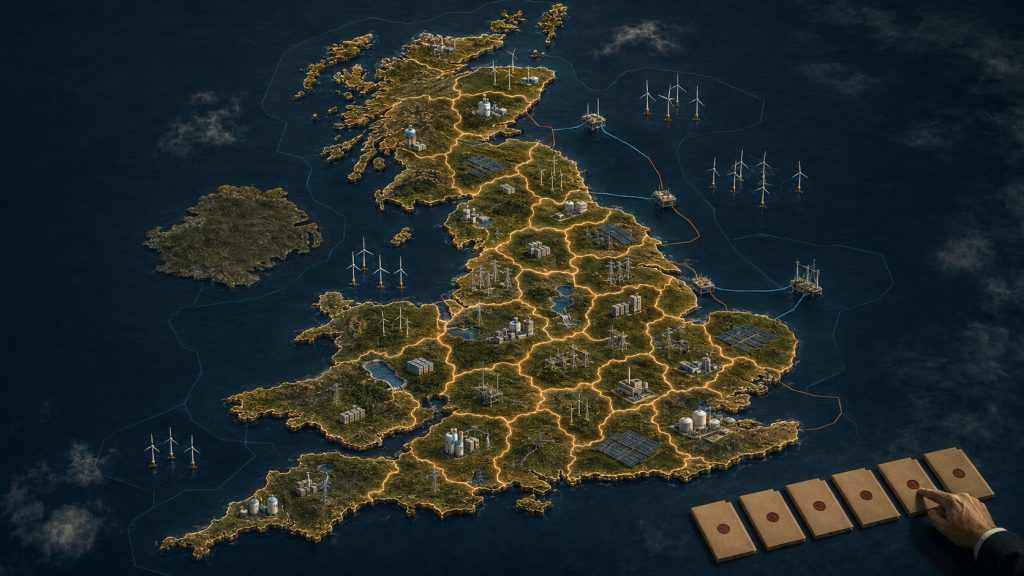
Six alternative futures are being assessed in confidence.
Ministers and regulators will see the comparison. The public will be consulted only after the Energy Secretary has chosen which one goes forward.
Britain is about to make one of the most consequential infrastructure choices in its modern history. It will affect what produces our electricity, where that infrastructure is concentrated, how much new grid is required, how much countryside and seabed is placed under pressure, which technologies receive investment signals, and what risks consumers are expected to carry.
Yet the decisive comparison is not being opened to the people who will live with the consequences.
The National Energy System Operator (NESO) has confirmed that its confidential Pathway Options Report will contain six Strategic Spatial Energy Plan pathways and their implications.
The report is intended to help the UK Energy Secretary select one preferred pathway.
It will be shared with the Department for Energy Security and Net Zero, Ofgem and the devolved governments.
A separate Environmental Pathway Options Report will give that same official group more detailed environmental information. A technical annex and stakeholder report will support the assessment.
Together, this is the comparative evidence package on which the choice will be made. (NESO SSEP FAQs)
The public will not receive that same opportunity before the choice.
Officials see the field. The public sees the selected pathway.
NESO says the full Pathway Options Report is confidential. Its published process provides for the Energy Secretary to select a preferred pathway first; that pathway will then be developed into the draft Strategic Spatial Energy Plan and put to public consultation.
The consultation material is expected to explain the selected pathway and the evidence supporting it.
NESO does not say that the full comparative report, or the five rejected alternatives on an equal evidential basis, will be published for public examination before the decision. (NESO SSEP FAQs)
This distinction is fundamental.
There is a world of difference between consulting the public about the choice and consulting the public after the choice has been made.
The first allows people to compare cost, security, land take, network requirements, environmental harm, technological dependence and deliverability across all six futures.
The second asks them to react to the option already preferred by government. Unless the later consultation expressly reopens the pathway selection itself, the five alternatives will no longer stand before the public on equal terms.
The secrecy must also be described precisely.
NESO is not proposing to hide the final SSEP forever.
The secrecy lies at the critical comparative and selection stage: the six-way evidence is confidential while the preferred future is chosen.
The governments designed the process this way – and can change it
NESO’s FAQ asks the question directly: will stakeholders be able to comment on the pathway options before the Energy Secretary decides?
Its answer is that the process follows the formal commission issued by the UK, Scottish and Welsh governments. NESO then makes the position unmistakable:
earlier consultation would require those three governments to direct a change to the commission. (NESO SSEP FAQs; formal SSEP commission)
That matters because it removes the excuse that the timetable is simply a technical decision for NESO.
This sequence was commissioned by governments. Governments can alter it.
If ministers refuse to do so, the exclusion of the public before selection is a political choice, not an unavoidable feature of energy modelling.
These are real strategic alternatives, not cosmetic variations
NESO’s published workshop material shows why comparison matters. The pathway-development work has explored contrasting themes including least cost, reduced land impact, lower reliance on nascent technologies, lower reliance on unabated gas and higher low-carbon dispatchable power.
NESO later confirmed that the confidential report would present six pathways, labelled A to F, and would examine such matters as cost, investment, spatial effects, environmental effects, operability, supply-chain constraints, network implications, policy alignment, deliverability, risks and opportunities. (NESO SSEP Developers Workshop)
Those are not minor differences in presentation. They are competing judgements about what Britain should build and what trade-offs the country should accept.
A pathway with heavier reliance on weather-dependent generation could have different land, sea, storage, balancing and network consequences from one with more dispatchable low-carbon power. A pathway designed around the lowest modelled system cost may perform differently when tested against construction delays, supply-chain limits or technology risk.
A route that minimises one category of environmental harm may transfer pressure elsewhere. These are exactly the comparisons that ought to be exposed before one pathway gains the authority of government preference.
This is the blueprint, not an academic forecast
The Strategic Spatial Energy Plan is intended to cover electricity and hydrogen generation and storage between 2030 and 2050. NESO’s current scope includes solar, offshore and onshore wind, nuclear, hydrogen, short- and long-duration electricity storage, carbon capture, bioenergy with carbon capture, interconnectors, unabated gas and data centres.
The plan will specify technology types, zonal locations, capacities and timings at a strategic level. (NESO SSEP FAQs)
The Government’s Reformed National Pricing Delivery Plan calls the SSEP the backbone of future energy planning.
It says the plan will guide how much capacity of each technology is built, where it is located and when it comes forward.
It will feed into the Centralised Strategic Network Plan and the Regional Energy Strategic Plans, while policy levers, connections, charging and investment signals are aligned around it.
The Energy Secretary is due to select the pathway in autumn 2026; consultation on the resulting draft SSEP is planned for early 2027, with final publication targeted for autumn 2027. (Reformed National Pricing Delivery Plan)
This is therefore not a speculative report that can be filed away without consequence. It is intended to become the strategic map around which investment, grid development and future planning decisions are organised.
The choice will travel downstream into the planning system
The consequences do not end with an attractive national map. The Government’s 2025 Overarching National Policy Statement for Energy says the Centralised Strategic Network Plan will use the chosen SSEP pathway to produce a long-term network plan.
It goes further: where a transmission project has been assessed and justified through the CSNP, the Secretary of State is to treat the need for that project as established during consenting.
The strategic parameters and alternatives assessed through the CSNP are not intended to be examined again at the project stage. (EN-1, paragraphs 3.3.75-3.3.77)
There is an important limitation: the SSEP is zonal and will not select individual projects, while precise routes and sites remain subject to later consultation, surveys and environmental assessment. But that does not make the upstream choice harmless. By the time a pylon route, substation or other network project reaches a community, the strategic need and important technological parameters may already have been settled elsewhere.
That is precisely why democratic scrutiny must occur at the front of the process, while alternatives remain open – not only at the end, when communities are asked to debate the local expression of a national decision they were never allowed to compare.
Public engagement is not the same as public choice
NESO is entitled to point out that it has undertaken public-engagement work. Its FAQ records two opinion surveys involving more than 9,000 people, 40 focus groups and 14 societal forums. Those exercises are relevant and should not be ignored. (NESO SSEP FAQs)
But asking people about values, perceptions or social impacts is not the same as showing the country six fully developed pathways and asking which trade-offs it is prepared to accept.
Survey responses fed into the modelling. They did not give the public a comparative voice at the point of selection.
Consultation after a preferred option has been announced also carries an obvious risk of institutional momentum.
Officials will have prepared the recommendation. The minister will have made a public choice. The selected pathway will begin feeding into connected programmes. Reversing direction will then be harder politically and administratively, even if the consultation exposes serious objections. That is an inference about how the process may operate, not proof that the later consultation will be meaningless. It is nevertheless the very risk that consultation at a formative stage is meant to avoid.
And where is Parliament?
The published SSEP pathway-selection process provides for confidential advice, ministerial selection, consultation on the resulting draft and eventual government endorsement. It identifies no dedicated vote in the House of Commons on the six alternatives or on the Energy Secretary’s preferred pathway.
That statement should not be misunderstood. Parliament may scrutinise ministers, hold committee inquiries, debate the policy and vote on separate legislation needed for parts of the wider reform programme. Individual projects will also pass through their applicable consenting procedures. But a parliamentary vote on the central pathway choice itself is not built into the published process.
For a blueprint intended to shape Britain’s energy geography to 2050, that is an extraordinary democratic gap.
The exposure window is now
The Energy Secretary is due to choose the pathway in autumn 2026.
The period before that decision is therefore the critical exposure window.
Once a preferred pathway has been selected, the argument will shift from which future Britain should choose to how the selected future should be refined and delivered.
Before selection, the UK, Scottish and Welsh governments should amend their commission and require meaningful public comparison of all six pathways.
NESO should publish accessible summaries and a common scorecard covering cost, security of supply, land and sea requirements, network build, constraint risk, technological maturity, supply-chain dependence and environmental effects.
The Pathway Options Report, Environmental Pathway Options Report and technical annex should be released before selection, with only narrow and clearly justified redactions for genuinely sensitive material.
The Energy Secretary should make a statement to Parliament, publish the reasons for any provisional preference and allow MPs to debate – and vote on – the strategic direction before it is treated as the foundation for the country’s future network. Select committees and the devolved legislatures should demand the same comparative evidence being supplied inside government.
This is not an argument against strategic planning. Britain desperately needs coherent energy planning. It is an argument that strategic planning of this scale must be open to strategic democratic scrutiny.
The issue is larger than whether someone favours wind, solar, nuclear, gas, hydrogen or storage.
It is whether one minister should be allowed to narrow six modelled futures to one before the country sees the full comparison, and without a parliamentary vote on the choice.
Six futures exist. Ministers will see them. Ofgem will see them. The devolved governments will see them.
The British public should see them before one becomes Britain’s official future.
Shane Oxer. Campaigner for fairer and affordable energy
 SAY NO TO THE DESTRUCTION OF OUR LAND
Leave a comment